Every company is now a media company—and every boss a star
The rise of the chatter-industrial complex
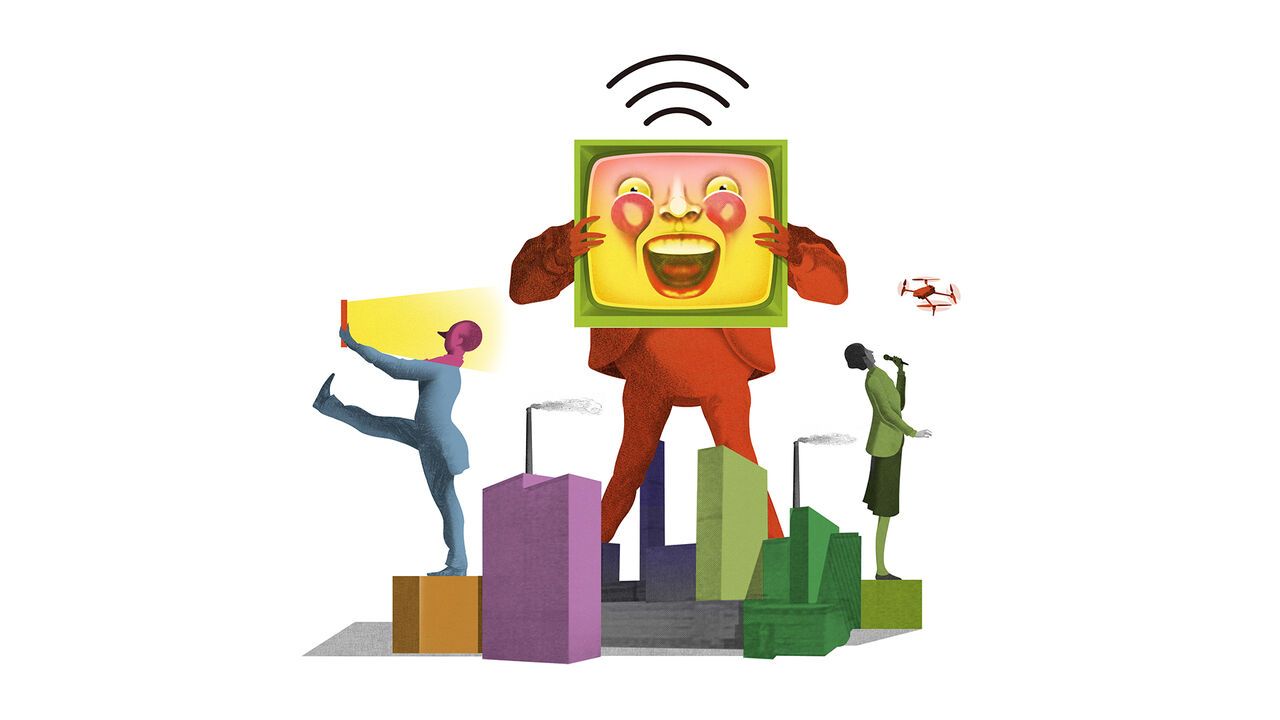
OpenAI has what the public-relations industry might call an image problem. The maker of ChatGPT must convince investors of its future profitability, and everyone else—the working, voting, rock-throwing public—of its humanity. Both are tricky. So tricky that Sam Altman, OpenAI’s boss, has decided that hiring ordinary corporate spin-doctors simply will not do.
Instead, he has bought a talk-show. According to the Financial Times, OpenAI paid in the “low hundreds of millions” of dollars for TBPN, a zany 18-month-old video-podcast presented by a pair of charming, besuited tech bros. Aesthetically the show is a mix between CNBC and NASCAR. A typical guest might be Alex Karp, the boss of Palantir, running through his exercise regimen (“dead hang is crucial”). Or Mr Altman, chatting about his firm’s latest model. Luckily for OpenAI’s boss, his two favourite journalists are now two of his richest employees.
Mr Altman is hardly unique among America’s business elite, either in wanting to be on camera or to own the show. Gone are the days when chief executives limited their public declarations to acerbic remarks on earnings calls and the occasional quote for hacks who, after all, don’t really know what they’re talking about. Instead the modern boss subjects himself to hours of gentle cross-examination by his peers. The biggest shows, like those hosted by Joe Rogan or Lex Fridman, are Super Bowl events. Many more have small, passionate and mostly male audiences, like third-tier Serbian football fixtures.
The recent urge to print one’s own press seems to have grown out of Silicon Valley. David Sacks, an entrepreneur-turned-podcaster, co-hosts “All In”, a popular techie bro-fest. He is also a top adviser to the White House on AI: an illustration of the three-way merger of American business, celebrity and politics if there ever was one. Andreessen Horowitz, a giant venture firm whose founders have often criticised the way newspapers write about their industry, says it is building a media business. Less brash but even busier is Stripe, a payments company, which runs a publishing house, a print magazine and a show where one of its founders sinks pints of stout with the great and good of American business.
Now Silicon Valley’s media habits are spreading. Wall Street is very online in a way it wasn’t until very recently. Hedge-funders who laboured for decades in self-imposed anonymity now gab openly about their investment strategies on podcasts. One of the best is hosted by Nicolai Tangen, the boss of Norway’s sovereign-wealth fund. Jamie Dimon has talked about getting involved in the media business after he retires as boss of JPMorgan Chase. The most talked-about piece of financial writing this year, a gloomy take on the economic effects of AI, was not a newspaper article or a note from an investment bank but a blog post on Substack by Citrini, a bootstrap firm of analysts whose account on X, a social-media site, is now one of the many that traders routinely monitor. A public rebuttal appeared forthwith from Citadel Securities, a trading firm with a low profile and high profits.
Although the corporate content creator is most at home in capitalism’s swankiest offices, he can be found in some of its drabbest ones too. Deloitte, an accounting firm, produces dozens of podcasts. KPMG, a competitor, is just as prodigious. “I like a really decent notepad with nice thick paper,” said Claudia Winkleman, a television presenter, on a podcast about the stationery industry produced by Vodafone, a British telecoms provider. Even relative quietude on the part of bosses now feels quaint. What is the most important enterprise for which the public cannot, within seconds, marshal a video of its boss chatting? Jane Street, perhaps. But even that secretive trading firm has its own mostly unintelligible podcast about computer science.
As is so often the case, bosses are discovering anew something that existed before. The closest analogue is the corporate magazine, a 19th-century invention which reached its zenith in the 20th. As many as 400 were launched in 1937 alone, according to a history of public relations by Roland Marchand. Ronald Reagan became a confident promoter of capitalism while hosting a television show for GE in the 1950s. (Kurt Vonnegut had the opposite reaction while employed in the industrial giant’s publicity department. He left to write “Player Piano”, a novel in which automation renders human work obsolete.) This time, however, the brands of bosses often supplant those of their firms.
Another curious feature of this anarchic landscape is that a growing number of traditional outlets are owned by people who agree with many of the interlopers’ criticisms of legacy media. To Jeff Bezos, founder of Amazon and owner of the Washington Post, and David Ellison, son of the founder of Oracle and owner of just about everything in Hollywood, one might soon add Bill Ackman, a very-online hedge-funder who wants to buy Universal Music, the world’s biggest recording label.
Video killed the earnings-call star
The chatter-industrial complex may still be in its infancy. Yet it has already yielded results ranging from the brilliantly informative to the strikingly odd. There is much to be said for the expertise now available, often free, to anyone in the world. But if the purpose of tech bosses becoming talking heads was to persuade the public that they are in good hands, the opposite has sometimes happened. Peter Thiel’s obsession with the coming “antichrist” lurked for over a decade in his writing, for those who bothered to read it, before he started talking about it on podcasts. Another case is Marc Andreessen, eponymous founder of the venture firm, who has popularised the word “retardmaxxing”, a vague concept of not taking things too seriously. If that is the bounty of his freedom from the free press, it is a shallow victory indeed. ■
Subscribers to The Economist can sign up to our Opinion newsletter, which brings together the best of our leaders, columns, guest essays and reader correspondence.