Taiwan’s opposition leader meets Xi Jinping in Beijing
The trip exposes divisions in her party
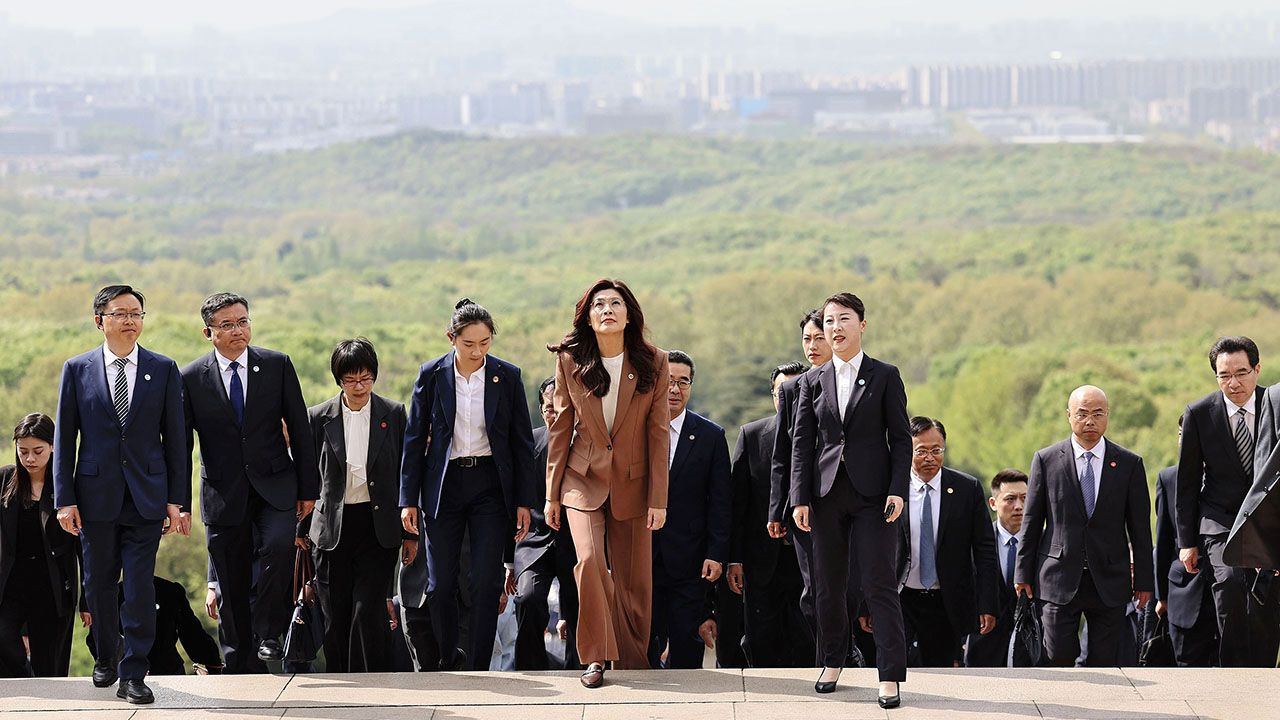
History casts a long shadow over relations between the Chinese Communist Party and the Kuomintang (KMT), which ruled China until it fled to Taiwan in 1949. The two parties remained sworn enemies for decades afterwards as the KMT fortified its island refuge with American weapons. Only in 1991, as Taiwan democratised, did the KMT formally renounce its goal to retake China by force. And yet, in one of the stranger ironies of present-day geopolitics, China now sees the KMT—the biggest opposition party in Taiwan’s current parliament—as its best hope of peacefully uniting the island with the mainland.
Hence the hoopla surrounding a six-day visit to China by Cheng Li-wun, the KMT’s new chairwoman—the first by a KMT leader in a decade. On April 10th, the fourth day of her trip, Ms Cheng met China’s president, Xi Jinping, in Beijing. They sounded in harmony, expressing common opposition to Taiwan’s independence while pledging to work together to maintain peace across the Taiwan Strait and to enhance economic and other exchanges between the two sides. Ms Cheng even said that she hoped to host Mr Xi on a visit to Taiwan if the KMT were to return to power.
At a news conference afterwards, Ms Cheng hailed the visit as a success. She said Mr Xi reacted positively to her proposal for a formal “peace framework” and her requests for China to facilitate Taiwan’s participation in international bodies and trade deals. Even so, the trip has not only divided public opinion in Taiwan. It is deepening American doubts about Ms Cheng, who is blocking the government’s proposed increase in defence spending, most of which would be used to buy yet more American weapons. And it is widening a rift between Ms Cheng and a rival KMT faction that leans closer to America.
The timing makes the visit even more controversial. It comes about a month before the proposed date for a summit in Beijing between Mr Xi and his American counterpart, Donald Trump. Mr Xi is expected to try to persuade Mr Trump to dilute America’s verbal support for Taiwan and to delay or reduce American arms sales. China already denounces Taiwan’s president, Lai Ching-te, as a separatist who could drag America into a war over the island. Mr Xi may try to argue that Ms Cheng, whose party and its allies control parliament, represents the majority of Taiwan’s people.
Ms Cheng’s remarks in Shanghai, Nanjing and China’s capital therefore drew much attention. As expected, she re-affirmed her party’s commitment to the “1992 consensus”, whereby China and Taiwan’s then KMT government agreed that both sides of the Taiwan Strait are part of “one China” while allowing each to interpret that differently, a formulation that the current Taiwanese government rejects. She also described Taiwanese people as being part of the Chinese nation and blamed Japan, which ruled Taiwan from 1895 to 1945, for splitting Taiwan from the mainland. Those remarks upset many in Taiwan who see themselves as Taiwanese, rather than Chinese, and who assert that the island was never fully part of the Chinese empire.
Mr Xi, too, stressed the importance of the 1992 consensus for maintaining peace. And he urged the KMT to strive for “national reunification and rejuvenation”. Mr Xi has set a goal of “national rejuvenation” by 2049, the centenary of Communist rule, and often links that to Taiwan’s unification with the mainland. But in his meeting with Ms Cheng, he described both goals as being in line with the wishes of Sun Yat-sen, the KMT’s founder credited with toppling the Qing dynasty who is revered in both China and Taiwan. Ms Cheng pledged to work towards national rejuvenation, also citing Sun’s wishes, but stopped short of echoing Mr Xi’s call for unification.
Her choice of words appeared to be calibrated to convince Mr Xi to continue engaging with the KMT while at the same time trying to avoid a bigger backlash in Taiwan, especially within her own party. Critics, however, fear that mainland authorities are likely to exploit her comments in their propaganda and diplomacy. For Mr Xi, “the main goal is of course to influence President Trump,” says Chen Shih-min of National Taiwan University.
American angst was evident when a bipartisan delegation of the country’s senators visited Taiwan at the end of March. They urged Taiwan’s political parties to approve the increase in military spending. Such deterrence was needed “to prevent a conflict that would be devastating,” said Jeanne Shaheen, a Democratic Party senator. Asked about Ms Cheng’s trip, she said dialogue was a “good thing” but China should talk to other Taiwanese politicians.
Taiwan’s government, meanwhile, warned the KMT not to fall for China’s “divide-and-rule strategy”. Meeting China’s leaders would not induce them to abandon their goal of annexing Taiwan, while accepting China’s political narratives on cross-strait relations would deepen divisions within Taiwan and “send the wrong message to the international community”, said Chiu Chui-cheng, the head of Taiwan’s Mainland Affairs Council.
When the KMT was last in power, from 2008 to 2016, China expanded trade, tourism and transport links with Taiwan. But it shuns President Lai’s Democratic Progressive Party (DPP), which rejects the 1992 consensus and maintains that Taiwan is already an independent country. Mr Xi is thus hoping that the KMT and its allies will dominate local elections in Taiwan in November and win the next presidential poll in 2028. If they do, Mr Xi might be able to revive economic and other exchanges enough to convince himself that peaceful unification can still be achieved, if not within his own lifetime, then by his 2049 deadline for “national rejuvenation”. The fear is, however, that another DPP victory could cause him to lose patience and turn to military options.
The snag for both Mr Xi and Ms Cheng is that closer cross-strait ties hold little appeal for many Taiwanese voters. Opinion polls consistently show that a majority of them distrust China’s government, have little appetite for unification and consider themselves Taiwanese rather than Chinese. They also suggest that a majority back the proposed increase in defence spending. One poll conducted in March showed that 56% thought the drawbacks of Ms Cheng meeting Mr Xi outweighed the advantages.
Ms Cheng believes that such views will change as people become more worried about the risk of war and less sure of America’s security guarantees under Mr Trump. But some prominent KMT politicians worry that her policies may cost the party votes in the coming elections.
One of her main rivals is Lu Shiow-yen, the mayor of Taichung city and a front-runner to be the KMT’s presidential candidate in 2028. Ms Lu visited America in March and spent much of her time there trying to convince American politicians and officials that the KMT was not opposed to increasing military spending, despite blocking the government’s proposal for a supplemental package. The KMT has called for an extra outlay of about $12bn. But on March 30th Ms Lu suggested a sum between $25bn and $31bn, much closer to the $40bn proposed by the DPP.
That tussle is now seen as part of the broader struggle between the China-leaning KMT faction and the other that turns more towards America, says Hsiao Yi-ching of Taiwan’s National Chengchi University. The civil war on the mainland may be long over. But the one within the KMT’s own ranks will shape the future of Taiwan. ■
Editor’s note (April 10th): This story has been updated.
Subscribers can sign up to Drum Tower, our new weekly newsletter, to understand what the world makes of China—and what China makes of the world.