When emigration helps bad rulers survive
A new book finds links between mass migration and democratic backsliding worldwide
AS HUNGARY’s OPPOSITION leader, Peter Magyar, campaigns to end the 16-year reign of Viktor Orban at elections on April 12th, he has chosen a slogan with a double edge. “Now or Never” conveys the urgency felt by Hungarians who sense a best-ever chance of defeating Mr Orban. That “or Never” hints at a grimmer thought, though—that this might be a last opportunity to stop Mr Orban from establishing rule-for-life. A pedlar of nationalist conspiracies, Mr Orban has repeatedly defied European Union laws (while accepting billions in Euro-subsidies), enfeebled democratic checks and balances, and packed courts, institutions and media outlets with cronies. He has used Hungary’s EU membership to divide the bloc and protect the interests of his avowed friends, Presidents Donald Trump, Xi Jinping and Vladimir Putin.
A weak economy and many corruption scandals are hurting Mr Orban’s party, which trails in the polls. His opponents are not complacent, for he is a survivor with powerful patrons. Eager to boost a fellow culture-warrior and immigration-sceptic, America’s vice-president, J.D. Vance, flew to Budapest on April 7th to hail Hungary’s prime minister as a defender of “Christian civilisation”.
Another Orban win would not just send a jolt of fear through mainstream European governments. An opposition defeat would prompt liberal Hungarians to vote with their feet, joining others who already live in other EU and Western countries. Kata, a 20-year-old photography student from Budapest, is one of a host of research subjects interviewed by Justin Gest, a professor of policy and government at George Mason University, for a book that explores links between global migration rates and an erosion of democratic freedoms in many countries. Kata spoke after Mr Orban won an election in 2022, dashing liberal hopes. She admitted that her plan to seek a new life in the Netherlands felt “super selfish”, fretting: “If we leave, then who will stay?” But after watching fellow Hungarians endorse Mr Orban’s anti-gay laws and repressive policies, she and many friends could not bear to remain.
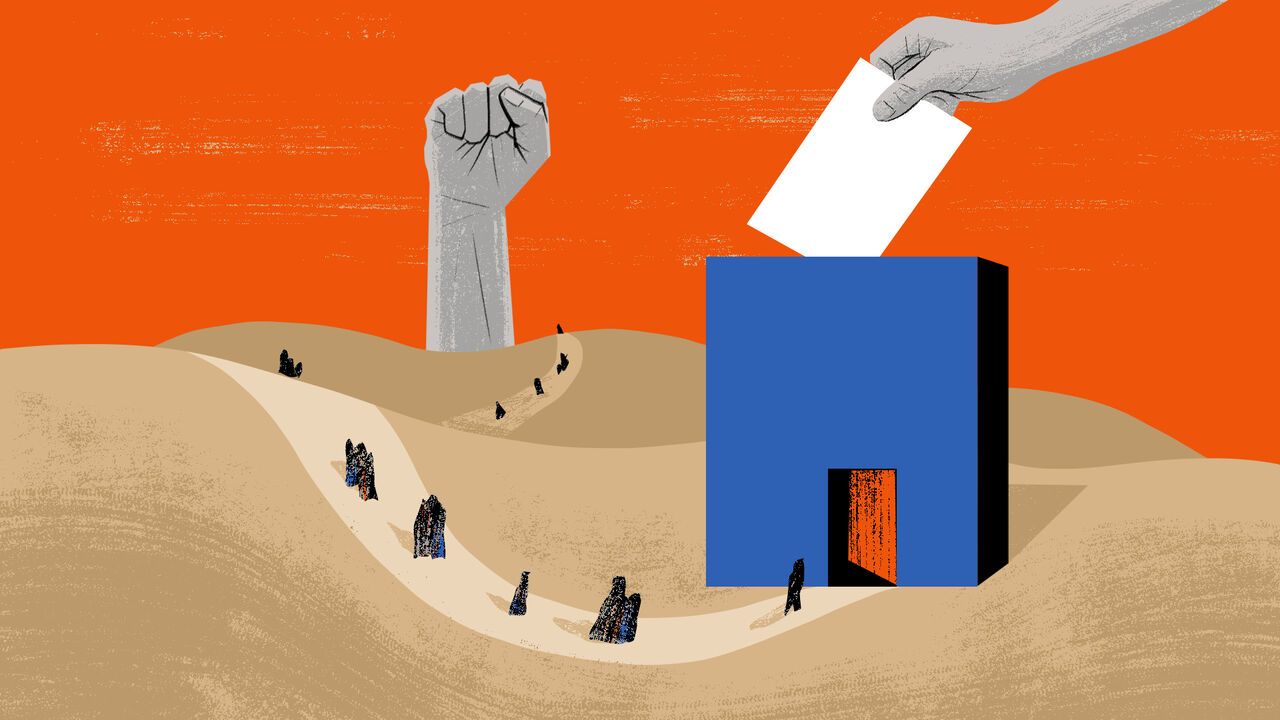
Mr Gest’s forthcoming book, “Democratic Drain: Global Migration and the Struggle for Democracy”, draws an analogy with the “brain drain” that poor countries fear when skilled migrants leave. It makes a solid, if dismaying, case for its central thesis: that mass migration is one explanation for democratic backsliding and the resilience of nasty regimes in recent years, from Hungary to Russia, Syria and Turkey. Worldwide, migration has surged in the past two decades, with an estimated 110m people moving country between 2015 and 2019 alone. To weigh the importance of politics in migration decisions, the book crunches data from specially commissioned surveys of nearly 30,000 migrants in Europe, the Middle East and north Africa, alongside data from the Gallup World Poll, a large study of global opinion conducted each year in over 140 countries. In survey after survey respondents who expressed an interest in moving country were consistently more liberal than their average compatriots. Would-be migrants were more likely to say they valued free speech or accountable government, or to voice anger over public corruption or rigged elections.
To be sure, those findings are hard to interpret with precision, because people are complicated. Lots of popular destinations, from western Europe to North America or Australia, are not just more democratic; they are richer, offer better jobs and have more generous welfare states than many countries migrants leave. As for democratic leanings, those are hard to disentangle from other traits that often co-exist with liberal views. Emigrants are often younger, have at least a secondary education and are open to new experiences. Still, there is evidence that some are tipped into emigration by their frustration with corrupt or autocratic rulers, specifically. Because the Gallup World Poll conducts country-level surveys in waves over a number of months, it is possible to isolate responses offered before and after elections. The book analyses answers from 225,000 respondents before and after 234 national elections between 2004 and 2022. Interest in emigration rose noticeably after results that were bad for democracy, it finds.
Not all diaspora populations are liberal. The book quotes a Russian émigré who divides the hundreds of thousands who left Russia after the invasion of Ukraine into ideological migrants and more materialistic “sausage migrants”. Turkey’s autocratic president, Recep Tayyip Erdogan, has legions of fans among older, blue-collar Turks living in Germany. At election times he earns rather few votes from younger, better-educated Turks in North America. Against that, despots clearly believe that shooing unhappy citizens into exile can help them. More than once when faced with protests Fidel Castro, the late Cuban dictator, opened his borders to let migrants flood out. A crackdown on free speech, liberal education and democratic politics in Hong Kong has prompted hundreds of thousands to leave for the West since 2019. The financial hub has happily replaced such troublemaking liberals with graduates from China’s mainland.
Out-voted, voting with their feet
Optimists will argue that democratic emigrants can do good from afar, by voting overseas when allowed, and by sending remittances and liberal values back to families in autocratic homelands—just as brain drain is mitigated when successful migrants return or create jobs back home. Alas, the evidence is mixed. Funds from remittances can weaken the state’s grip on a given household. But they also prop up economically inept dictators, studies find.
Of course, liberal migrants have every right to want freer lives. But if individual departures hasten a division of the world into autocratic and democratic blocs, despots may celebrate too. These are bleak times for liberal democrats. More disappointments doubtless lie ahead. Mr Orban, for one, is counting on that. ■
Subscribers to The Economist can sign up to our Opinion newsletter, which brings together the best of our leaders, columns, guest essays and reader correspondence.