HONDA TAMIKO began working as a child on her family’s farm back when Japan was at war with America. Now 93, Ms Honda still puts in a hard day’s toil(辛苦劳作) as a janitor at a McDonald’s branch in Kumamoto, in southern Japan. Ms Honda says her pension is plenty to live off(靠……过活); she chooses to keep showing up. “Humans are animals, after all,” she chuckles. “We have to keep moving as much as we can.”
本田民子从小就在自家的农场干活,那时日本还在与美国交战。现年93岁的本田女士仍在日本南部熊本县的一家麦当劳分店当清洁工,每天辛勤劳作。本田女士说,她的养老金足够维持生活;她选择继续上班。“人类毕竟是动物,”她笑着说,“我们必须尽可能保持活动。”
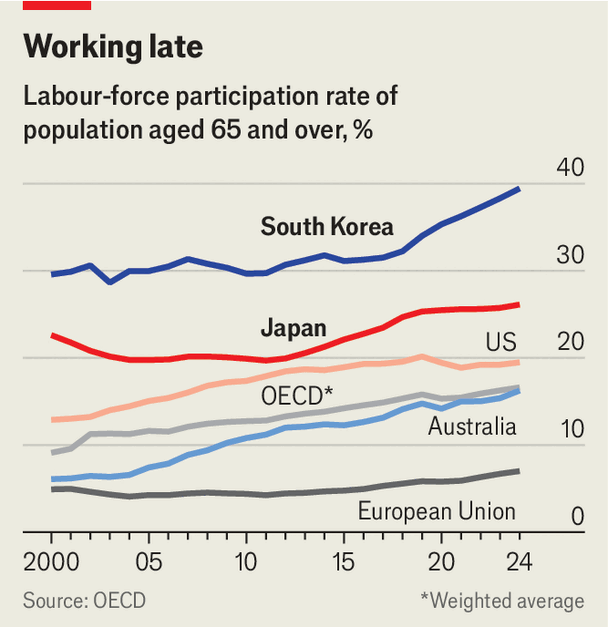
Ms Honda is the oldest in McDonald’s crew of some 220,000 in Japan. But she is less an outlier(异类,离群值) than a harbinger(预兆,先驱). As people live longer, they are staying healthy for longer and working longer, too. Japan and its neighbour South Korea, two of the most rapidly ageing countries, are at the forefront of(处于……最前沿) this transition. Nearly 40% of South Koreans and more than 25% of Japanese aged above 65 remain at work, the highest rates in the OECD, a club of mostly rich countries (see chart). But labour markets and social systems designed for a different demographic era struggle to make the most of those who can work and to support those who can’t.
本田女士是日本麦当劳约22万名员工中年龄最大的。但她与其说是个异类,不如说是一个预兆。随着人们寿命延长,他们保持健康的时间也更长,工作时间也更长。日本及其邻国韩国是老龄化最迅速的国家之一,处于这一转变的前沿。近40%的韩国人和超过25%的65岁以上日本人仍在工作,这在主要由富裕国家组成的经合组织(OECD)中比例最高(见图表)。但为不同人口时代设计的劳动力市场和社会体系,却难以充分利用那些能够工作的人,并支持那些不能工作的人。
Many people in both Japan and South Korea keep working out of necessity(必要性,需要). More than half of elderly employees in Japan say they work for income. The financial pressure is even greater in South Korea, where the pension system failed to keep pace with(跟上……的步伐) the country’s rapid development after the Korean war, leaving generations of people with inadequate(不充分的,不足的) support. The average public pension replaces only about a third of workers’ pre-retirement income, so nearly 40% of South Koreans over 65 make less than half the median income, the highest rate in the OECD. Many in South Korea fear being made to retire too early: bus drivers in Seoul went on strike earlier this year demanding that the retirement age be raised. “In the past, 65 was considered quite elderly, but now, even at 65, people live a youthful life,” says Shin Gyo-beom, who drives Seoul’s bus number 107. “Wouldn’t it be better for someone more experienced to drive?”
日本和韩国的许多人出于需要而继续工作。日本超过一半的老年雇员表示他们工作是为了收入。韩国的经济压力甚至更大,其养老金体系未能跟上朝鲜战争后国家的快速发展,导致几代人缺乏足够的支持。平均公共养老金仅替代工人退休前收入的大约三分之一,因此近40%的65岁以上韩国人的收入不到中位数的一半,这一比例在经合组织中最高。许多韩国人担心过早被强制退休:首尔的公交车司机今年早些时候罢工,要求提高退休年龄。“过去,65岁被认为相当老了,但即使在65岁,人们也过着充满活力的生活,”驾驶首尔107路公交车的Shin Gyo-beom说道。“让更有经验的人开车不是更好吗?”