“One strait”, Indonesia’s President Prabowo Subianto told his ministers in a televised cabinet meeting on April 8th, referring to the Strait of Hormuz(① 详细背景:霍尔木兹海峡连接波斯湾和阿...), “determines the fate of many nations, of the price of oil. And the key to it is held by one country(钥匙掌握在一个国家手中).” “But do we realise”, he asked them, raising the pitch of his voice and his eyebrows in a way that could only be described as coy(故作羞涩的), that “70% of East Asia’s energy needs and 70% of its trade pass through the Indonesian straits?”
“一条海峡”,印尼总统普拉博沃·苏比安托在4月8日的电视内阁会议上对其部长们说道,他指的是霍尔木兹海峡,“决定了许多国家的命运和油价。而钥匙掌握在一个国家手中。”“但我们是否意识到”,他问道,提高了音调并扬起眉毛,那种神态只能被形容为故作羞涩,“东亚70%的能源需求和70%的贸易都经过印尼海峡?”
Sitting in front of Mr Prabowo was Purbaya Yudhi Sadewa, his outspoken(直言不讳的) finance minister. On April 22nd, Dr Purbaya took Mr Prabowo’s remarks to their natural conclusion(将普拉博沃的言论引向自然结论), complaining to an infrastructure-investment conference that ships passed through the Strait of Malacca without being charged. “I’m not sure whether that’s right or wrong,” the minister continued. Noting that Iran had begun charging traffic through the Strait of Hormuz a fee, he wistfully(惆怅地、渴望地) added, “if only it could be like that” in the Strait of Malacca.
坐在普拉博沃面前的是普尔巴亚·尤迪·萨德瓦,他直言不讳的财政部长。4月22日,普尔巴亚博士将普拉博沃的言论引向了自然结论,在一个基础设施投资会议上抱怨船只通过马六甲海峡而不被收费。“我不确定那是对是错,”部长继续说道。注意到伊朗已开始对通过霍尔木兹海峡的交通收费,他惆怅地补充道,“要是马六甲海峡也能那样就好了。”
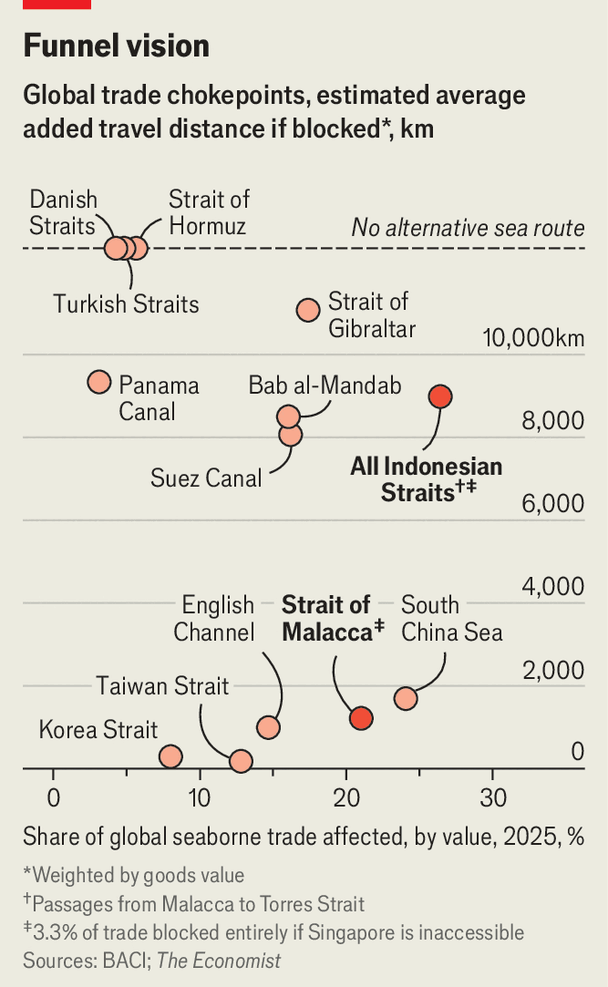
Mr Prabowo’s figures on the amount of energy and trade passing through the archipelago’s straits are imprecise(不精确的). But he is right that Indonesia sits upon(坐落于、拥有) some of the world’s most strategic waterways. Modelling by The Economist estimates that blocking the Strait of Malacca would force around 21% of global seaborne trade to reroute(改道、改变路径), adding an additional 1,200km to ships’ journeys. However, blocking all of the Indonesian straits, including the Sunda, Lombok and Makassar straits, would affect some 26% of global seaborne trade, and require an average detour(绕行、迂回) of 7,800km.
普拉博沃关于经过群岛海峡的能源和贸易量的数字并不精确。但他说印尼坐拥一些世界上最具战略意义的水道是正确的。《经济学人》的模型估计,封锁马六甲海峡将迫使全球约21%的海运贸易改道,使船只航程增加1200公里。然而,封锁所有印尼海峡,包括巽他海峡、龙目海峡和望加锡海峡,将影响全球约26%的海运贸易,并需要平均绕行7800公里。