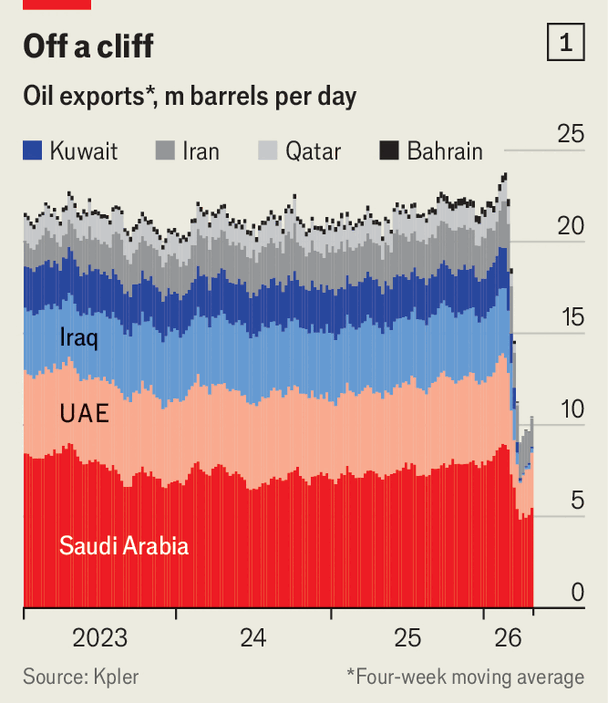
WHAT WAS once unthinkable(不可想象的) now appears unending. Most energy traders used to assume that, even under attack, Iran would not close the Strait of Hormuz, the narrow chokepoint through which almost a fifth of the world’s oil ordinarily flows. Doing so would antagonise(激怒,对立) its neighbours in the Gulf, starve its customers in Asia and sever(切断,断绝) its own economic lifeline. Even if Iran attempted a blockade, America, the traders assumed, would quickly put an end to it. Yet two months after America and Israel began bombing Iran, and Iran began targeting commercial vessels in retaliation, traffic in Hormuz remains near zero. Diplomatic efforts to get it flowing again are intermittent(断断续续的) and inconclusive(非决定性的). Although a negotiated resolution is always possible, it is also conceivable that the strait could stay shut indefinitely.
曾经不可想象的事情,如今似乎无休无止。大多数能源交易商过去认为,即使遭受攻击,伊朗也不会关闭霍尔木兹海峡——这条狭窄的咽喉要道通常承载着全球近五分之一的石油运输。这样做会激怒海湾邻国、使其亚洲客户陷入饥荒,并切断自身的经济命脉。即便伊朗试图封锁,交易商们认为美国也会迅速终结它。然而,在美国和以色列开始轰炸伊朗、伊朗报复性地瞄准商船两个月后,霍尔木兹海峡的通行量仍然接近于零。旨在恢复通行的外交努力时断时续且毫无结果。尽管通过谈判达成解决方案总是可能的,但该海峡无限期关闭也是可以想象的。
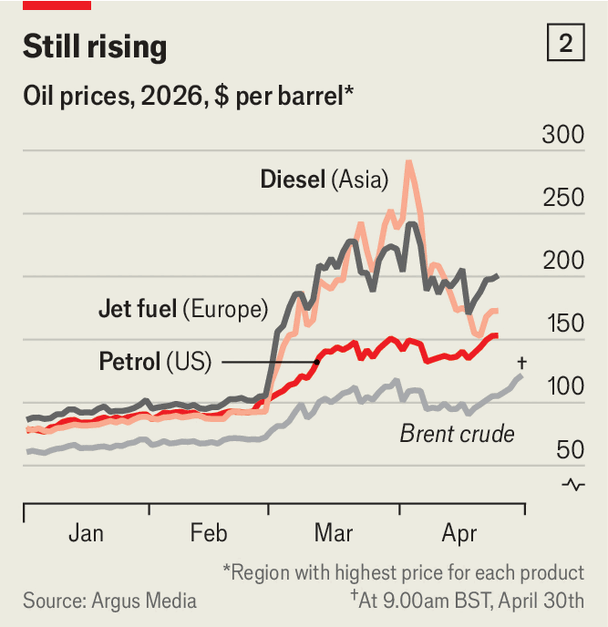
Glance at oil prices, though, and the consternation(惊恐,惊慌) appears relatively muted(缓和的,减弱). Even after a sharp rise in recent days, Brent crude futures, at over $120 a barrel, are still well below the $150-200 many analysts predicted in March if the strait were to stay closed for a long period. Parts of Asia are contending with acute(严重的,急性的) shortages or scrambling to avoid them, but across most of the rich world, daily life has scarcely(几乎不) been affected. Petrol prices are up and airfares have climbed, but forecasts for economic growth have been trimmed only modestly. Stockmarkets are near record highs. Against all odds, the world’s economy appears to be taking the biggest supply shock in the history of the oil market in its stride.
不过,看看油价,恐慌情绪似乎相对温和。即使在近日大幅上涨之后,布伦特原油期货价格超过每桶120美元,仍远低于许多分析人士在三月份预测的,如果该海峡长期关闭将达到的150-200美元。亚洲部分地区正面临严重短缺或争相避免短缺,但在大多数富裕国家,日常生活几乎没有受到影响。汽油价格上涨,机票价格攀升,但对经济增长的预测仅被小幅下调。股市接近历史高位。尽管困难重重,全球经济似乎对石油市场历史上最大的供应冲击应付自如。
Markets always find equilibrium(均衡,平衡状态)—the question is only at what level. Optimists draw comfort from 2022, when most Western countries stopped buying oil from Russia after it invaded Ukraine: oil peaked then at $129 without triggering a global recession. But just 3m barrels a day (b/d) of Russian oil—3% of world supply—were involved, and most of that was rerouted(改变路线) to Asia. Every day Hormuz stays closed, nearly five times that volume is completely removed from global supply. Even if the strait were to reopen tomorrow, some 3% of the world’s annual output has probably already been forfeited(丧失,损失), given inevitable delays getting export volumes back to normal. A deficit of that magnitude cannot be papered over for long. The world is just weeks away from a severe reckoning(清算,报应).
市场总能找到平衡——问题只在于平衡在什么水平。乐观主义者从2022年找到安慰,当时大多数西方国家在俄罗斯入侵乌克兰后停止购买其石油:油价当时达到每桶129美元的峰值,但并未引发全球衰退。但这只涉及每天300万桶的俄罗斯石油——占全球供应的3%——而且其中大部分被转售至亚洲。霍尔木兹海峡每关闭一天,就几乎有五倍于此的石油被完全从全球供应中移除。即使海峡明天重新开放,考虑到出口量恢复到正常水平的不可避免的延迟,全球年产量的大约3%可能已经损失了。如此大规模的赤字不可能长期掩盖。世界距离一次严重的清算只有几周时间了。
Crude calculations
粗略计算
Pump it up
加油泵开
Not feeling well
感觉不妙