At a museum outside Inverness proud Scots recently gathered to mark what they see as the destruction of the Scottish way of life. They came to remember the Battle of Culloden(卡洛登战役(Battle of Cull...) of 1746, when the British army crushed the Jacobite rising. The ancient language repressed(被压制、被镇压) after that defeat—Gaelic—was everywhere at this event: heard in the romantic poems, seen on the signage. Strangely absent(奇怪地缺席) was Scotland’s other national language: Scots.
在因弗内斯郊外的一座博物馆里,自豪的苏格兰人最近聚集在一起,纪念他们认为的苏格兰生活方式的毁灭。他们来纪念1746年的卡洛登战役,当时英国军队镇压了詹姆斯党起义。在那场失败后受到压制的古老语言——盖尔语——在这次活动中随处可见:在浪漫的诗歌中听到,在标牌上看到。奇怪的是,苏格兰的另一种民族语言——苏格兰语——却缺席了。
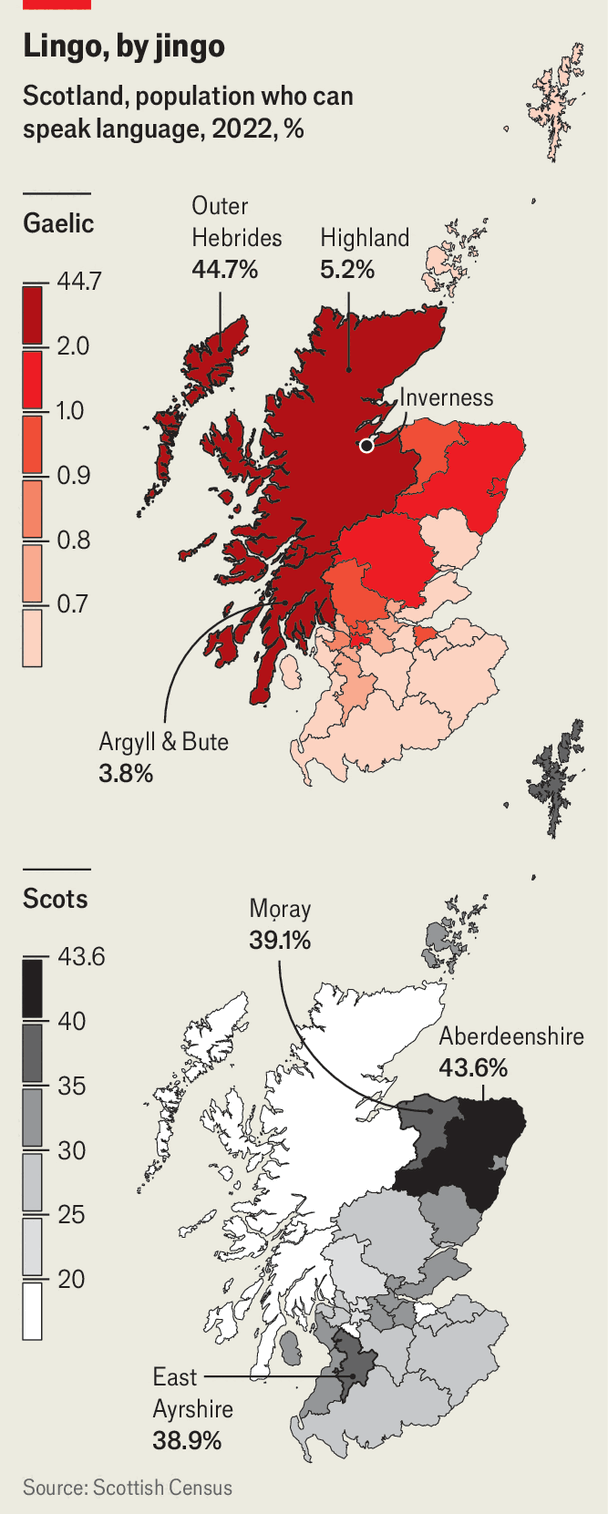
Scottish Gaelic and Scots are in competition to be the country’s native tongue. Gaelic, rooted in Old Irish, is alien(陌生的、异质的) to English ears. It was spoken by people in mountainous western Scotland but in effect banned(实际上被禁止) after Culloden. Scots, descended from Old English, was brought to the Lowlands by Anglo-Saxons who could not penetrate the Highlands. It shares much vocabulary and grammar with English; it is unrelated to Gaelic. Instead of “I don’t know,” a Scots speaker might say, “Ah dinnae ken.”(苏格兰语使用者可能不说“I don’t know”,而说“Ah dinnae ken”。) Sceptics say it is a dialect; others insist it is a language in its own right(凭借自身资格、独立地).
苏格兰盖尔语和苏格兰语正在竞争成为该国的本土语言。盖尔语源于古爱尔兰语,对英语使用者来说很陌生。它曾被苏格兰西部山区的人们使用,但在卡洛登战役后实际上被禁止。苏格兰语源于古英语,由无法进入高地的盎格鲁-撒克逊人带到低地。它与英语共享大量词汇和语法;与盖尔语无关。苏格兰语使用者可能不说“I don’t know”,而说“Ah dinnae ken”。怀疑者称它是一种方言;其他人则坚持它是一种独立的语言。
Forty years ago some feared Gaelic faced extinction(灭绝、消亡). Yet thanks to government funding it is now spoken by nearly 70,000 people in Scotland—a rise of over 20% since 2011. Scots, even though more people speak it (1.5m at the last census), is quietly declining(悄然衰落). Between 2011 and 2022 the number of speakers fell by almost 30,000. Last year just ten pupils in their penultimate(倒数第二的) year of secondary education studied it, compared with 70 who took Gaelic.
四十年前,有人担心盖尔语面临灭绝。然而,由于政府资助,现在苏格兰有近7万人使用它——比2011年增长了20%以上。苏格兰语,尽管使用人数更多(上次人口普查为150万),却在悄然衰落。2011年至2022年间,使用人数减少了近3万。去年,只有10名学生在中学倒数第二年学习它,而学习盖尔语的有70人。