There are few rivalries in business as fierce and long-lasting as that between Coca-Cola and Pepsi.(商界很少有像可口可乐和百事可乐这样激烈而持久的竞争。) For more than a century the pair have battled for dominance of the fizzy-drink business, with witty ads, bold publicity stunts(宣传噱头) and new—occasionally disastrous—takes on their classic colas all used as weapons in their fight against one another.
商界很少有像可口可乐和百事可乐这样激烈而持久的竞争。一个多世纪以来,这两家公司一直在为碳酸饮料业务的主导地位而战,运用诙谐的广告、大胆的宣传噱头以及对其经典可乐的新配方(偶尔是灾难性的)作为互相斗争的武器。
Over time, however, the two have grown into very different companies. Coca-Cola’s various brands account for(占(比例)) 17% of the American soft-drink market, compared with 11% for Pepsi’s, according to Beverage Digest, a research firm. But Pepsi now makes more than half its revenue from packaged food, including brands such as Lay’s and Quaker Oats. And unlike Coca-Cola, which around a decade ago shifted back to franchising(特许经营) out its American bottling operations, Pepsi has continued to make its own drinks in its home market. All this could soon change, however, as the underdog(弱者/落后者) embarks on a turnaround effort that relies in part on becoming more like its long-term rival.
然而,随着时间的推移,这两家公司已经发展成为截然不同的企业。根据研究公司Beverage Digest的数据,可口可乐旗下各品牌占美国软饮料市场的17%,而百事可乐的这一比例为11%。但百事现在超过一半的收入来自包装食品,包括乐事和桂格燕麦等品牌。与大约十年前重新将美国装瓶业务外包的可口可乐不同,百事在其本土市场继续自行生产饮料。然而,所有这一切可能很快改变,因为这家落后者开始了一项扭转局面的努力,部分依赖于变得更像其长期竞争对手。
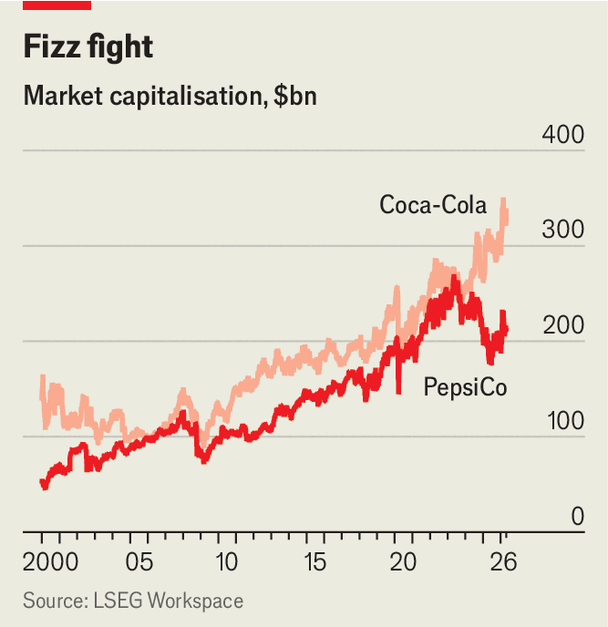
The last few years have been far bubblier(更兴盛的(比喻)) for Coca-Cola, whose market value has risen by 23% since the start of 2023, than for Pepsi, which has slumped(暴跌) by 15% (see chart). Pepsi’s troubles stem in part from the hefty price rises it applied to its food and beverages amid the post-pandemic surge in inflation, exceeding even those of its competitors. That strategy has lately backfired(适得其反) as cost-conscious shoppers have fled to upstart(新贵(品牌)) brands and retailers’ in-house alternatives.
过去几年,可口可乐的日子比百事好过得多,自2023年初以来,可口可乐的市值上涨了23%,而百事则下跌了15%(见图表)。百事的困境部分源于其在疫情后通胀飙升期间对其食品和饮料大幅提价,甚至超过了竞争对手。这一策略最近适得其反,因为对价格敏感的消费者纷纷转向新兴品牌和零售商的自有品牌替代品。