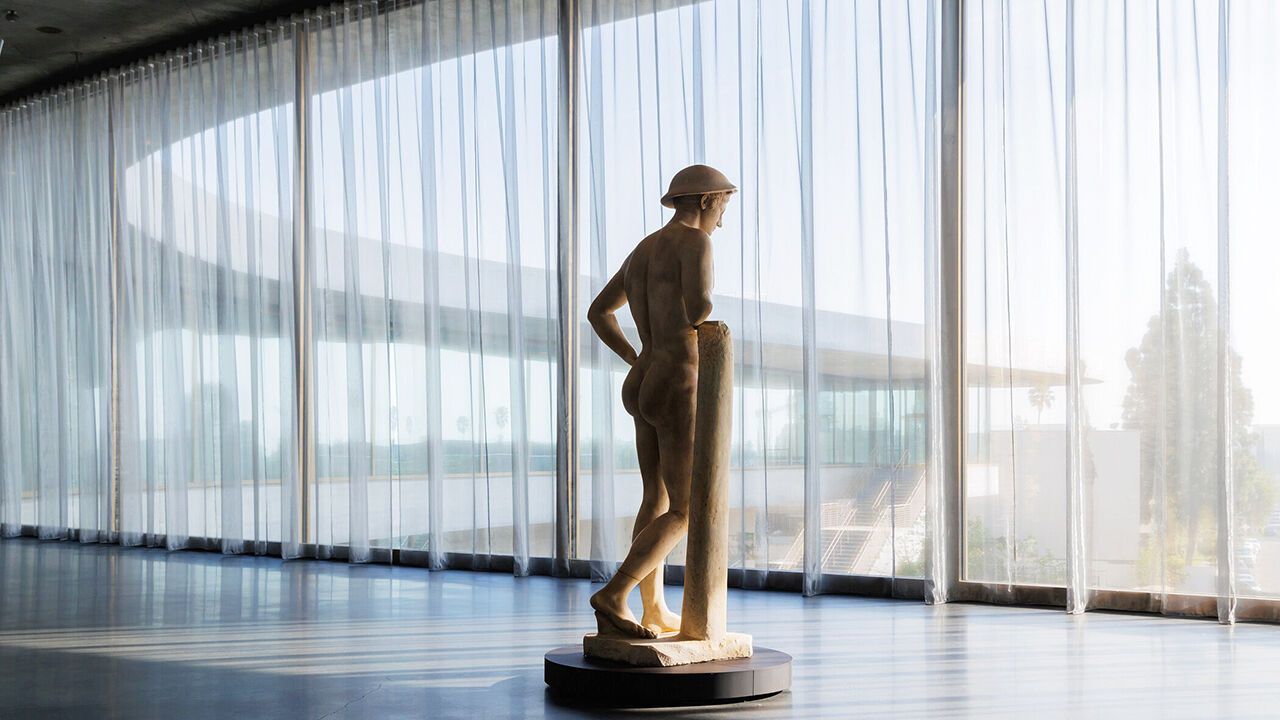
A HULKING structure hangs above traffic on Wilshire Boulevard like a levitating amoeba(悬浮的变形虫). The concrete-and-glass colossus(混凝土玻璃巨构)—designed by Peter Zumthor, a Swiss architect—is known as the David Geffen Galleries and is the new home of the Los Angeles County Museum of Art (LACMA), the largest art museum in western America. After 20 years, the building will finally open to the public on May 4th. Its $724m price tag(价格标签;造价) and daring architecture(大胆的建筑设计) are not the only radical things about it.
一个庞然大物悬浮在威尔希尔大道上方的车流之上,如同一个变形虫。这个由瑞士建筑师彼得·卒姆托设计的混凝土玻璃巨构被称为大卫·格芬美术馆,是洛杉矶郡艺术博物馆(LACMA)的新馆,也是美国西部最大的艺术博物馆。经过20年,该建筑将于5月4日正式向公众开放。其7.24亿美元的价格和大胆的建筑并非其唯一激进之处。
“We’ve eschewed(避开;摒弃) traditional categories of geography, chronology, medium,” says Michael Govan, LACMA’s director. “The idea is to wander(漫步;闲逛).” Walk up the imposing(宏伟的;壮观的) concrete staircase and Mr Govan’s meaning becomes apparent. The museum’s single floor is a great equaliser: no one movement or era is presented as more important than another. Rather than galleries devoted to the usual suspects(通常提到的对象)—the Renaissance, Impressionism, Surrealism—the museum is loosely(松散地;不严格地) organised around oceans and seas, as a way to emphasise trade and cultural exchange. The Indian Ocean section, for example, includes Turkish porcelain with blue-and-white floral patterns, influenced by earlier Chinese designs.
“我们摒弃了传统的地理、年代和媒介分类,”LACMA馆长迈克尔·戈万说,“目的是让人漫步。”走上宏伟的混凝土楼梯,戈万的意思便显而易见了。博物馆的单层结构是一个伟大的平等器:没有任何一个流派或时代被呈现得比另一个更重要。与其设置通常的展厅——文艺复兴、印象主义、超现实主义——博物馆松散地围绕海洋组织,以强调贸易和文化交流。例如,印度洋展区包含受早期中国设计影响的土耳其青花瓷。
LACMA’s shunning(回避;避免) of conventional organisation typifies(代表;是……的典型) a movement among some Western institutions towards less hierarchical, more global galleries. Christophe Cherix, the director of the Museum of Modern Art (MoMA) in New York City, reckons(认为;估计) such experiments amount to “a generational shift(世代转变)” in how museums display their treasures.
LACMA回避传统组织方式的做法代表了部分西方机构向更少层级、更全球化画廊发展的趋势。纽约现代艺术博物馆(MoMA)馆长克里斯托夫·切里克斯认为,此类实验代表了博物馆展示其珍宝方式的“世代转变”。