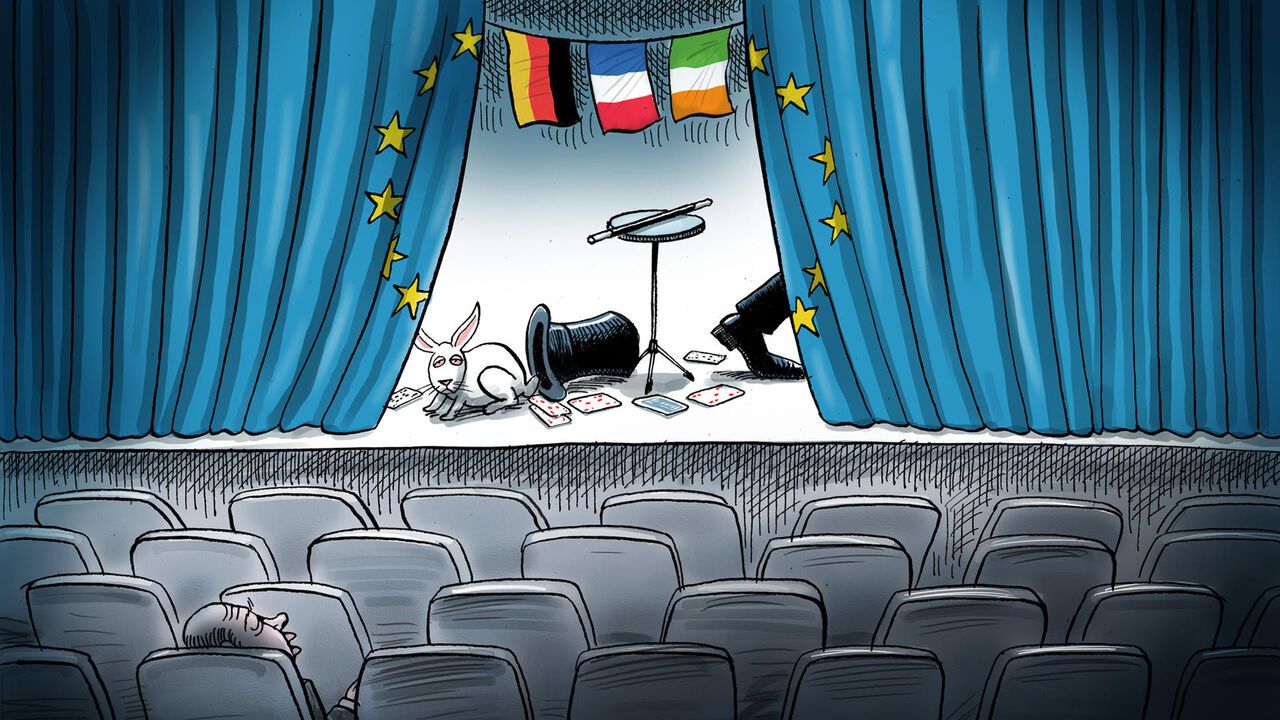
To keep the European Union ticking along(平稳运行,持续运转) has always required a certain sleight of hand. National leaders of its 27 member states act as the bloc’s chief conjurors, selling the illusion to voters back home that every compromise hashed out at some interminable summit in Brussels marks yet another victory for Poles, Spaniards or whoever. Alas, such tricks become harder to pull off when voters stop trusting the magicians. And European publics these days seem to have seen through the smoke and mirrors: across the continent, leaders have been plumbing recent depths of unpopularity. In France and Germany, the EU’s two biggest countries, approval ratings have sunk to something akin to contempt. This is more than a mere obstacle to politicians’ hopes to one day sell a fat pile of memoirs and earn handsomely on the lecture circuit.(这不仅仅是政治家们有朝一日出售一大摞回忆录并靠巡回演讲大发其财的障碍。) Like the best magic, the reforms which Europe needs still depend on the audience’s willingness to be taken in. The EU cannot outrun the unpopularity of its political class.
要让欧盟保持运转一直需要一定的巧妙手法。27个成员国的国家领导人充当着欧盟的首席魔术师,向国内选民兜售这样一种幻觉:在布鲁塞尔没完没了的峰会上达成的每一项妥协,都是波兰人、西班牙人或任何人的又一次胜利。唉,当选民不再信任魔术师时,这样的把戏就更难奏效了。而如今欧洲公众似乎已经看穿了这些烟雾和镜子:在整个欧洲大陆,领导人的不受欢迎程度已跌至近年来的谷底。在法国和德国这两个欧盟最大的国家,支持率已降至近乎蔑视的地步。这不仅仅是政治家们有朝一日出售一大摞回忆录并靠巡回演讲大发其财的障碍。就像最好的魔术一样,欧洲需要的改革仍然取决于观众是否愿意被蒙骗。欧盟无法摆脱其政治阶层的不受欢迎。
Becoming disliked by voters is an occupational hazard(职业风险,行业通病) for elected leaders the world over. But Europe’s current heads of government stand out for their lack of public appeal. France’s Emmanuel Macron has the confidence of fewer than one in five voters; over three-quarters think of him unfavourably, a net support score of -49%, according to YouGov, a pollster. Perhaps that is inevitable after nine years in the job; his predecessor François Hollande once enjoyed an abysmal(极糟的,深不可测的) 4% public support. More strikingly, Friedrich Merz in Germany has seen his popularity vanish faster than a coin down a street magician’s sleeve. After less than a year in the job the chancellor has a net approval of -43%. Giorgia Meloni in Italy and Pedro Sánchez in Spain may feel smug, given they have only about twice as many detractor(批评者,诋毁者)s as fans. But that is still worse than Donald Trump, whose net score among American voters is a mere -19%. Newish leaders in Canada and Japan, meanwhile, still manage positive approval ratings.
不受选民喜欢是全世界民选领导人的职业风险。但欧洲现任国家首脑在缺乏公众吸引力方面尤为突出。法国的埃马纽埃尔·马克龙的支持率不到五分之一;超过四分之三的选民对他持负面看法,根据民调机构YouGov,他的净支持率为-49%。这在任职九年后或许是不可避免的;他的前任弗朗索瓦·奥朗德曾享有惨淡的4%公众支持率。更引人注目的是,德国的弗里德里希·默茨的受欢迎程度消失得比街头魔术师袖子里的硬币还快。上任不到一年,这位总理的净支持率就达到了-43%。意大利的焦尔吉娅·梅洛尼和西班牙的佩德罗·桑切斯可能暗自得意,因为他们的反对者大约只有支持者的两倍。但这仍然比唐纳德·特朗普差,后者在美国选民中的净支持率仅为-19%。与此同时,加拿大和日本的新任领导人仍然保持着正面的支持率。
Unpopular leaders struggling to get reforms through is a familiar pitfall in any democracy. In Europe’s case, the ramifications stretch beyond the usual political gridlock. The EU runs on the borrowed authority(借来的权威) of its national leaders—and currently they have precious little. Call it the coalition of the weakened. Placating a grumpy coalition partner, or fending off a Eurosceptic rabble-rousing opposition, makes it all the harder to do deals at EU level. This could scarcely be happening at a worse time. The list of problems European countries have to handle collectively is daunting, from how to deal with the mercurial(反复无常的) Mr Trump, a reheated energy crisis, an enduring war in Ukraine, a flabby economy and a clogged enlargement process. Haggling over the bloc’s next seven-year budget is in full swing, too. All these require compromises and trade-offs—the sort that cannot easily be pulled out of a hat by unpopular politicos. Weakness at home makes it hard for national leaders to be ambitious in Europe.
不受欢迎的领导人难以推动改革,这是任何民主国家都熟悉的陷阱。就欧洲而言,其影响远不止通常的政治僵局。欧盟依靠其国家领导人的借来权威运行——而目前他们几乎没什么权威。可以称之为“弱者联盟”。安抚脾气暴躁的联盟伙伴,或抵挡疑欧派煽动性的反对派,使得在欧盟层面达成协议更加困难。这种情况几乎不能再糟了。欧洲国家必须集体应对的问题清单令人望而生畏:如何应对反复无常的特朗普先生、重燃的能源危机、持续的乌克兰战争、疲软的经济和堵塞的扩大进程。就欧盟下一个七年预算进行讨价还价也正在如火如荼地进行。所有这些都需要妥协和权衡——这些不是不受欢迎的政客们能轻易从帽子里变出来的。国内的弱势使得国家领导人很难在欧洲有雄心壮志。
Ta-da for now
暂时就这样吧