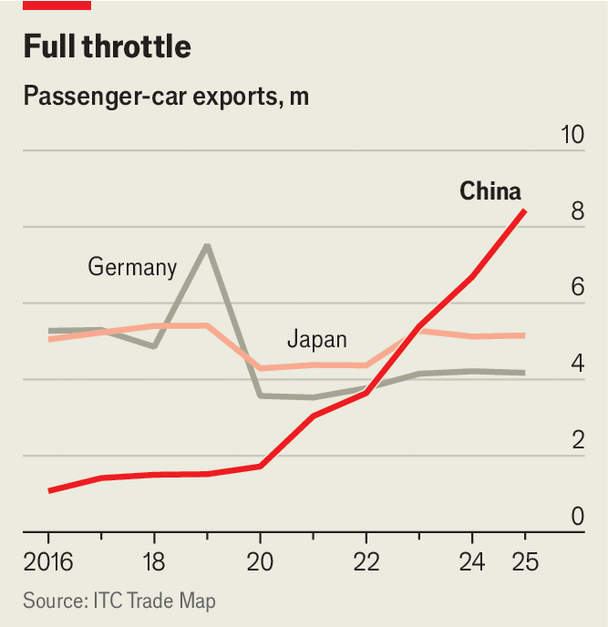
Any doubts that China has become the heartland(中心区域) of the global car industry are quickly dispelled(被迅速打消) by a visit to the country’s main motor show. Beijing’s crowded event this year was twice as large as in 2024 (it moves to Shanghai on alternate years) with around 180 new cars on display. The show, which concluded on May 3rd, demonstrated once again that foreign carmakers are lagging behind(落后于) their Chinese rivals in the race to the industry’s future.
任何关于中国已成为全球汽车产业核心的疑虑,只要参观一下该国的主要车展就会迅速打消。今年北京车展的规模是2024年的两倍(车展在两地轮流举办),展出了约180款新车。于5月3日结束的这场展会再次证明,外国汽车制造商在迈向产业未来的竞赛中落后于中国对手。
Yet the show also illustrated the extent to which foreign carmakers are looking to remake themselves in the image of their ascendant Chinese competitors(外国汽车制造商在多大程度上希望按照他们崛起的中国竞争对手的形象重塑自己). At events to launch new models Western executives from Volkswagen (VW) and Mercedes switched effortlessly between English and Mandarin. VW opted to round off(圆满结束) its show with a display of interpretive Chinese dance set to electronic music; Mercedes went for a Chinese rap.
然而,这场展会也展示了外国汽车制造商希望在多大程度上按照他们崛起的中国竞争对手的形象重塑自己。在新车发布会上,来自大众和梅赛德斯的高管们轻松地在英语和普通话之间切换。大众选择以一场配合电子音乐的中国现代舞表演来结束其发布会;梅赛德斯则选择了中文说唱。
To stem(遏制) their loss of market share, carmakers around the world are looking to become more like their Chinese competitors—and not just when operating in China. So they might. François Provost, Renault’s chief executive, admits that China now leads the industry in technology, speed and competitiveness. To match them, increasingly rattled(焦虑不安的) car bosses are adopting Chinese practices and partnering with Chinese firms. Done judiciously(如果明智地做), this may help them close the gap. But further down the road potholes lurk(潜伏着坑洼).
为了遏制市场份额的流失,全球各地的汽车制造商都希望变得更像他们的中国竞争对手——而且不仅仅是在中国运营时如此。他们或许可以做到。雷诺首席执行官弗朗索瓦·普罗沃斯特承认,中国如今在技术、速度和竞争力方面引领行业。为了赶超,越来越焦虑的车企老板们开始采用中国做法,并与中国公司合作。如果明智地行事,这或许有助于缩小差距。但前方的道路上潜伏着坑洼。