The third gulf war should, in theory, be a huge blessing(巨大的福音) for big oil. In January most analysts had expected Brent crude(布伦特原油), the global oil-price benchmark, to average $60 a barrel in 2026. It ended the first quarter at $118; refined products(成品油) have risen faster still. With most Gulf oil trapped behind the Strait of Hormuz(① 霍尔木兹海峡是连接波斯湾与印度洋的关...), exports from America, Africa and Brazil are up. Western majors should therefore be collecting fatter margins on every barrel—and selling more of them, too.
从理论上讲,第三次海湾战争对大型石油公司来说应该是个巨大的福音。今年1月,大多数分析师预期全球油价基准布伦特原油在2026年的平均价格将为每桶60美元。而第一季度结束时,油价已达118美元;成品油价格上涨更快。由于大部分海湾石油被封锁在霍尔木兹海峡之后,来自美国、非洲和巴西的出口增加。因此,西方石油巨头每桶油的利润应该更丰厚,而且销量也更大。
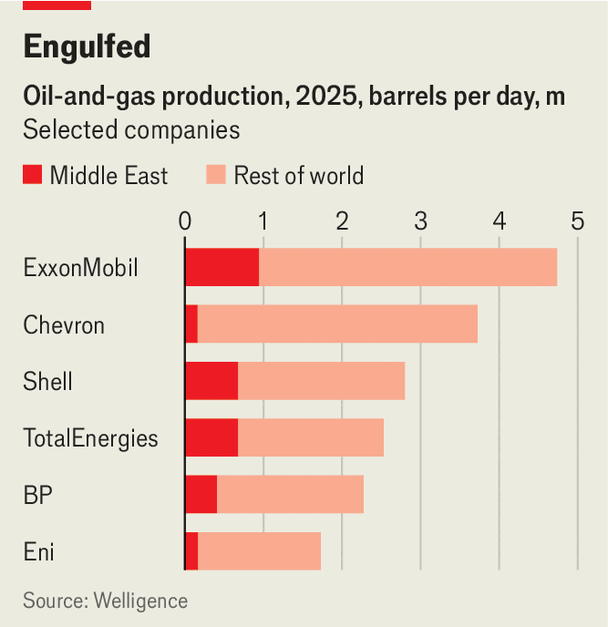
Since the war began the share price of Shell, a British giant, has risen by 4%; those of TotalEnergies, BP and Eni, its big European rivals, have soared by 14–17%. But Chevron and ExxonMobil, America’s twin colossi(双巨头), are down by 1% and 2%, respectively. The war’s effect on Western majors, it turns out, is uneven. First-quarter results, released in recent days, point to three reasons: hedging positions(对冲头寸), trading gains and the location of production assets.
自战争开始以来,英国巨头壳牌的股价上涨了4%;其欧洲主要竞争对手道达尔能源、BP和埃尼的股价飙升了14%至17%。但美国的双巨头雪佛龙和埃克森美孚分别下跌了1%和2%。事实证明,战争对西方石油巨头的影响是不均衡的。近日发布的第一季度业绩指向三个原因:对冲头寸、交易收益和生产资产的地理位置。
In the three months to March 31st Chevron and Exxon reported net incomes of $2.2bn and $4.2bn—down by 37% and 46%, respectively, from a year before. These sharp declines are largely accounting illusions(会计假象). Oil-and-gas sales are typically agreed weeks or months before delivery. To guard against price swings, the majors buy hedges(对冲合约)—contracts that pay if oil prices fall in the interim. When prices soar, the hedges lose value, causing paper losses(账面损失). These amounted to $2.9bn for Chevron and $3.9bn for Exxon in the quarter.
在截至3月31日的三个月里,雪佛龙和埃克森美孚报告净利润分别为22亿美元和42亿美元,同比下降37%和46%。这些大幅下滑很大程度上是会计假象。石油和天然气销售通常在交货前几周或几个月就已商定。为了防范价格波动,这些巨头购买对冲合约——如果在此期间油价下跌,这些合约就会支付。当价格飙升时,对冲合约价值下跌,造成账面损失。本季度,雪佛龙和埃克森美孚的此类损失分别达29亿美元和39亿美元。