
THE EUROPEAN UNION is an economic giant(经济巨人). Its 27 member states combine into the world’s second-biggest economy behind America and its third-most-populous internal market(内部市场), behind India and China. The EU is home to some of the world’s most recognisable brands, from Adidas to Zara, and key industrial firms such as ASML, whose lithography machines(光刻机) are critical in AI chipmaking, and Zeiss, whose lenses are critical to ASML.
欧盟是一个经济巨人。其27个成员国组合成仅次于美国的世界第二大经济体,以及仅次于印度和中国的第三大人口内部市场。欧盟是一些世界最知名品牌的所在地,从阿迪达斯到Zara,以及像ASML(其光刻机对AI芯片制造至关重要)和蔡司(其镜头对ASML至关重要)等关键工业公司。
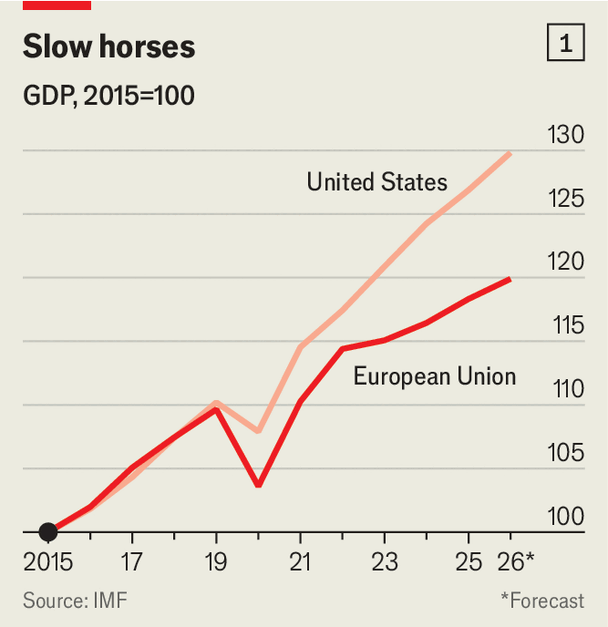
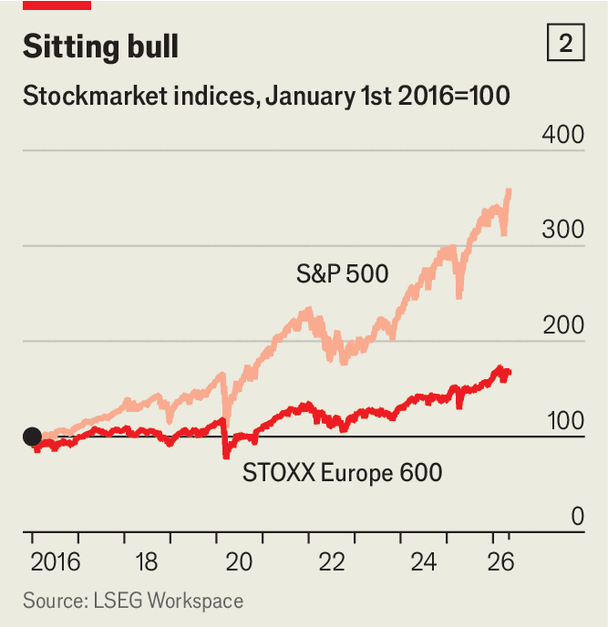
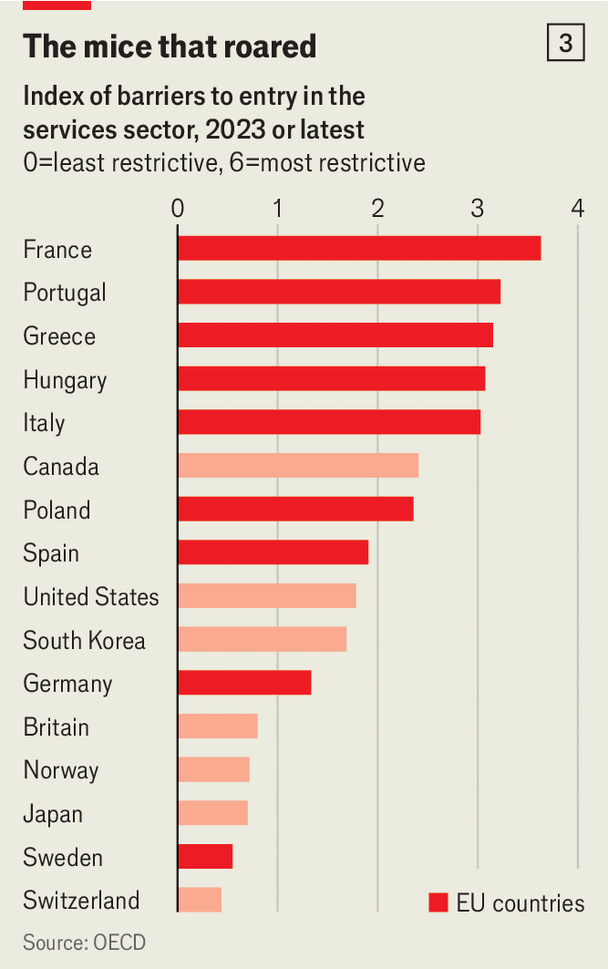
Alas, these days the giant is sleepy. The bloc’s GDP and its stockmarket have lagged far behind(远远落后) America’s over the past decade (see charts 1 and 2). In April activity in its services sector fell to a 62-month low. The recent shocks which contributed to the sluggishness were not of its own making(非自身造成): the covid-19 pandemic, Russia’s invasion of Ukraine and now America’s war on Iran. But the EU and its members have also been getting in their own way(自设障碍), by overregulating companies (see chart 3) and failing to properly integrate their supposedly single market.
唉,如今这个巨人昏昏欲睡。过去十年,欧盟的GDP和股市远远落后于美国(见图表1和2)。4月份,其服务业活动降至62个月低点。导致经济低迷的近期冲击并非其自身造成:新冠疫情、俄罗斯入侵乌克兰以及现在美国对伊朗的战争。但欧盟及其成员国也一直在自设障碍,过度监管公司(见图表3)且未能妥善整合其本应统一的单一市场。
Between 2014 and 2024 the European Commission, the bloc’s executive arm, considered over 1,000 proposals. Some 660 were adopted. Among (many) other things, these forced even smallish firms to monitor their data and global supply chains for all manner of digital, environmental and human-rights transgressions(违规行为). The EU’s official beancounters(数字统计员(贬义)) at Eurostat estimate that reporting requirements and other paperwork cumulatively cost European businesses €150bn ($176bn) a year, equivalent to nearly 1% of the EU’s GDP—and that is not counting the innovation and growth forgone because entrepreneurs were put off by it all. Some new rules under discussion could add another €80bn to the bill if unchecked. The IMF reckons that selling goods and services across national borders in the EU costs firms the equivalent of a 44% and 110% tariff, respectively. A survey in 2025 found that German firms had to hire an additional 325,000 employees over the preceding three years whose job was to tick ever more bureaucratic boxes.
2014年至2024年间,欧盟的执行机构欧盟委员会审议了超过1000项提案,约660项被采纳。这些提案迫使甚至较小的公司监控其数据和全球供应链,以防各类数字、环境和人权违规行为。欧盟的官方统计机构欧盟统计局估计,报告要求和其他文书工作每年给欧洲企业造成1500亿欧元(1760亿美元)的累积成本,相当于欧盟GDP的近1%——这还不算因企业家被此劝退而放弃的创新和增长。正在讨论的一些新规则如果不加约束,可能会再增加800亿欧元的账单。国际货币基金组织估计,在欧盟内跨境销售商品和服务的成本分别相当于44%和110%的关税。2025年的一项调查发现,德国公司在前三年不得不额外雇佣32.5万名员工,其工作就是完成越来越多的官僚繁琐任务。
Nouveau Berlaymont
新贝雷蒙