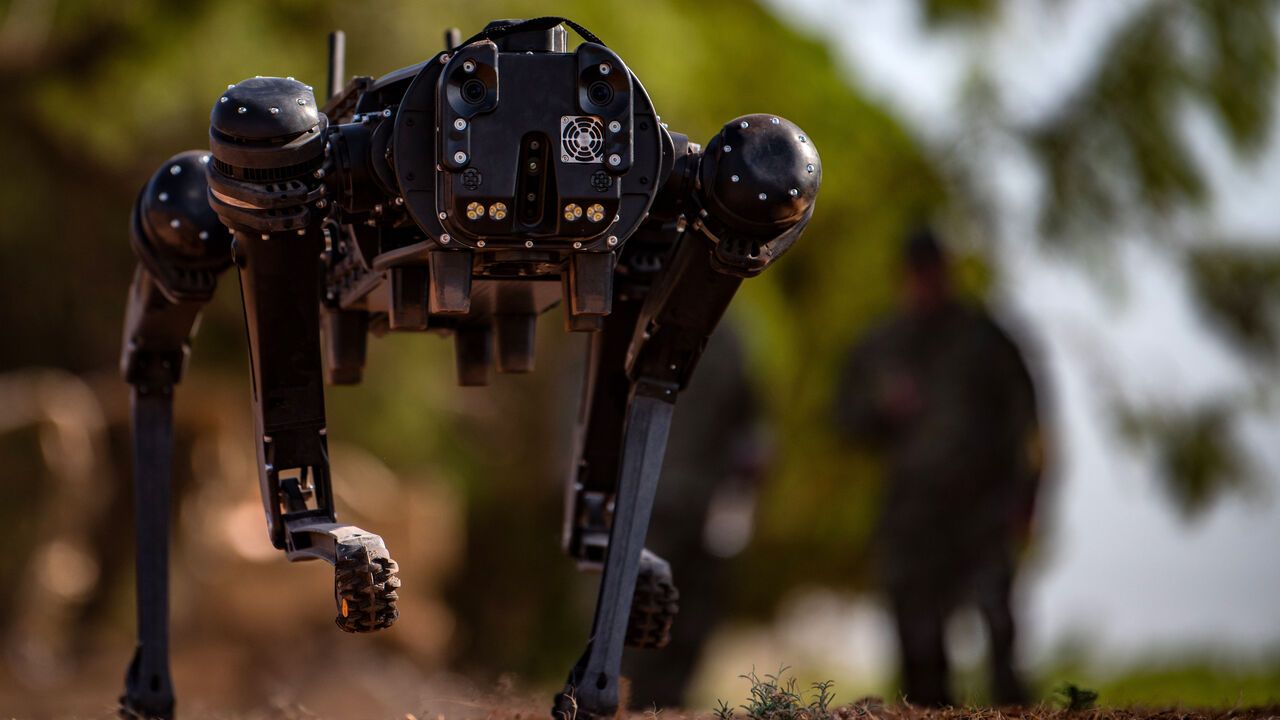
The exhibition hall of the annual Border Security Expo (BSE), held this month in Phoenix, Arizona, looked more like the set of a dystopian(反乌托邦的,糟糕的) science-fiction film. Surveillance towers flashed brightly. Drones buzzed(嗡嗡作响,充满嘈杂声) overhead. One company demonstrated a robotic dog designed to patrol borders. Another showed off(展示,炫耀) a thermal camera that can detect movement kilometres away. On stage Tom Homan(① 背景:Tom Homan 曾在奥巴马...), President Donald Trump’s “border czar(沙皇,独裁者;特派专员)”, praised the technology firms in attendance for helping to build “the most secure border in history”.
本月在亚利桑那州凤凰城举行的年度边境安全博览会(BSE)的展览厅,看起来更像是一部反乌托邦科幻电影的场景。监控塔闪烁着明亮的光芒。无人机在头顶嗡嗡作响。一家公司展示了一种用于巡逻边境的机器狗。另一家公司展示了一台可以探测数公里外移动的热成像摄像机。舞台上,唐纳德·特朗普总统的“边境沙皇”汤姆·霍曼称赞在场的技术公司帮助建立了“史上最安全的边境”。
As the bustling(熙熙攘攘的,繁忙的) trade fair demonstrated, the business of immigration enforcement is booming(迅速发展的,繁荣的). Right-wing populists—and incumbents seeking to fend them off—are spending more on monitoring borders, tracking down those who have entered the country illegally, then detaining and deporting them. In America, Congress has approved roughly $170bn in cumulative(累积的,累计的) additional funding for immigration enforcement until 2029. Even the European Union is ratcheting up(逐步增加,一级级提升) spending. That is benefiting not only incumbent outsourcers, but also a wave of startups hoping to bring new technologies to the industry.
正如这场热闹的贸易展览所证明的,移民执法业务正在蓬勃发展。右翼民粹主义者——以及试图抵御他们的现任官员——正在加大支出,用于监控边境、追踪非法入境者,然后拘留和驱逐他们。在美国,国会已批准到2029年累计约1700亿美元的额外移民执法资金。甚至连欧盟也在增加支出。这不仅惠及现有的外包服务商,也惠及一波希望将新技术引入该行业的初创公司。
Border control is an area of particular interest for newcomers(新来者,新进入者). Much of that business has tended to(倾向于,往往会) flow to large defence contractors(承包商,承包公司) and established security firms. Yet agencies across America and Europe have been simplifying procurement(采购,获得) rules and running pilot programmes to allow new products to be tested and deployed more quickly, luring in(吸引,引诱) startups.
边境控制是新人特别感兴趣的领域。这类业务的大部分往往流向大型国防承包商和知名安全公司。然而,美国和欧洲的机构一直在简化采购规则并开展试点项目,以允许新产品更快地测试和部署,从而吸引初创公司。