
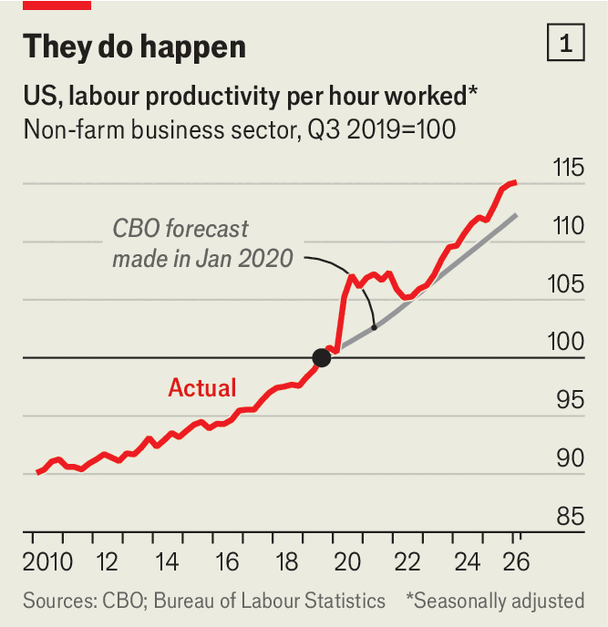
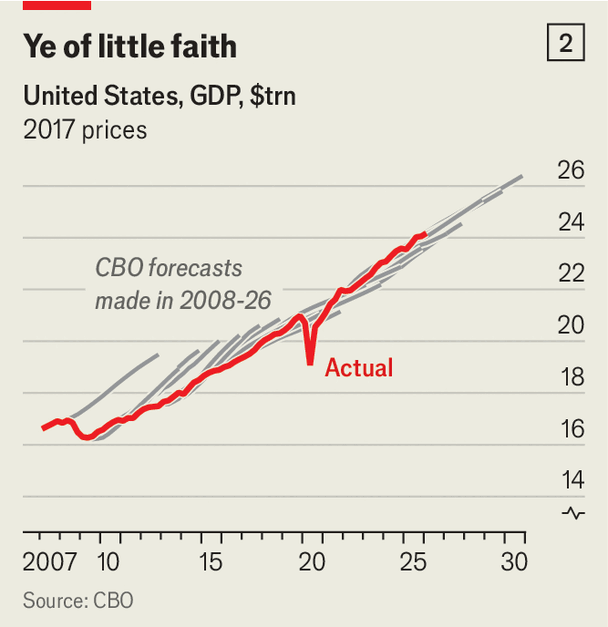
As with many a(许多(后接单数名词)) miracle, onlookers disbelieved their eyes at first. For a decade after the global financial crisis of 2007-09 rich-world productivity growth was, by historical standards, deadish(近乎停滞的). Since prosperity depends on the ability to produce more with the same labour, this consigned even America to eternal stagnation (and don’t ask about Europe). The Congressional Budget Office, a fiscal watchdog which consistently overestimated productivity growth in the 2010s, has been consistently glum(闷闷不乐的,悲观的) this decade (see charts 1 and 2). Partial data hinting otherwise were dismissed as false prophets(假先知(喻不可靠的预测)).
如同许多奇迹一样,旁观者起初不敢相信自己的眼睛。2007-09年全球金融危机后的十年里,富裕国家的生产率增长按照历史标准来看近乎停滞。由于繁荣依赖于用同等劳动力生产更多产品的能力,这使美国甚至陷入了永久性停滞(别提欧洲了)。美国国会预算办公室——这个在2010年代一贯高估生产率增长的财政监督机构——在本世纪一直持悲观态度(见图表1和2)。暗示相反情况的零星数据被斥为假先知。
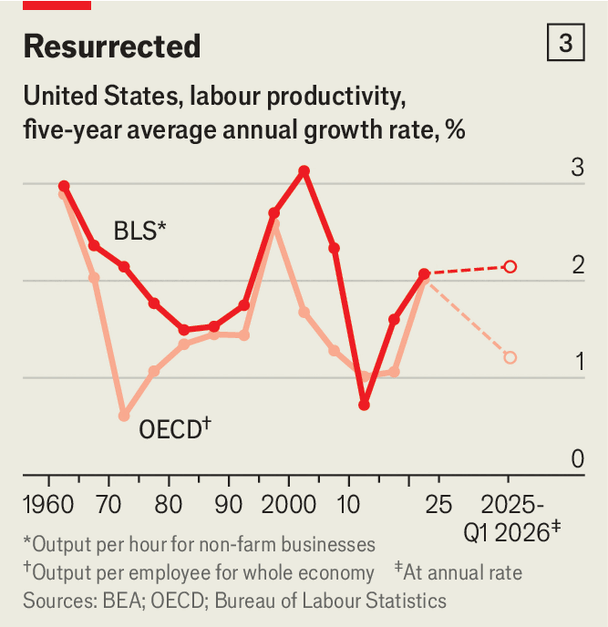
But those data kept coming. And now they are indisputable(无可争辩的): over the past five years or so American productivity has been growing at the fastest rate in around two decades. Whether you look at output per worker or per hour, it has risen by a lively 2% a year, from a moribund(停滞不前的,垂死的) 1% for most of the 2010s (see chart 3). This has led the Federal Reserve to raise its median forecast for America’s long-run GDP growth from 1.8% to 2%. Jerome Powell, the outgoing chair, bore witness(作证,证实) at a recent press conference. “I never thought I’d see this many years of really high productivity,” he marvelled(惊叹) in response to a question from The Economist.
但这些数据不断出现。现在它们无可争辩:过去五年左右,美国生产率增速达到了近二十年来最快。无论看人均产出还是每小时产出,年增长率都达到了2%,而2010年代大部分时间仅为1%(见图表3)。这促使美联储将其对美国长期GDP增长的中位预测从1.8%上调至2%。即将离任的主席杰罗姆·鲍威尔在最近一次新闻发布会上证实了这一点。他在回答《经济学人》的提问时惊叹道:“我从未想过会看到这么多年的高生产率。”
It is too early to credit artificial intelligence for the resurrection(复苏,复活). Productivity picked up in the early 2020s, whereas large language models have come into real commercial use only in the past year or so. If previous technological revolutions are anything to go by(依据…来判断), the AI age will take at least a few years to show up in productivity statistics. Its main macroeconomically discernible(可辨别的,可察觉的) impact so far has been on business investment, particularly in data centres.
现在将这次复苏归功于人工智能还为时过早。生产率在2020年代初就开始回升,而大型语言模型仅在最近一年左右才真正投入商业使用。如果以以往的技术革命为参照,AI时代至少需要几年时间才能在生产率统计中显现。目前为止,其主要的宏观经济可见影响是商业投资,尤其是数据中心。
The book of jobs
就业之书