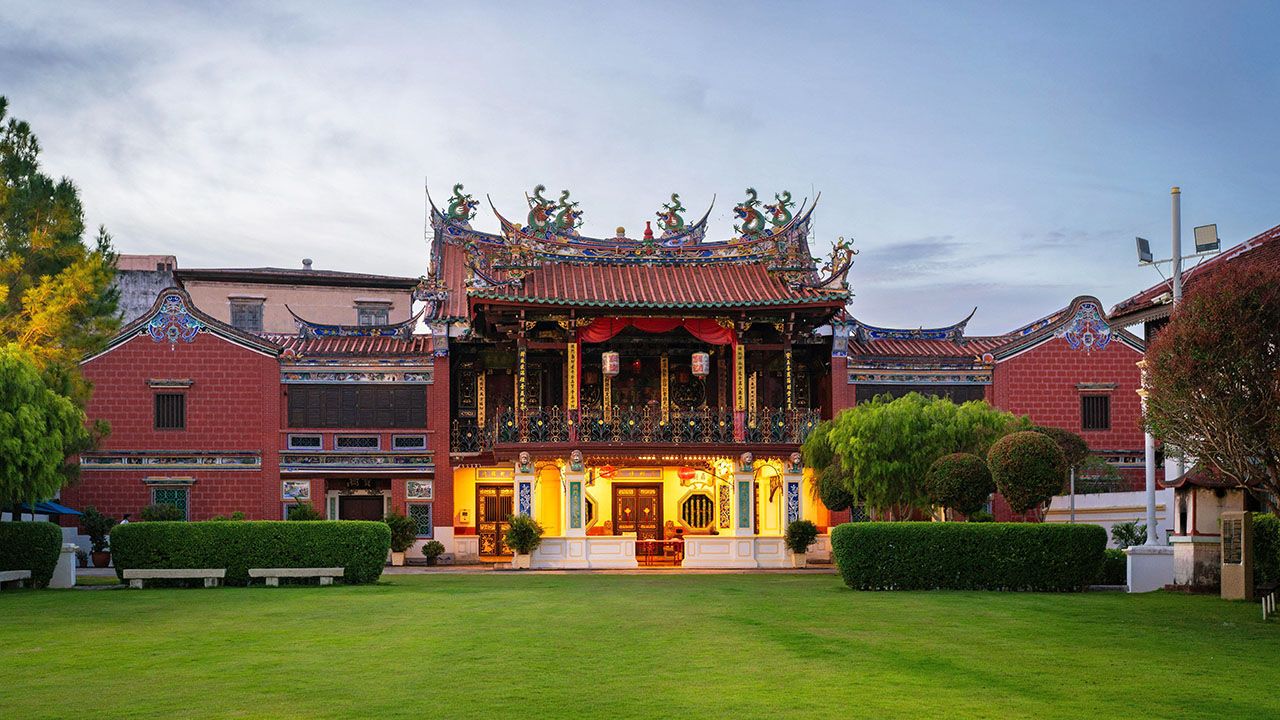
Tourists in Georgetown, a city on the Malaysian island of Penang, love to pose by a well-known piece of street art depicting two children on a bicycle. Most of them miss the ornate(装饰华丽的) building on the other side of the wall: home to Cheah Kongsi, one of Penang’s richest Chinese clan associations, founded in 1810 (pictured). For two centuries such groups served migrants fleeing violence and poverty(逃离暴力和贫困) in China. Now they face a new challenge: the apathy(冷漠;漠不关心) of the young.
游客们喜欢在马来西亚槟城岛乔治市一幅著名的街头艺术(描绘两个骑自行车的孩子)旁摆姿势拍照。他们中的大多数人都会错过墙另一边那座华丽的建筑:谢公司(Cheah Kongsi)的所在地,它是槟城最富有的华人宗亲会之一,成立于1810年(如图)。两个世纪以来,这些组织为逃离中国暴力和贫困的移民提供服务。如今,它们面临一个新挑战:年轻人的冷漠。
South-East Asia is home to about 80% of the world’s overseas Chinese. Clan associations, along with Chinese-language schools and Chinese newspapers, are one of the three pillars(三大支柱) of overseas Chinese society, according to Hong Liu of Nanyang Technological University in Singapore. Malaysia has more than 10,000 clan associations, with Penang a particular hotspot. They are also found in Myanmar, the Philippines, Singapore, Thailand and Vietnam, among other countries.
东南亚居住着全球约80%的海外华人。据新加坡南洋理工大学刘宏介绍,宗亲会、华文学校和华文报纸是海外华人社会的三大支柱之一。马来西亚有超过一万个宗亲会,槟城尤其集中。在缅甸、菲律宾、新加坡、泰国和越南等国也有分布。
When they started in the early 19th century the associations were a kind of welfare state, employment agency and temple rolled into one(集于一身;合为一体). Migrants originating from the same clan, village or trade came together to socialise, pray to common deities(神祇;神灵), find housing and jobs, open schools, lend money and operate cemeteries. Some grew rich. The most influential ones in Georgetown own homes and palm-oil plantations, among other properties. Cheah Kongsi still provides welfare, giving between 250 and 2,000 ringgit(林吉特(马来西亚货币)) ($55-450) per year to children of members and to retired people.
宗亲会始于19世纪初,当时它们集福利国家、就业机构和寺庙于一体。来自同一宗族、村庄或行业的移民聚集在一起,社交、向共同的神灵祈祷、寻找住房和工作、开办学校、借钱和经营墓地。有些变得富有。乔治市最有影响力的宗亲会拥有住宅和油棕榈种植园等产业。谢公司至今仍提供福利,每年向会员子女和退休人员发放250至2000林吉特(约55至450美元)。