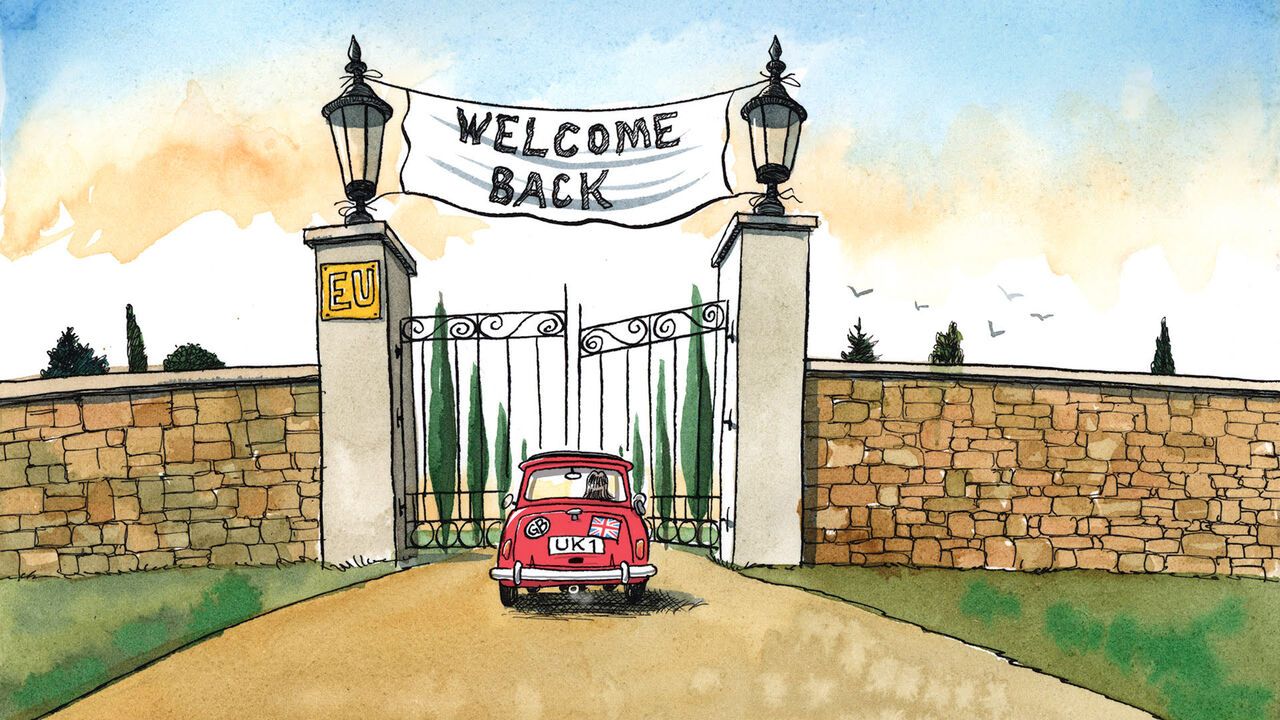
Picture the scene, some time in the 2030s. Three dozen leaders of the European Union’s member states crowd around a gilded desk in some history-laden hall—perhaps in Versailles, Sarajevo or Rome. The Spanish prime minister signs a thick vellum document, before passing the Mont Blanc pen to the German chancellor, then the Ukrainian president. The mood is jovial(欢乐的;愉快的) as, one by one, signatures are affixed on “The Treaty of Accession of the United Kingdom to the European Union (version 2.0)”. As the pen makes its way to the French president, she seems to waver for a second, perhaps recalling past tabloid headlines about bendy bananas and budget rebates. Finally it is the turn of the British prime minister of the day. In one stroke Brexit is reversed; the only member to have left the EU’s embrace is now safely back inside. Amid the sound of champagne corks popping, few can make out the words of an elderly gentleman in the public gallery, one Nigel Farage, fulminating vaguely about the will of the people. Welcome back, Britain! The prodigal(挥霍的;回头的浪子) nation returns!
想象一下2030年代的某个场景。欧盟成员国的三十多位领导人挤在一张镀金办公桌旁,围聚在某间充满历史气息的大厅里——也许在凡尔赛宫、萨拉热窝或罗马。西班牙首相签署了一份厚厚的羊皮纸文件,然后将万宝龙钢笔递给德国总理,接着是乌克兰总统。气氛欢快,人们一个接一个地在《大不列颠及北爱尔兰联合王国加入欧洲联盟条约(2.0版)》上签字。当钢笔传到法国总统手中时,她似乎犹豫了一秒,或许是想起了过去小报上关于弯曲香蕉和预算返款的标题。最后轮到当时的英国首相。一笔勾销,脱欧被逆转;唯一离开欧盟怀抱的成员现在安全归来。在香槟塞啵啵作响的声音中,很少有人能听清公众席上一位老先生的话——奈杰尔·法拉奇含糊地怒斥着“人民的意志”。欢迎回来,英国!浪子回头般的国家回来了!
What would once have seemed like a Remainer fever dream no longer feels so absurd. For the first time since the Brexit referendum of June 2016, the idea of asking to return to the fold(回归集体;重归团体) is on Britain’s political horizon. Granted, for now the idea of Bre-entry is confined to Labour politicians, floating the notion to charm party members ahead of a possible challenge to Sir Keir Starmer; several hope to become prime minister in his stead. Granted, too, that the euro-bashers of Mr Farage’s Reform UK party are far ahead in the polls. But rejoining the EU seems to resonate(引起共鸣;回响) with many British voters, a majority of whom think leaving was a mistake. The notion is unlikely to go away soon. As more and more Westminster politicians declare they favour applying for re-entry, the EU may one day need to say what it thinks of the idea of Britain boomeranging(像回旋镖一样返回) back into the union it left in a huff(气冲冲地;愤怒地).
这种曾经看起来像是留欧派狂热梦境的想法,如今不再显得那么荒唐。自2016年6月脱欧公投以来,请求回归欧盟的想法首次出现在英国的政治地平线上。诚然,目前重新入欧的想法仍局限于工党政客,他们提出这一概念以在可能挑战基尔·斯塔默爵士之前讨好党内成员;有几位希望取代他成为首相。同样,法拉奇先生的改革英国党中的“欧元抨击者”在民调中遥遥领先。但重新加入欧盟似乎引起了许多英国选民的共鸣,大多数人认为脱欧是个错误。这一概念不太可能很快消失。随着越来越多的威斯敏斯特政客宣布支持申请重新入盟,欧盟可能总有一天需要表态,如何看待英国在愤怒离开后又像回旋镖一样重返联盟。
The current state of Britain-EU relations offers nary(绝不;一个也没有) a hint of what response might emanate(发出;源自) from Brussels. Since the divorce was officialised in 2020, the two sides have haggled over relatively small fry(小鱼小虾;微不足道的事), such as aligning rules on food safety and whatnot. That is the purview(范围;职权) of mid-level Eurocrats(欧盟官员(贬称)). In contrast, a bid for Bre-entry would be taken up by the EU’s national leaders in Paris, Berlin and beyond. Plenty would see the case for Britain to rejoin. Any union should welcome a G7 country with a seat on the UN Security Council, its own nuclear weapons and the continent’s biggest capital-markets hub. The same factors that are prompting some in Britain to discuss a return—a chaotic global order, in which America and China vie for supremacy and leave middle powers(中等强国) scrambling for security—should also sway the EU towards Bre-entry. Across the union, voters say they would welcome Britain back.
目前英欧关系的现状丝毫没有透露出布鲁塞尔可能做出何种回应。自2020年离婚正式生效以来,双方一直在争论相对次要的问题,比如协调食品安全规则等等。这属于中级欧洲官僚的管辖范围。相比之下,申请重新入欧将由巴黎、柏林及其他地方的欧盟国家领导人来处理。很多人会看到英国重新加入的理由。任何联盟都应欢迎一个七国集团国家,这个国家拥有联合国安理会席位、自己的核武器以及欧洲最大的资本市场中心。促使一些英国人讨论回归的同样因素——一个混乱的全球秩序,美中争霸,中等国家竞相寻求安全——也应推动欧盟倾向于重新入欧。在整个欧盟,选民们表示他们会欢迎英国回来。
Breturn to sender
退回发件人