SINCE DONALD TRUMP took office in January last year, America’s economy has continued to be the envy of the world(世界羡慕的对象). In 2025, while Britain, France and Japan eked out(勉强获得) annual GDP growth of around 1%, and Germany all but stood still(几乎停滞不前), American output grew by 2.1%. In the past 15 months American stockmarkets have broken record after record(屡创新高). And all this even as the president has unleashed(释放;推行) seemingly anti-growth policies like mass deportations(大规模驱逐出境) of migrant workers and chaotic trade wars.
自特朗普去年1月就职以来,美国经济依然是世界羡慕的对象。2025年,当英国、法国和日本勉强实现约1%的年GDP增长,德国几乎停滞不前时,美国产出增长了2.1%。过去15个月,美国股市屡创新高。而这一切甚至发生在总统推行看似反增长的政策(如大规模驱逐移民工人和混乱的贸易战)的背景之下。
Observers who had predicted economic disaster are left scratching their heads(摸不着头脑). Perhaps, some now whisper, the policies are not as destructive as economists had assumed.(也许,有些人现在低声说,这些政策并不像经济学家之前假设的那样具有破坏性。) Others wonder what might have been. For all its strength, America’s economy could, on this interpretation, be doing even better. But how much better? Put another way: how big is the “MAGA tax”?(换句话说:“MAGA税”有多大?)
此前预测经济灾难的观察者们现在摸不着头脑。也许,有些人低声说,这些政策并不像经济学家之前假设的那样具有破坏性。其他人则在想,原本可能会怎样。尽管美国经济强劲,按照这种解释,它本可以表现更好。但好多少呢?换句话说:“MAGA税”有多大?
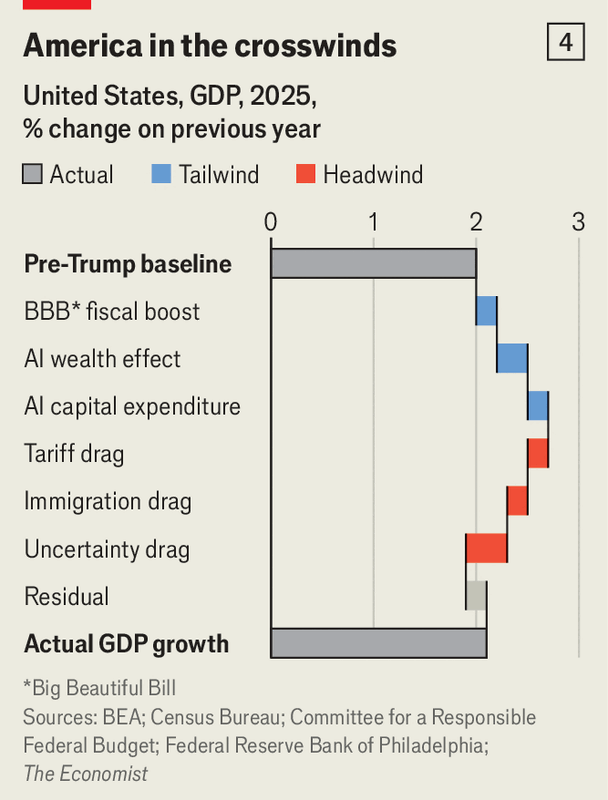
One way to arrive at a figure(得出一个数字) is to imagine what America’s economy would look like in this levy(征税额;征税)’s absence. Mr Trump inherited an economy that was growing strongly. It has since had three boosts, which The Economist has roughly quantified.
得出一个数字的一种方法是想象如果没有这项“征税”,美国经济会是什么样子。特朗普接手的是一个增长强劲的经济。此后经济经历了三大推动力,《经济学人》对此进行了粗略量化。