A couple of months after two children attacked Enna Pink’s son with sticks at kindergarten, he began pleading with her to stay at home. “I didn’t want to force him to go,” says Ms Pink. She and her husband, who both worked at a startup, thought home-schooling would be a better fit for their son, who is “hyper-sensitive(高度敏感的)”. But it is illegal in Germany, where they lived. So they moved to Costa Rica, where home-schooling is illegal for locals but there is little oversight for digital nomads.
在两个孩子用棍子在幼儿园袭击了恩娜·平克的儿子几个月后,他开始恳求她留在家里。“我不想强迫他去,”平克女士说。她和丈夫都在一家初创公司工作,他们认为在家教育更适合他们“高度敏感”的儿子。但这在她们居住的德国是非法的。于是他们搬到了哥斯达黎加,在那里在家教育对当地人来说是违法的,但对数字游民几乎没有监管。
Now her children, seven and four, do not follow lesson plans; instead they learn by playing outside, joining other children in local activities and travelling around the world. She thinks all this fosters curiosity and confidence(培养好奇心和自信心). “We feel that what our society needs in the future is not what the school system can offer,” she says.
现在她七岁和四岁的孩子不遵循课程计划;而是通过户外玩耍、参加当地其他孩子的活动以及环游世界来学习。她认为这一切培养了好奇心和自信心。“我们觉得未来社会所需的不是学校系统能提供的,”她说。
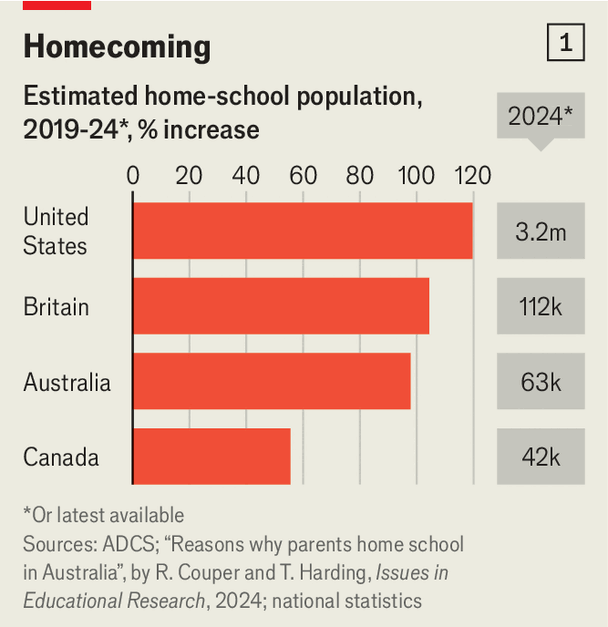
Home-schooling has long been associated with oddball(古怪的,异类的) parents, awkward children and shaky pedagogy(不可靠的教学方法). But it is growing swiftly. Numbers were rising before the pandemic; they have since surged in countries like Britain, Australia and Canada (see chart 1). In America 3.2m children, or 6% of the school-age population, were home-schooled in 2024—more than double the number in 2019.
长期以来,家庭教育一直与古怪的家长、笨拙的孩子和不靠谱的教学法联系在一起。但它正在迅速增长。疫情前数字就在上升;此后在英国、澳大利亚和加拿大等国家激增(见图表1)。在美国,2024年有320万儿童(占学龄人口的6%)接受家庭教育,是2019年的两倍多。
Those who can’t, teach
不会教的人,才去教