Since the global financial crisis of 2007-09 the days of offshore finance have regularly looked numbered(显得时日无多). In 2010 America passed the Foreign Account Tax Compliance Act, which required foreign financial firms to disclose the assets of Americans. A year later Nicolas Sarkozy—who led both France and the G20 at the time—boldly declared that tax havens would face global ostracism(排斥,孤立). In 2016 investigative reporters unearthed the “Panama papers”, a vast cache of documents that traced hundreds of thousands of tax-dodgers. The revelations led many rich-world governments to force offshore centres to create registers of beneficial ownership and share information with other jurisdictions on pain of sanctions(否则将面临制裁).
自2007-09年全球金融危机以来,离岸金融的日子似乎一直屈指可数。2010年,美国通过了《外国账户税收合规法案》,要求外国金融机构披露美国人的资产。一年后,时任法国和G20领导人的尼古拉·萨科齐大胆宣称,避税天堂将面临全球孤立。2016年,调查记者曝光了“巴拿马文件”,这是一批庞大的文件,追踪了数十万逃税者。这些揭露促使许多富裕国家政府迫使离岸中心建立实际所有权登记册,并与其他司法管辖区共享信息,否则将面临制裁。
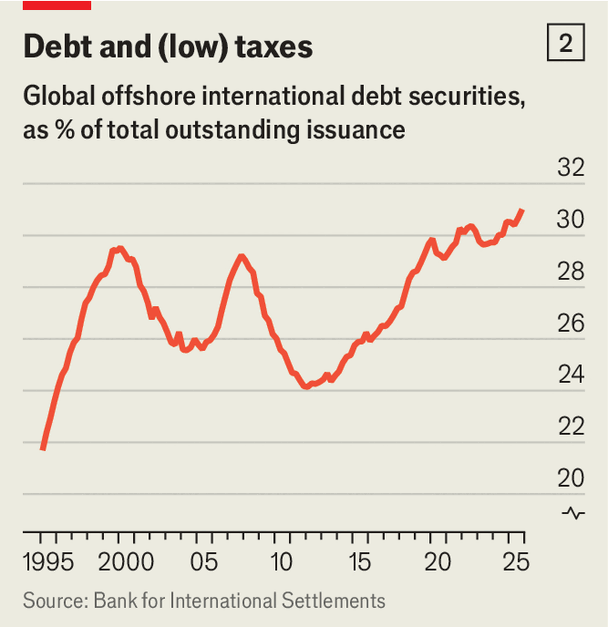
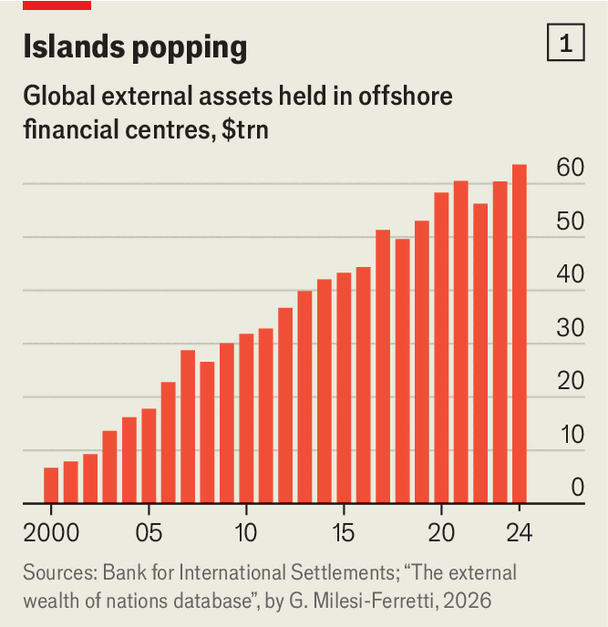
In the years since, it is Mr Sarkozy who has been ostracised after a brief spell(一段时间) in prison for election-finance misdeeds. Offshore financial hubs, by contrast, are on some measures more popular than ever. Between 2010 and 2024 companies’ total offshore assets grew half as fast again as(比……快一半) world GDP, more than doubling in nominal terms to $64trn (see chart 1). By the end of last year 31% of the total outstanding stock of international corporate bonds, which firms use to raise debt outside their home countries, had been issued in offshore centres—a record, and up from a post-financial-crisis trough(低谷,低点) of 24% in 2010 (see chart 2).
此后的数年里,反倒是萨科齐先生因选举财务不当行为入狱短刑后遭到排斥。相比之下,离岸金融中心在某些衡量标准下比以往更受欢迎。2010年至2024年间,公司的离岸资产总额增速比全球GDP增速快一半,名义价值翻了一番多,达到64万亿美元(见图1)。截至去年底,国际公司债券(企业用于在本国以外筹集债务)的未偿总额中,有31%在离岸中心发行——创下纪录,且高于2010年金融危机后24%的低谷(见图2)。
A big reason for the recent growth is that, as Jason Sharman of the University of Cambridge observes: “Secrecy was less important than people thought it was.” So were lax regulations(宽松的监管). Andrew Morriss of Texas A&M University, another scholar of offshore finance, explains that being small and nimble, havens are in some areas simply better regulated. This makes them a magnet especially for fast-growing parts of finance such as reinsurance, private-credit funds and emerging-market wealth. It also gives them an incentive to stay off rich-world regulators’ naughty lists(黑名单,不良名单).
近期增长的一个重要原因是,正如剑桥大学的杰森·沙曼所言:“保密性并没有人们想象得那么重要。”宽松的监管也是如此。另一位离岸金融学者、德克萨斯农工大学的安德鲁·莫里斯解释说,由于规模小且灵活,天堂岛在某些领域反而监管得更好。这使它们成为再保险、私募信贷基金和新兴市场财富等快速增长金融领域的磁石。这也激励它们远离富裕国家监管机构的“黑名单”。