
AN IMPERTINENT SOUL once asked Paul Samuelson to name a social-scientific principle that was true but not trivial. The Nobel laureate’s answer was comparative advantage(比较优势), which explains why two countries can both benefit from trade even if one is better than the other at everything. That principle has sadly fallen out of fashion. So here is another one that is true, non-trivial and more germane(密切相关的) to this age: China would face fewer trade wars with the rest of the world if its people were less thrifty.
一个无礼的家伙曾让保罗·萨缪尔森说出一个真实但不平凡的社会科学原理。这位诺贝尔奖得主的回答是比较优势,它解释了两个国家即使一个在各方面都比另一个强,也能从贸易中互惠互利。遗憾的是,这个原理已经过时了。所以这里还有另一个真实、不平凡且更切合这个时代的原理:如果中国人不那么节俭,中国与世界其他地区的贸易战就会更少。
China angers its trading partners because it sells more goods than it buys, earning more than it spends. The underspenders(支出不足者) include its households, which save at an unusually high rate(以异常高的比率储蓄). China’s migrants are among the thriftiest. And there are a lot of them. The number of people who have left the countryside to work in cities was 131m at the end of 2025. (The broader “floating population(流动人口)”, which includes non-workers and urbanites living outside their home city, exceeds 357m.)
中国激怒其贸易伙伴是因为它卖出的商品多于买入的,赚得比花得多。支出不足者包括其家庭,这些家庭以异常高的比率储蓄。中国的农民工是其中最节俭的群体之一。而且他们人数众多。截至2025年底,离开农村到城市工作的人数为1.31亿。(更广泛的“流动人口”,包括非就业者和离开户籍所在地的城市居民,超过3.57亿。)
The migrants’ thrift reflects insecurity. Though they live and work in bustling(繁忙的,熙熙攘攘的) cities, many remain registered in their villages of birth under the hukou system of internal passports. This creates what one author calls “invisible walls(隐形墙壁)” within cities. It makes it harder for new residents to gain full access to social insurance and public services where they live. Instead they save strenuously for a rainy day. In 2012-22 the saving rate of migrant households, living in cities with rural hukou, was 6.8 percentage points higher on average than similar households with urban hukou, according to a paper published last year by Yizhi Xu and colleagues at the IMF.
农民工的节俭反映了不安全感。尽管他们在繁华的城市生活和工作,但许多人仍根据内部护照性质的户籍制度登记在出生村庄。这造成了某位作者所说的城市中的“隐形墙壁”。它使得新居民更难在他们居住的地方获得社会保险和公共服务的全面享受。相反,他们拼命储蓄以备不时之需。根据徐以智(音)及其国际货币基金组织同事去年发表的一篇论文,2012-2022年间,居住在城市的农村户籍农民工家庭的储蓄率平均比类似的城市户籍家庭高出6.8个百分点。
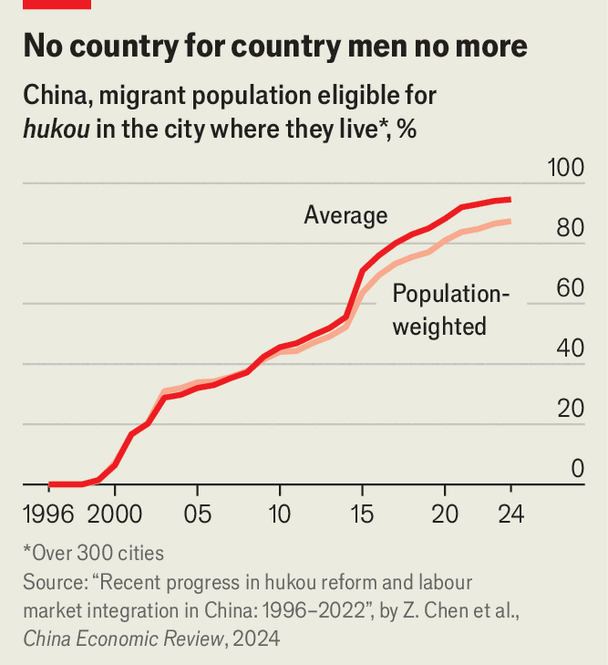
Slicker cities
更精明的城市