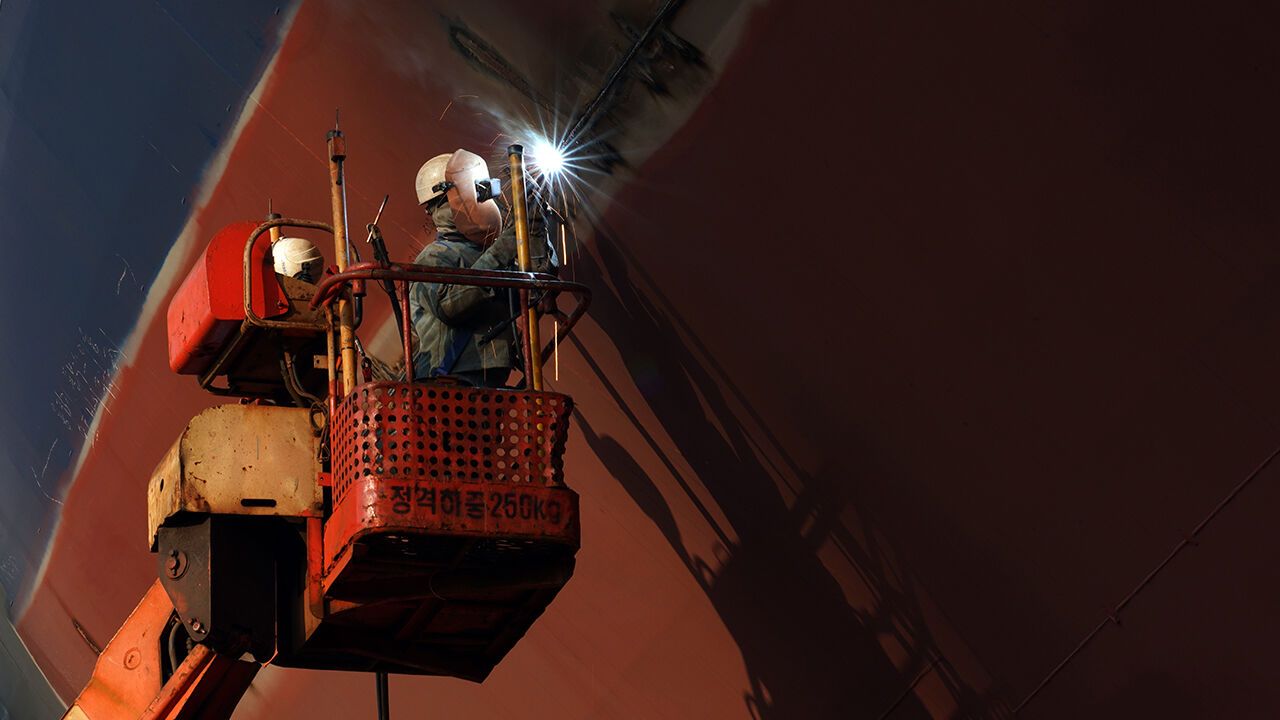
“THERE’S NO WORK back home,” says Wichit, a welder from Thailand.(“家乡没有工作,”来自泰国的焊工威奇特说。) In Ulsan, a city in south-eastern South Korea, he’s found plenty. He works for HD Hyundai Heavy Industries (HHI), a South Korean shipbuilder(造船企业;造船工人). Migrants such as Wichit are helping companies like HHI fulfil a boom in orders(完成订单激增) from foreign buyers for liquefied-natural-gas carriers and fuel-efficient container ships. Now their presence(存在,在场) is making waves(引起轰动;制造麻烦).
“在家乡没有工作,”来自泰国的焊工威奇特说。在韩国东南部的蔚山市,他找到了很多工作。他为韩国造船企业HD现代重工(HHI)工作。像威奇特这样的移民正在帮助HHI等公司完成来自外国买家的大量订单,这些订单涉及液化天然气运输船和节能集装箱船。如今,他们的存在正在引起波澜。
In 2025 South Korean shipbuilders took 21% of all global orders, the largest share(份额) after China, according to Clarksons, a British maritime-research firm. The government has recently offered to share the country’s know-how(专有技术,诀窍) to help Donald Trump “Make American Shipbuilding Great Again(让美国造船业再次伟大,模仿特朗普竞选口号)”. Last year it pledged(承诺(动词)) to invest $150bn in shipbuilding projects in America as part of its effort to wriggle out of tariffs(摆脱关税).
根据英国海事研究公司克拉克森的数据,2025年韩国造船商拿下了全球订单的21%,仅次于中国,位居第二。韩国政府最近提出分享该国技术,以帮助唐纳德·特朗普“让美国造船业再次伟大”。去年,韩国承诺在美国投资1500亿美元用于造船项目,作为摆脱关税努力的一部分。
Yet the yards face a big staffing(人员配备,员工配置) problem. South Korea’s population is one of the world’s fastest-ageing. Many of the workers who powered(推动,驱动) the industry through a previous boom in the 2000s have retired or moved into management. Young South Koreans see shipbuilding as dangerous, laborious and low-paying: the fatality rate(死亡率) at shipyards is four times higher than in the average industrial workplace. So they have left shipbuilding regions in droves(成群结队地). In Ulsan only 24% of adults are under the age of 40. That has decreased by six percentage points in a decade.
然而,船厂面临着严重的人员配备问题。韩国是世界上人口老龄化最快的国家之一。许多在2000年代上一次繁荣中推动行业发展的工人已经退休或进入管理层。年轻的韩国人认为造船业危险、费力且收入低:船厂的死亡率是普通工业场所的四倍。因此,他们成群结队地离开了造船地区。在蔚山,只有24%的成年人年龄在40岁以下。这一比例在十年间下降了6个百分点。