IN THE SPRAWLING slum in Delhi where Parul Gayen lived in the 1970s, children were everywhere. It was not unusual then that her mother had been one of six, or her grandfather one of 11. Swapan, the handsome boy whom she often saw cycling to work, and later married at 16, had six siblings—the seventh did not survive infancy(活过婴儿期). But times have changed, says Ms Gayen, who is now 58 and lives with Swapan in a one-bedroom flat nearby. Of the couple’s three grown-up kids, only two decided to have children of their own. Both stopped at one. “One child feels lonely,” she says.
在德里一个庞大的贫民窟里,帕鲁尔·盖恩(Parul Gayen)20世纪70年代居住在那里,到处都是孩子。那时,她的母亲是六个孩子之一,她的祖父是11个孩子之一,这并不罕见。斯瓦潘(Swapan)是她经常看到骑车上班的英俊男孩,后来她在16岁嫁给了他,他有六个兄弟姐妹——第七个没有活过婴儿期。但时代变了,现年58岁的盖恩女士说,她和斯瓦潘住在附近一套一居室的公寓里。这对夫妇的三个成年子女中,只有两个决定要自己的孩子。两人都只生了一个。“一个孩子觉得孤独,”她说。
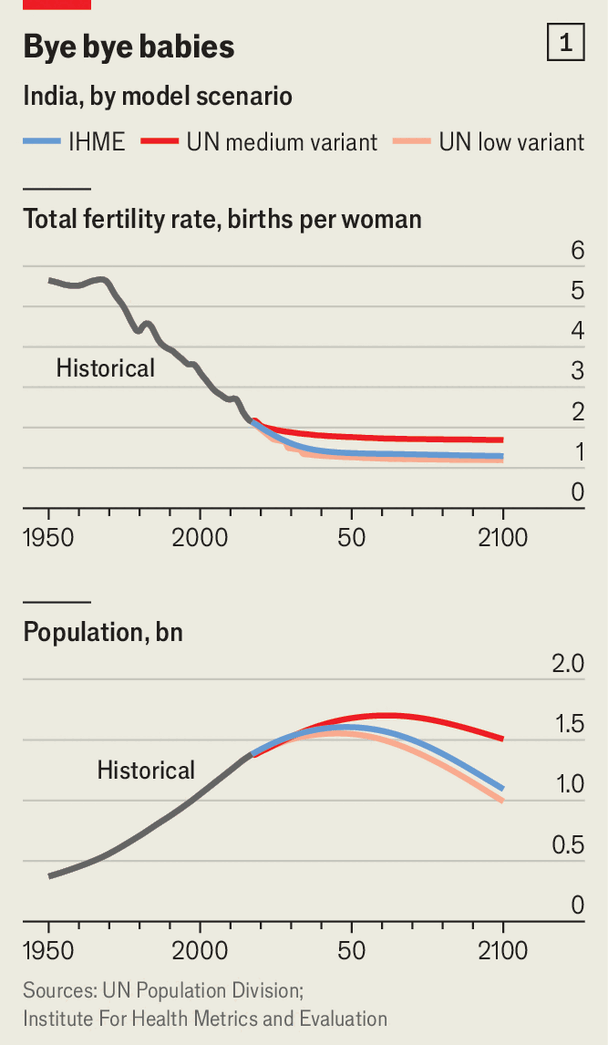
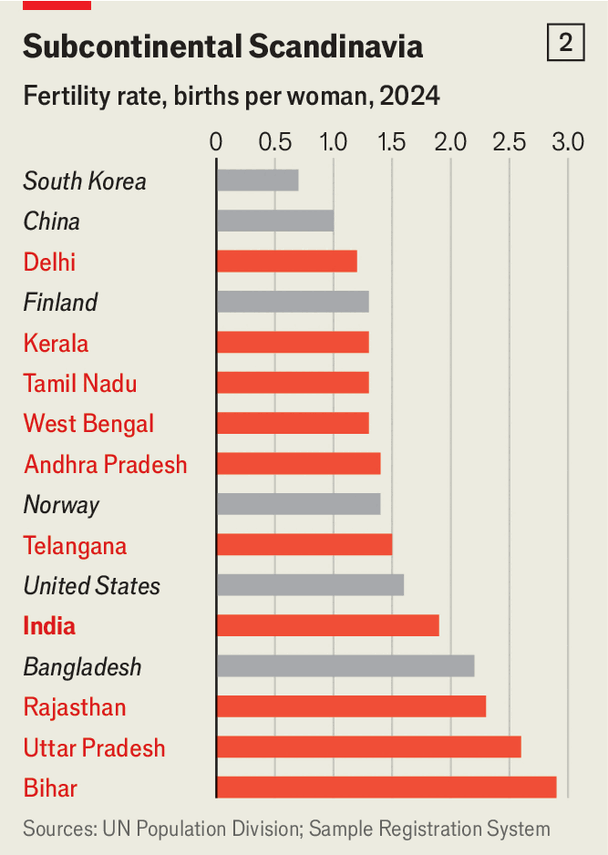
In 1950 India’s population was 360m. The average woman had six children—roughly the same as an American woman a century earlier. Today, with a population of 1.45bn, India accounts for a sixth of humanity. It surpassed China as the world’s most populous country in 2023 and has kept growing. But its total fertility rate (TFR)(总和生育率), the number of births a typical woman has over her lifetime, has fallen to 1.9 (see chart 1), below the level needed to keep the population stable in the long run. Although the population will keep growing for a spell(一段时间), as the generation that are currently children themselves become parents, a future contraction is inevitable unless the fertility rate rises back above 2.15. In practice, it is likely to keep falling, accelerating the impending shrinkage(即将到来的收缩). In Delhi, for instance, the TFR is 1.2.
1950年,印度人口为3.6亿。平均每个妇女生育六个孩子——大致相当于一个世纪前美国妇女的水平。如今,印度人口达14.5亿,占人类的六分之一。2023年它超越中国成为世界人口最多的国家,并且还在增长。但其总和生育率(TFR),即一名典型妇女一生中生育的数量,已降至1.9(见图表1),低于长期维持人口稳定所需的水平。随着目前还是孩子的这一代人成为父母,人口将继续增长一段时间,但未来收缩不可避免,除非生育率回升至2.15以上。实际上,它很可能继续下降,加速即将到来的缩减。例如,在德里,TFR为1.2。
Baby blues
少子忧郁
The rich world and many middle-income countries are awash with anxiety(充满焦虑) about declining fertility, shrinking workforces and impending or intensifying falls in population. Politicians often badger(纠缠,唠叨) or bribe parents to have more children, with little success. Now India, once a source of angst(焦虑,担忧) about exponential population growth, is joining the same club(加入同一行列). New school textbooks, to be published this summer, will warn of the perils of too few, rather than too many, children. In May Chandrababu Naidu, the chief minister of Andhra Pradesh, a southern state of about 55m, announced a 30,000 rupee ($315) payout for couples who have a third child.
富裕世界和许多中等收入国家普遍对生育率下降、劳动力萎缩以及即将到来或加剧的人口下降感到焦虑。政治家们经常唠叨或贿赂父母多生孩子,但收效甚微。如今,曾经对人口指数增长感到担忧的印度也加入了同一俱乐部。今年夏天即将出版的新教科书将警告孩子太少而不是太多的危险。今年5月,安得拉邦(南部邦,人口约5500万)首席部长钱德拉巴布·奈杜宣布,对生第三个孩子的夫妇奖励3万卢比(315美元)。
Trad wives, not trad mothers
传统妻子,非传统母亲
Pink aye
粉色认同