MORE THAN 500 children attend St Joseph’s College, a private school in Reading that prides itself on(以…为自豪) providing the “best value” education in its area. In mid-May it announced that, unless it can find a big cash injection(资金注入), it will close in July. The school has blamed years of rising costs—worsened by the Labour government’s decision to make private schools start paying full business rates and to levy(征收(税、费)) value-added tax on their fees. Martyn Cook is among hundreds of parents now racing to find new schools for their children; having spent 20 years as an army officer, he has experience getting out of scrapes(困境;麻烦). “But when you have a problem and your kids are upset, emotionally it’s very hard.”
超过500名儿童就读于雷丁的私立学校圣约瑟夫学院,该校以提供该地区“最具价值”的教育而自豪。五月中旬,校方宣布除非能获得大笔现金注入,否则将于七月关闭。学校将原因归咎于多年来的成本上升——工党政府决定让私立学校开始支付全额商业税,并对其学费征收增值税,加剧了这一问题。马丁·库克是数百名正忙于为孩子寻找新学校的家长之一;他曾在军队服役20年,有摆脱困境的经验。“但当你遇到问题,孩子又难过时,情感上真的很难。”
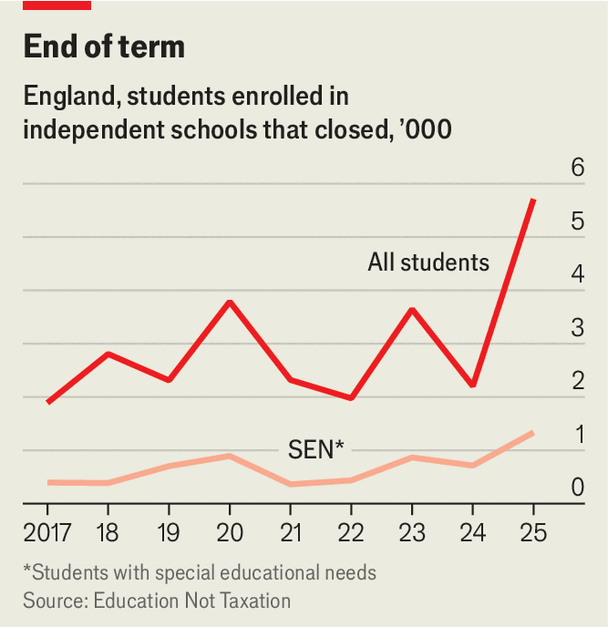
Eighteen months on from Labour’s reforms, many private schools are finding things hard. Government data released on June 4th showed pupil numbers in mainstream independent schools in England are down by 5% (about 27,000 pupils) this year. That follows a 2.8% fall in 2024-25, the first year after Labour came to power. The declines have come mainly from fewer children joining private schools, rather than from an exodus(大批离去;外流) of existing pupils. They have been most pronounced(明显的;显著的) outside London—perhaps because it is in poorer regions that parents have been stretching furthest(竭尽全力(支付)) to pay for private lessons.
工党改革实施18个月后,许多私立学校举步维艰。6月4日发布的政府数据显示,今年英格兰主流独立学校的学生人数下降了5%(约2.7万人)。此前在2024-25学年(工党执政第一年)已下降2.8%。这些下降主要源于进入私立学校的孩子减少,而非现有学生大量外流。伦敦以外地区的情况最为明显——可能是因为在较贫困地区,家长们一直在竭尽全力支付私立教育费用。
Exactly how far these declines have been driven by Labour’s policies is open to question(存疑;有争议). Some of it is doubtless because the total number of school-age children in Britain is dropping (by around 1.2% in England last year). And well before Labour arrived in government, rising living costs were forcing many parents to think hard about their outgoings. But even taking that into account, it seems the reforms are having a greater impact on enrolment than was predicted. Back in 2024 the government forecast that imposing VAT would leave the sector with 6% fewer pupils by the 2030s, compared with what would otherwise have happened. It may drive more shrinkage(缩减;收缩量) than that.
这些下降在多大程度上是由工党的政策驱动的,尚有疑问。毫无疑问,部分原因是英国学龄儿童总数在下降(去年英格兰下降约1.2%)。早在工党执政之前,生活成本上升就已迫使许多家长认真考虑开支。但即便考虑到这一点,改革对入学率的影响似乎仍大于预期。早在2024年,政府预测征收增值税将使该行业到2030年代学生人数比原本情况减少6%。实际缩减幅度可能更大。
The bottom line
关键问题