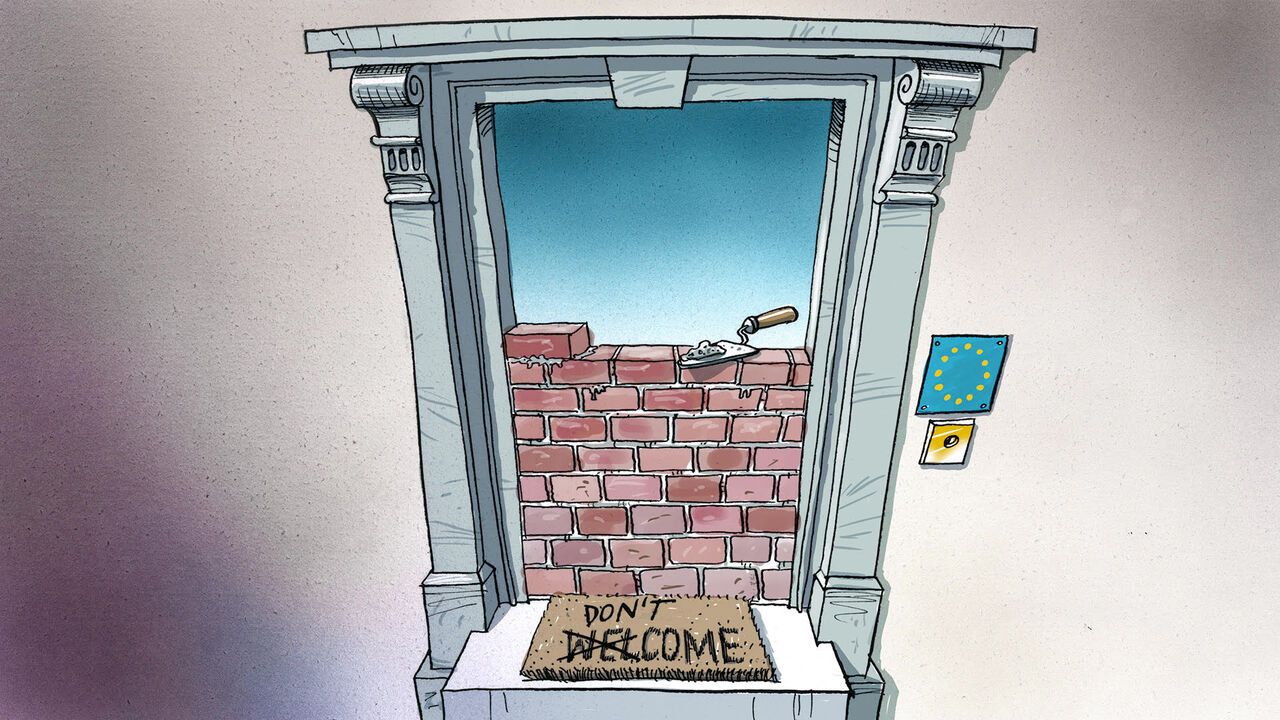
Given its oft-proclaimed calling as a peace project, the European Union can sound oddly bellicose(好战的) when it sets about crafting policy. There are trade and fiscal “bazookas” to blast away crises, “silver bullet(银弹;万能良方)” solutions for every problem, and “nuclear options” to be used as a last resort. Yet in the absence of an EU army or even a police force, the pen-wielding(执笔的;文职的) Eurocracy rarely gets its hands on anything that looks like an actual weapon. The only exception—tellingly—is the club’s border-patrol agency. For over a decade after it was founded in 2005, Frontex agents wielded little more than whistles and admonishments as they helped national authorities keep out migrants. These days they also carry Glock 9mm handguns, FBI-style. In a union built to make war unthinkable, the first supranational weapon was issued not for defence against armies, but for keeping unarmed people out.
鉴于欧盟常自诩为和平项目,当它制定政策时,却显得出奇地好战。有贸易和财政“巴祖卡”来轰走危机,有“银弹”解决每个问题,还有“核选项”作为最后手段。然而,在缺乏欧盟军队甚至警察力量的情况下,执笔的欧盟官僚很少能接触到任何像真正武器的东西。唯一例外——显然——是欧盟的边境巡逻机构。自2005年成立后的十多年里,Frontex特工在协助国家当局阻止移民时,几乎只使用口哨和警告。如今,他们携带格洛克9毫米手枪,如同FBI。在一个旨在让战争不可想象的联盟中,第一件超国家武器不是用于防御军队,而是用于阻止手无寸铁的人进入。
Whether because of the Glocks or, more likely, because of a slew of(大量的) new measures in recent years, irregular migration into the EU has markedly(显著地) declined of late. Illegal crossings spotted by Frontex are down by more than half over the past couple of years. Demands for asylum in EU countries have also fallen sharply. Though migration can ebb and flow according to unpredictable rhythms—a million-strong influx of Syrians and Afghans arrived in Europe in 2015 and 2016, years after strife in their respective countries had broken out—there is an odd sense of calm about the EU’s external frontier these days.(尽管移民可能随着不可预测的节奏而起伏——2015年和2016年,百万规模的叙利亚人和阿富汗人涌入欧洲,而这些国家的战乱早在几年前就已爆发——但最近欧盟的外部边境却有一种奇特的平静感。) On June 12th a “migration package” of measures originally conceived in the depths of the crisis a decade ago will come into force, tightening border controls and sending irregular migration down further. Perhaps, maybe, conceivably, Europe has cracked the problem of new unwanted arrivals onto its shores. Alas, the politically toxic issue of migrants already in Europe, who are often poorly integrated, remains. Europe can be said to have half-solved one half of its migration problem.
无论是由于格洛克手枪,还是更可能由于近年一系列新措施,非正常移民进入欧盟的数量近期显著下降。Frontex发现的非法越境行为在过去几年减少了一半以上。欧盟国家的庇护申请也大幅下降。尽管移民可能随着不可预测的节奏而起伏——2015年和2016年,百万规模的叙利亚人和阿富汗人涌入欧洲,而这些国家的战乱早在几年前就已爆发——但最近欧盟的外部边境却有一种奇特的平静感。6月12日,一项最初在十年前危机最深处构思的“移民一揽子”措施将生效,收紧边境管制,使非正常移民进一步下降。也许,可能,可以想象,欧洲已经破解了新移民不受欢迎地抵达其海岸的问题。唉,已经身在欧洲、往往融入不佳的移民这一政治上毒性的问题依然存在。可以说,欧洲解决了一半移民问题的一半。
Still, for the first time, a mood akin to optimism reigns among interior-ministry types. Illegal migration is the one issue that every EU leader knows can cost them their job if handled poorly. Officials in Brussels have thus worked up tangible ways to throttle unwanted arrivals. The most effective trick is to shower “transit” countries such as Tunisia and Egypt with cash if they prevent migrants from farther afield from travelling onwards to Europe. Such a deal with Turkey helped stem the crisis in 2016; it has since been expanded. The EU now works more closely with places from where migrants originate, even if that means talking to unsavoury(令人不快的;道德上可疑的) regimes such as the Taliban in Afghanistan.
然而,有史以来第一次,内政部门官员中弥漫着近乎乐观的情绪。非法移民是每个欧盟领导人都知道如果处理不当就会让他们丢掉饭碗的问题。因此,布鲁塞尔官员已经制定出具体措施来遏制不受欢迎的入境者。最有效的策略是向突尼斯和埃及等“中转”国家提供大量资金,前提是它们阻止来自更远地方的移民继续前往欧洲。2016年与土耳其达成的类似协议帮助遏制了危机;此后该协议得以扩大。欧盟现在与移民来源地合作更加紧密,即使这意味着要与诸如阿富汗塔利班等令人不快的政权对话。
Not now, huddled masses
不是现在,拥挤的群众