When European regulators were tweaking(微调,调整) the continent’s wholesale electricity markets some years ago, they added a price floor to short-circuit trading snafus(短路交易故障). At minus €500 ($580) per megawatt-hour (MWh), it was more of a price basement((价格)底部,基座). It was set so low in order to be triggered only in exceptional circumstances(特殊情况). May 1st, when bright sunshine and strong winds met low demand for electricity from Europeans enjoying a public holiday, may have seemed pretty ordinary. Yet the wholesale electricity price in Germany reached minus €499 per MWh. If this translated into retail prices, you would pocket((非正式)赚取,获得) €50 for charging your electric car.
几年前,当欧洲监管机构调整该地区的批发电力市场时,他们引入了价格下限以防范交易故障。该下限为每兆瓦时负500欧元(约580美元),更像是一个价格基座。设定如此之低,是为了只在特殊情况下才被触发。5月1日,明媚的阳光和强劲的风力遇上享受公共假日的欧洲人低电力需求,这看似相当平常。然而,德国批发电价却达到了每兆瓦时负499欧元。如果这一价格传导至零售,你给电动汽车充电还能赚50欧元。
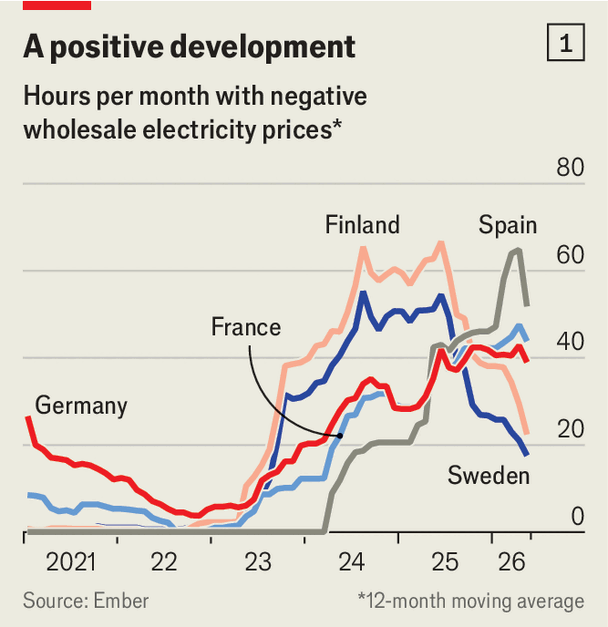
For economists, the number zero is not particularly special. If a price needs to be negative to clear a market(出清市场), so be it. Solar plants and wind farms produce power at near zero marginal cost(边际成本) when the sun is shining and wind blowing. But because that is not necessarily when people need power, and because it is costly to stop producing, they may need to pay someone to absorb the excess electricity(多余电力). As more renewables plugged into(接入(电网)) Europe’s grids in the past few years, the number of hours during which buyers in the wholesale market, such as utilities(公共事业公司) and heavy industry, were paid to take electricity started rising.
对于经济学家来说,数字零并非特别特殊。如果价格需要为负才能出清市场,那就接受吧。太阳能电站和风电场在阳光明媚和风吹时以接近零的边际成本发电。但由于这未必是人们需要电力的时候,而且停产成本高昂,它们可能需要付费让他人吸收多余电力。随着过去几年越来越多的可再生能源接入欧洲电网,批发市场买家(如公用事业和重工业)被付费接收电力的小时数开始上升。
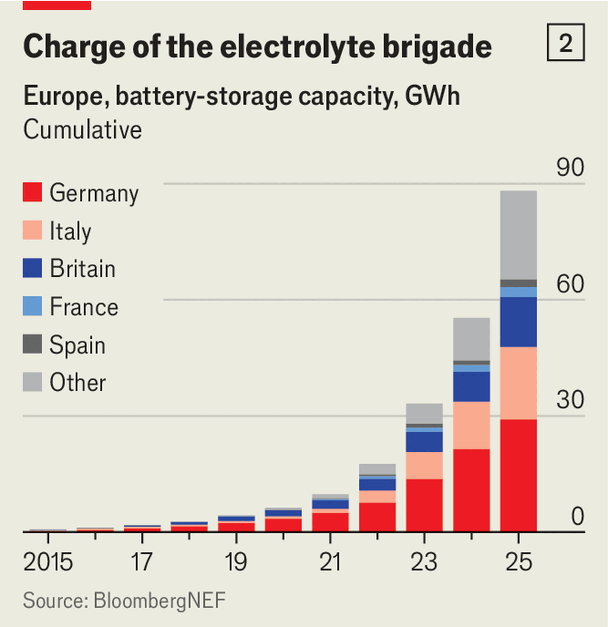
Obviously, negative prices offer a strong incentive(激励,动力) for anyone who can store electricity(储存电力) and then sell it for more than nothing when demand returns. In sunny California, where batteries are replacing fossil energy(化石能源) to cover the evening demand peaks after charging during the day, the number of hours with negative prices started to decline last year. Across much of Europe, May Day notwithstanding, it is beginning to plateau(达到平稳期) (see chart 1). The market, at last, is adapting(适应).
显然,负电价为任何能储存电力并在需求恢复时以高于零的价格出售的人提供了强大激励。在阳光明媚的加利福尼亚,电池正在取代化石能源,在白天充电后满足晚间需求高峰,那里的负电价小时数去年开始下降。在欧洲大部分地区,尽管有劳动节的影响,该数字正开始趋于平稳(见图1)。市场终于开始适应了。