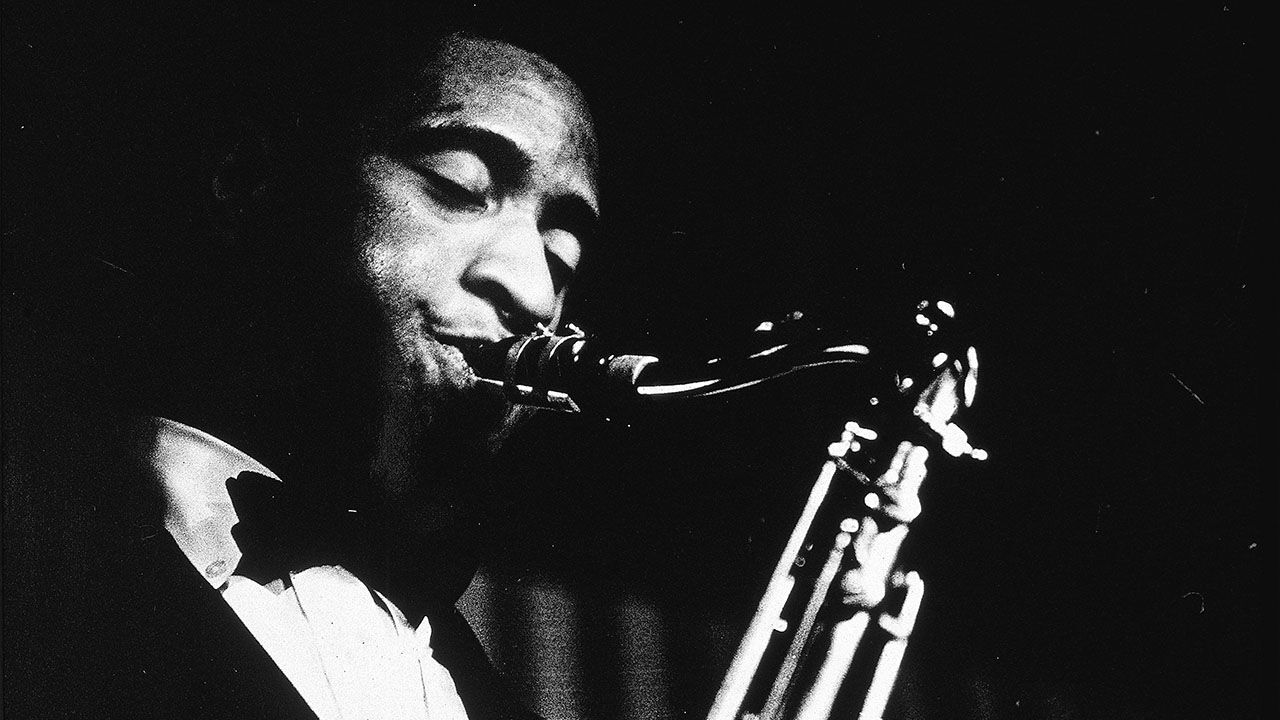
Though he lived a mere(仅仅,只有) two blocks away, Sonny Rollins hadn’t noticed those steps on Delancey Street before. One summer day in 1959, he climbed up. There, at the top, he found himself on the Williamsburg Bridge above New York’s East River. Subway cars and traffic were rattling(发出咔嗒声) over, hooting(鸣笛,发出汽笛声) boats passing underneath. All around him were pillars and abutments(桥台,桥墩) in which he could hide. Close above him was the open sky. Corny or not(无论俗气与否), it gave him a spiritual(精神的,心灵的) feeling to be there.
尽管他只住在两个街区之外,但桑尼·罗林斯以前从未注意到德兰西街上的那些台阶。1959年一个夏日,他爬了上去。在顶端,他发现自己置身于纽约东河之上的威廉斯堡桥。地铁车辆和交通从桥上隆隆驶过,汽笛鸣响的船只从桥下经过。他周围都是可以藏身的桥柱和桥台。离他不远处就是开阔的天空。无论俗气与否,那里给他一种精神上的感受。
This was the ideal place to practise his music, which was not just any music. His tenor saxophone, endlessly inventive, seamlessly melodic, percussive or romantic, was already famous. Since 1953 he had been cutting records(录制唱片) as the leader of small bands, but in 1956 came “Saxophone Colossus”, which put him in the same league as(与…同一级别) his heroes Charlie “Bird” Parker and John Coltrane. He kept that status for the rest of his career, which contained more than 60 albums and two Grammys. But however much he was applauded(受到鼓掌/赞扬), he was never satisfied with the way he played. Every so often(偶尔,时常) the voice that kept talking inside him would tell him to improve himself. Hence, later, his time in an ashram in India, and hence his daily sojourns(逗留,暂住) on the Williamsburg Bridge.
这是练习他的音乐的理想之地,而他的音乐绝非等闲。他的次中音萨克斯管,无尽创新、旋律无缝、兼具打击乐感或浪漫色彩,早已闻名。自1953年起,他就以小乐队领袖身份录制唱片,但1956年《萨克斯巨人》问世,使他与心目中的英雄查理·“鸟”·帕克和约翰·科尔特兰并驾齐驱。他在余下的职业生涯中保持了这一地位,共发行60多张专辑并获两项格莱美奖。但无论受到多少赞誉,他从不满意自己的演奏方式。内心的声音时常告诉他需要提高。因此后来他去印度修行,也因此每天在威廉斯堡桥上逗留。
They went on for two years. Sometimes he would play for 15 hours or more, coming down only for bathroom breaks or a cognac(干邑白兰地) at a bar he liked. In winter he played with gloves on. Some passers-by noticed his tall frame squeezed(挤,压入) among the steelwork(钢架结构), and all heard his music, but few spoke to him. That was fine, because the only company he needed was his horn, which he was pushing further and further. Somewhere, at the bottom of the ocean, maybe, or beyond the stars—way beyond Sonny Rollins as yet—there was an ultimate sound. He had no ideas about what it might be, but he would know it when he heard it, and perhaps twice a year onstage he might get a snatch of(一小段(声音等)) it. Instantly it would fulfil(使满足,实现) him, and he would know that, at last, he was playing well. But not til then(直到那时才).
这样持续了两年。有时他会演奏15个小时以上,只有去洗手间或去他喜欢的酒吧喝杯干邑时才停下。冬天他戴着手套演奏。一些路人注意到他高大的身躯挤在钢架之间,所有人都听到了他的音乐,但很少有人跟他说话。没关系,因为他需要的唯一伴侣就是他的号角,他正把它推向越来越远的地方。在某处——可能在海底,或者超越星辰——远远超出桑尼·罗林斯当时的水平——存在着一种终极声音。他不清楚那可能是什么,但一旦听到就会知道,也许每年在舞台上有两次他能捕捉到一丝。那一瞬间他会感到满足,他会知道,他终于演奏得好了。但仅此而已。