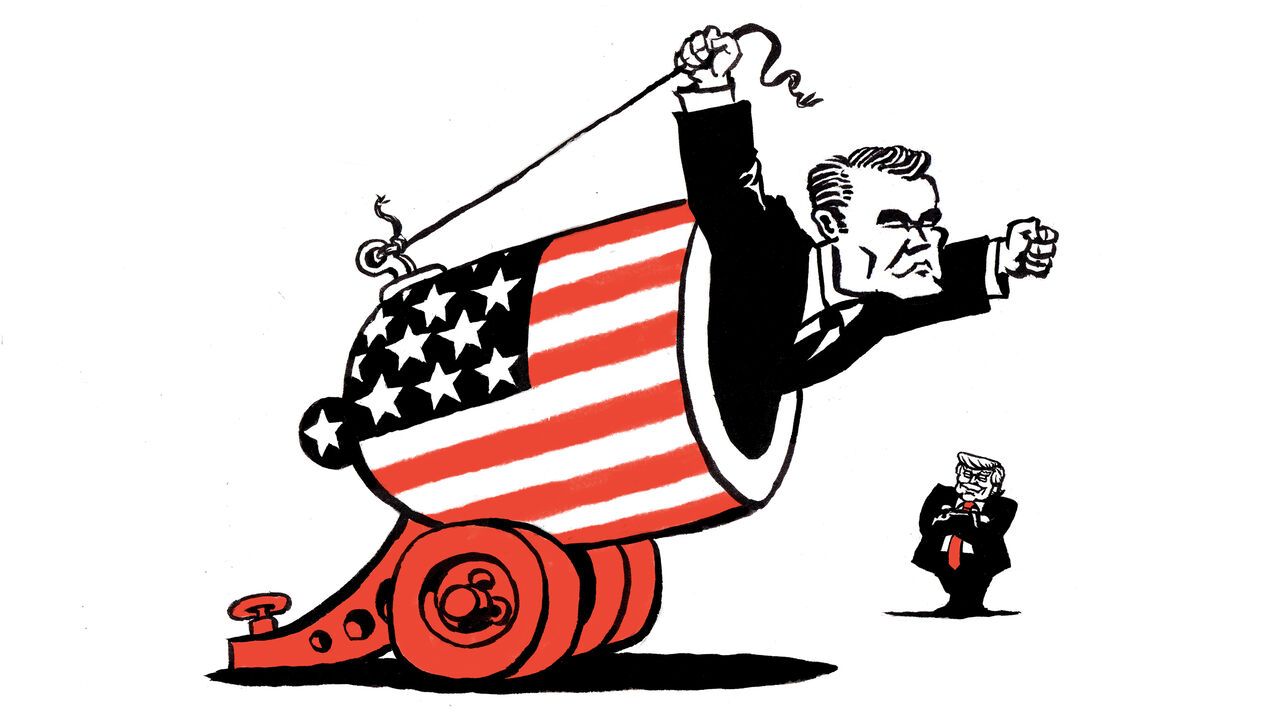
Of all the jokes President Donald Trump has told at his aides’ expense, none has been more demeaning(贬低的,有辱人格的) than his remark in late May about his civilian leader(文职领导人) of the armed forces, Pete Hegseth. “He loves war,” Mr Trump said during a cabinet meeting, grinning as he patted Mr Hegseth on the arm. Mr Hegseth, fawning(奉承的,讨好地), chortled(咯咯地笑,开心地笑) along. If Mr Hegseth meant what he has often said about America’s need to restore its warrior ethos(战士精神,尚武精神), he should have winced(畏缩,皱眉,躲避) instead. In the code of America’s greatest generals, hatred of war has been as foundational as grim awareness(严肃的意识,清醒认识) of the necessity to prepare for it.
唐纳德·特朗普总统开过的所有拿助手们取笑的玩笑中,没有哪个比他在5月底关于他的军队文职领导人皮特·赫格塞思的言论更贬低了。“他热爱战争,”特朗普在内阁会议上说,咧嘴笑着拍了拍赫格塞思的手臂。赫格塞思阿谀奉承地跟着咯咯笑。如果赫格塞思对他经常所说的美国需要恢复战士精神的话是认真的,他本该畏缩才对。在美国最伟大将领的信条中,厌恶战争和对备战必要性的严肃认识一样,都是基石。
“War is mankind’s most tragic and stupid folly(愚蠢,蠢事),” General Dwight Eisenhower told the graduating class of the United States Military Academy at West Point in 1947. Fifteen years later, General Douglas MacArthur, no one’s idea of a pacifist(和平主义者), cautioned the cadets against becoming warmongers(好战分子,战争贩子). “On the contrary,” he said, “the soldier above all other people(比所有其他人都更) prays for peace.”
“战争是人类最悲惨最愚蠢的愚蠢行为,”德怀特·艾森豪威尔将军在1947年对西点军校毕业班说。十五年后,道格拉斯·麦克阿瑟将军——没人认为他是和平主义者——告诫学员们不要成为好战分子。“恰恰相反,”他说,“军人比任何人都更祈求和平。”
Mr Trump may just have been teasing Mr Hegseth, as he had before, for his early advocacy of a war with Iran that is stuck in a costly stalemate(僵局,对峙). Yet with his knack for naming discomfiting truths(有指出令人不安的事实的本事), the president put his finger on(准确地指出,察觉) an unsettling quality in his “secretary of war”, the title that he and Mr Hegseth prefer. Where past military leaders treated violence as a tragic necessity, Mr Hegseth celebrates it as righteous and even thrilling(令人兴奋的,激动人心的). His favourite word—it does sound pretty cool—is “lethality(杀伤力,致死性)”. When he got his own chance to address West Point cadets, at their commencement on May 23rd, he deployed the word five times, not counting two mobilisations of “lethal”. By contrast, “peace” clouded his vision of ferocity only once, thus: “You feel comfortable inside the violence,” he instructed the cadets, “so that our fellow citizens can live peacefully. Lethality is your calling card(名片,标志性特征).”
特朗普可能只是在取笑赫格塞思,像以前一样,因为他早期鼓吹一场陷入昂贵僵局的伊朗战争。然而,凭借他点出令人不安的事实的本领,总统精准地指出了他的“战争部长”——他和赫格塞思更喜欢这个头衔——身上令人不安的特质。过去的军事领导人将暴力视为悲剧性的必要,而赫格塞思则将其美化为正义甚至令人兴奋。他最喜欢的词——听起来确实很酷——是“杀伤力”。当他有机会在5月23日的西点军校毕业典礼上演讲时,他使用了这个词五次,还不算两次“致命”的动员。相比之下,“和平”只在他的凶暴景象中出现了一次,是这样的:“你对暴力感到自在,”他指导学员们说,“这样我们的同胞才能和平地生活。杀伤力就是你的名片。”
The old-boys preference
老男孩偏好(任人唯亲)