While TYPING away at a WeWork in San Francisco recently, your correspondent spied a plane flying across the skyline trail(拖着,跟随)ing a banner. "SAAS IS DEAD", it declared in huge letters. The software developers with whom he was sharing the co-working space also noticed. "Thanks for reminding us," one groan(呻吟,抱怨)ed.
最近,本刊记者在旧金山一家WeWork里打字时,看到一架飞机拖着横幅飞过天际线,上面用大字写着“SAAS IS DEAD”。同处联合办公空间的软件开发人员也注意到了。其中一人呻吟道:“谢谢提醒。”
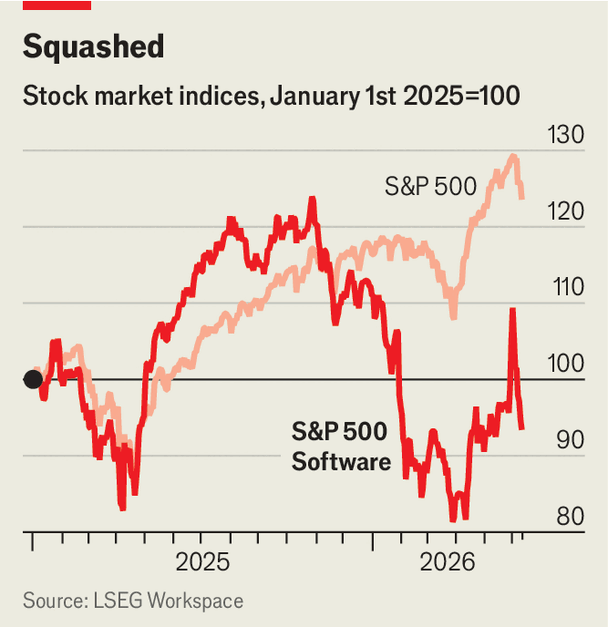
The stunt(噱头,特技), paid for by an artificial-intelligence startup, reflects the increasingly widespread belief in techland that AI presents an existential(存在的,生死攸关的) threat to the Software-as-a-Service (SaaS) industry, which only a few years ago looked unstoppable. Since the brutal sell-off(惨烈的抛售) in their stock in February, its bosses have been desperately trying to persuade investors that fears of a so-called "SaaSpocalypse" are wildly exaggerate(夸大,夸张)d. Over the past month or so the share prices of listed American software companies have, on the whole, begun to recover some lost ground(失去的阵地,损失) (see chart). Yet many investors remain cautious.
这场闹剧由一家人工智能初创公司出资,反映了科技界日益普遍的看法:AI对软件即服务(SaaS)行业构成了生存威胁,而就在几年前,该行业还看似不可阻挡。自2月份其股票惨遭抛售以来,SaaS公司老板们一直在拼命说服投资者,称所谓的“SaaSpocalypse”担忧被严重夸大。过去一个月左右,已上市的美国软件公司股价总体上已开始收复部分失地(见图表)。但许多投资者仍持谨慎态度。
Their worries are unlikely to dissipate(消散,消失) soon, as AI agents that can operate other computer programs become cleverer and more capable. It doesn’t help that the threat to SaaS incumbent(现任者,现有企业)s is coming from four directions: large AI labs; AI-native startups; DIY software development; and the industry’s own disruptive efforts to reinvent itself. Call them the four SaaSquatches(SaaS大脚怪(戏称)) of the apocalypse.
他们的担忧不太可能很快消散,因为能够操作其他计算机程序的AI代理正变得越来越聪明、越来越能干。更糟的是,对SaaS现有企业的威胁来自四个方向:大型AI实验室、AI原生初创企业、DIY软件开发,以及该行业自身的颠覆性重塑努力。不妨称它们为天启四SaaSquatch。