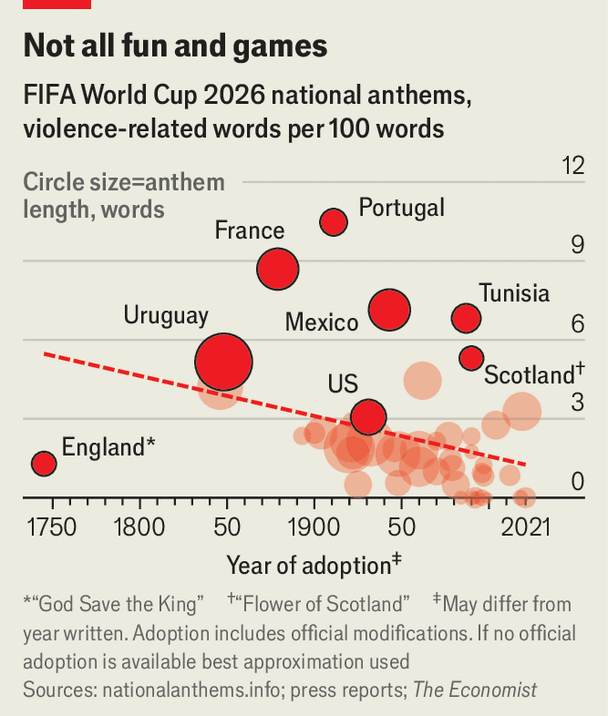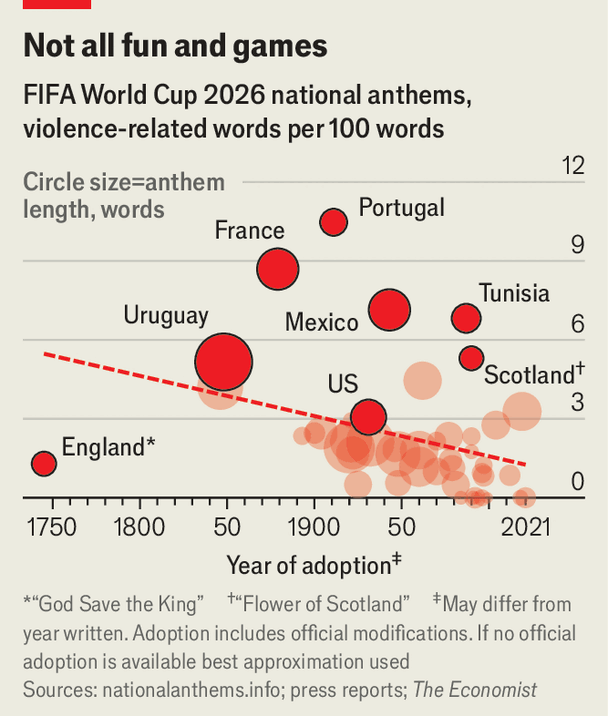
National anthems are among the world’s most recognisable(可识别的) and widely performed political texts. Many were written to rally troops(集结军队), celebrate victory in war or unite new states. Today these battle cries(战斗口号) are most often heard at sporting events. Before each match at the World Cup, teams will sing songs of the conflicts that once divided them.
国歌是世界上最易识别且广泛传播的政治文本之一。许多国歌最初是为了集结军队、庆祝战争胜利或团结新国家而写。如今,这些战斗口号最常见于体育赛事。在世界杯的每场比赛前,球队都会唱起那些曾分裂他们的冲突之歌。
Forty-eight countries will compete in the group stages(小组赛阶段) this year, up from 32. Which ones will appear most often as enemies in the tournament’s national anthems? To find out, The Economist used AI tools to analyse the translated lyrics of every competing country’s song. To start, we ranked villains(反派、坏蛋) according to where there were explicit mentions(明确提及) of countries, specific battles, historical figures and symbols. Anthems with no official lyrics, such as Spain’s and Bosnia and Herzegovina’s, were excluded from the analysis.
今年将有48个国家参加小组赛,高于此前的32个。哪些国家会在赛事国歌中最常作为敌人出现?为了找出答案,《经济学人》使用AI工具分析了每个参赛国国歌的翻译歌词。首先,我们根据是否明确提及国家、具体战役、历史人物和象征来对“反派”进行排名。没有官方歌词的国歌(如西班牙和波黑国歌)则被排除在分析之外。
Spain is the most hated country in our textual analysis, appearing in three national anthems. Perhaps this is because Spain’s former colonies and territories were more likely than Britain’s to gain independence through revolutionary wars. Ecuador’s anthem recalls how “the toppled(被推倒的) lion could be heard, as it roared in impotence(无力、无能) and despair.” The Dutch—hardly strangers to(对...并不陌生) empires themselves—are less subtle: “The Spaniards rape thee, my Netherlands so sweet.” (We analysed the full official lyrics, including verses rarely sung at matches.)
西班牙在我们的文本分析中是最令人憎恨的国家,出现在三首国歌中。或许这是因为西班牙的前殖民地和领土比英国更可能通过革命战争获得独立。厄瓜多尔国歌回忆说:“可以听到被推倒的狮子,它在无助和绝望中咆哮。”荷兰人——他们自己也不是殖民帝国的新手——则没那么含蓄:“西班牙人强奸你,我甜蜜的尼德兰。”(我们分析了完整的官方歌词,包括比赛中很少唱的段落。)