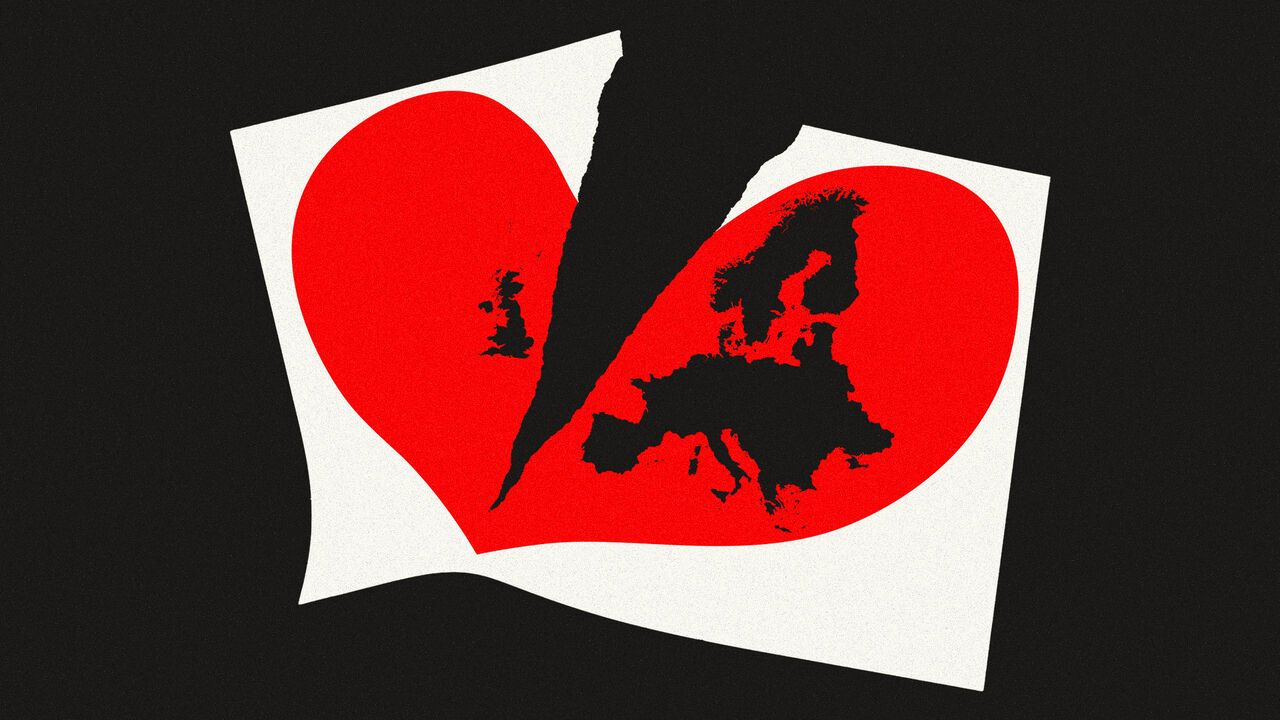
At the time of the Brexit referendum in June 2016, many predicted that in the next decade the European Union would either fall apart or march briskly towards(大步迈向) ever-closer union(日益紧密的联盟). Which one depended on who was talking. Right-wing populists, including those in Britain’s Leave campaign, forecast that the first country to leave the bloc would trigger a domino effect(多米诺骨牌效应) of others yearning to break free(渴望摆脱束缚). Europhiles, for their part, spotted an opportunity: with the non-continental stick-in-the-mud(顽固保守的人) gone, a more cohesive EU could be forged. Both sides agreed that English, the tongue of l’Albion perfide, would lose its grip over Brussels.
2016年6月英国脱欧公投时,许多人预测未来十年欧盟要么分崩离析,要么大步迈向更紧密的联盟。哪种结果取决于说话者。右翼民粹主义者(包括英国脱欧阵营)预测,第一个离开欧盟的国家将引发其他渴望脱离的国家产生多米诺骨牌效应。而亲欧派则看到了机会:随着非欧洲大陆的顽固分子离开,一个更团结的欧盟将得以形成。双方都认为,英语——‘背信弃义的阿尔比昂’的语言——将失去对布鲁塞尔的掌控。
As of 2026, neither scenario has panned out(实现,结果证明)—though the federalist version is closer to the mark(更接近目标). No other country has come close to leaving the EU. That is unsurprising, given how the years-long negotiations over the modalities of exiting the bloc upended(颠覆,打乱) British politics. Meanwhile, the union has deepened a bit. The absence of a big liberal brake on French statist(国家主义的) schemes has nudged it towards more integration, at least in places. In many ways the EU has remained the same. English is even more of a lingua franca(通用语) in Brussels than it was in 2016.
截至2026年,两种情景都未实现——尽管联邦主义版本更接近现实。没有其他国家接近离开欧盟。这并不奇怪,考虑到关于退出方式的多年谈判如何颠覆了英国政治。与此同时,联盟略有深化。缺少一个对法国国家主义计划施加巨大自由刹车的力量,推动它朝着更一体化前进,至少在某些方面。在许多方面,欧盟保持不变。英语在布鲁塞尔甚至比2016年更像通用语。
Still, there are three big differences between today’s EU and that of a decade ago. The most notable evolution is fiscal(财政的). In July 2020, just six months after Britain formally departed, the EU’s remaining 27 members agreed on an €800bn ($928bn) covid recovery fund. Not only did this mark a large expansion of the bloc’s budget, which normally amounts to(总计,相当于) 1% or so of GDP. It was also the first instance of spending paid for through issuance by the EU of bonds in its own name, a federalising act of a sort Britain would surely have derailed had it been in on the negotiations(一种联邦化行为,如果英国还在谈判中,肯定会被它破坏。).
尽管如此,今天的欧盟与十年前有三个重大差异。最显著的演变是财政方面的。2020年7月,就在英国正式脱离仅六个月后,欧盟剩下的27个成员国同意了一项8000亿欧元(9280亿美元)的新冠复苏基金。这不仅标志着欧盟预算的大幅扩张(通常只占GDP的1%左右),也是第一次以欧盟自身名义发行债券来支付支出,这是一种联邦化行为,如果英国当时还在谈判桌上,肯定会被它破坏。