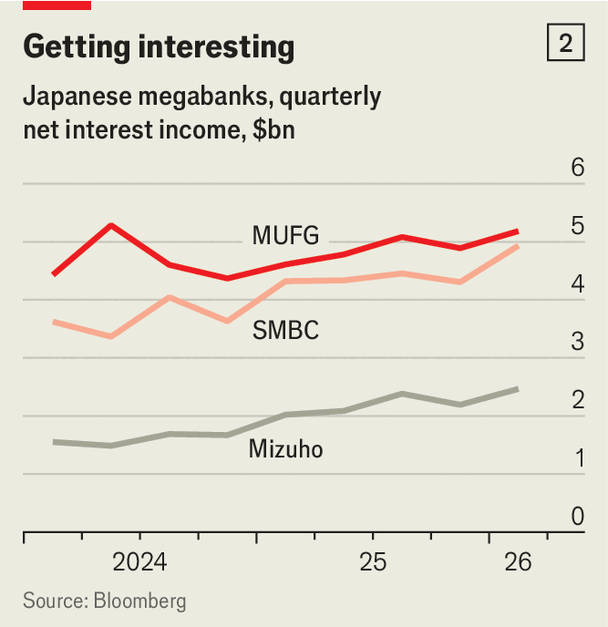
FOR nearly 31 years, as Japan struggled with low growth and bouts of deflation(间歇性通缩), its benchmark interest rate began with a zero, sometimes with a minus in front of it. So the decision by the Bank of Japan (BoJ) on June 16th to raise it from 0.75% to 1% carried symbolic weight(象征性意义). Few Japanese businesses are happier to see the back of zero than banks, whose balance-sheets are reviving after three decades of punishing strain.(几乎没有日本企业比银行更欢迎零利率的终结,它们的资产负债表在经历了三十年的残酷压力后正在复苏。) Since the BoJ started raising rates in March 2024 the index of Japanese bank shares has more than doubled, far outpacing the broader stock market (see chart 1).
近31年来,日本在低增长和间歇性通缩中挣扎,其基准利率以零开头,有时前面还有负号。因此,日本央行于6月16日决定将利率从0.75%上调至1%具有象征意义。几乎没有日本企业比银行更欢迎零利率的终结,它们的资产负债表在经历了三十年的残酷压力后正在复苏。自2024年3月日本央行开始加息以来,日本银行股指数已翻了一番多,远远跑赢整体股市(见图表1)。
Banks borrow money from depositors at short-term rates (set by the BoJ) and lend to borrowers at long-term ones (determined by the bond market). In a zero-rate world they could pay depositors next to nothing(几乎为零) but eked out little more from reluctant borrowers. “Net interest margins”, which reflect the difference between interest income and interest expenses, languish(低迷不振)ed. So did banks’ profits.(银行的利润也同样如此。)
银行以短期利率(由日本央行设定)从储户处借钱,然后以长期利率(由债券市场决定)贷给借款人。在零利率世界里,它们几乎不用付给储户利息,但也只能从勉强借贷的借款人身上挤出微薄利润。反映利息收入与利息支出差额的“净息差”低迷不振,银行的利润也同样如此。
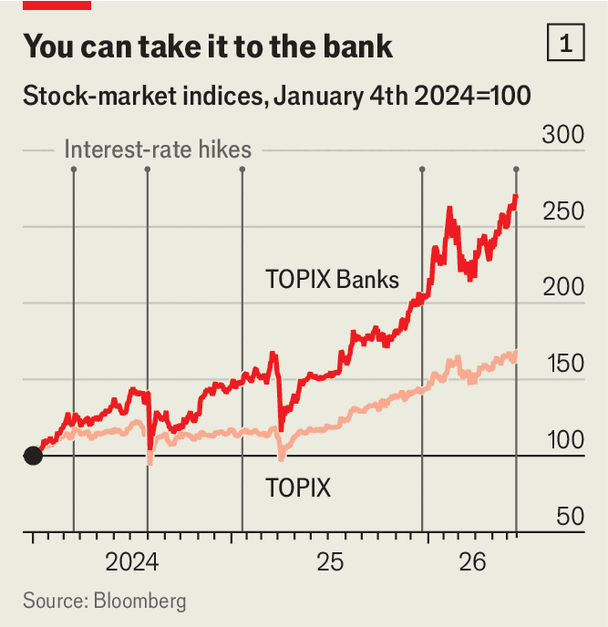
Today the gap between short-term and long-term rates is up from near zero to 1.6 percentage points(百分点). That should be great news for lenders. And it is—if they are big(只要它们规模够大). Net interest income at Japan’s three mega-banks(巨型银行)—MUFG, SMBC and Mizuho—has increased by a third on average since 2024 (see chart 2). They expect record profits this year. Small banks, though, continue to struggle. And their balance-sheets may be storing up trouble(积累麻烦) for the banking system as a whole.
如今,短期利率与长期利率之间的差距从接近零上升到了1.6个百分点。这对贷款机构来说应该是个好消息。确实如此——只要它们规模够大。日本三大巨型银行——三菱UFJ、三井住友和瑞穗——的净利息收入自2024年以来平均增长了三分之一(见图表2)。它们预计今年将实现创纪录的利润。然而,小型银行仍在挣扎。它们的资产负债表可能正在为整个银行体系埋下隐患。