
PAKISTAN IS TYPICALLY viewed more as a source of geopolitical problems than as a salve(药膏;慰藉) to them. Yet over the past few months it has done more than just about any other country to bring about an end to the war between America and Iran. And it is not the only unlikely peacebroker(和平斡旋者) to have interceded(调解,说情) in recent conflicts. In just the past five years Turkey has mediated between Russia and Ukraine, Ethiopia and Somalia, and Pakistan and Afghanistan. China is also trying to reconcile Afghanistan and Pakistan. Qatar has served as a go-between(中间人,媒人) for Hamas and Israel and America and the Taliban, as well as playing a role in America’s deal with Iran.
巴基斯坦通常被视为地缘政治问题的根源,而非解决这些问题的良药。然而在过去几个月里,它在促成美伊战争结束方面所做的比几乎所有其他国家都多。而且它并不是唯一一个在近期冲突中进行调解的出人意料的和平斡旋者。仅在过去五年中,土耳其就在俄罗斯与乌克兰、埃塞俄比亚与索马里、以及巴基斯坦与阿富汗之间进行了调解。中国也在试图调解阿富汗和巴基斯坦。卡塔尔在哈马斯与以色列、美国与塔利班之间充当了中间人,还在美国与伊朗的协议中发挥了作用。
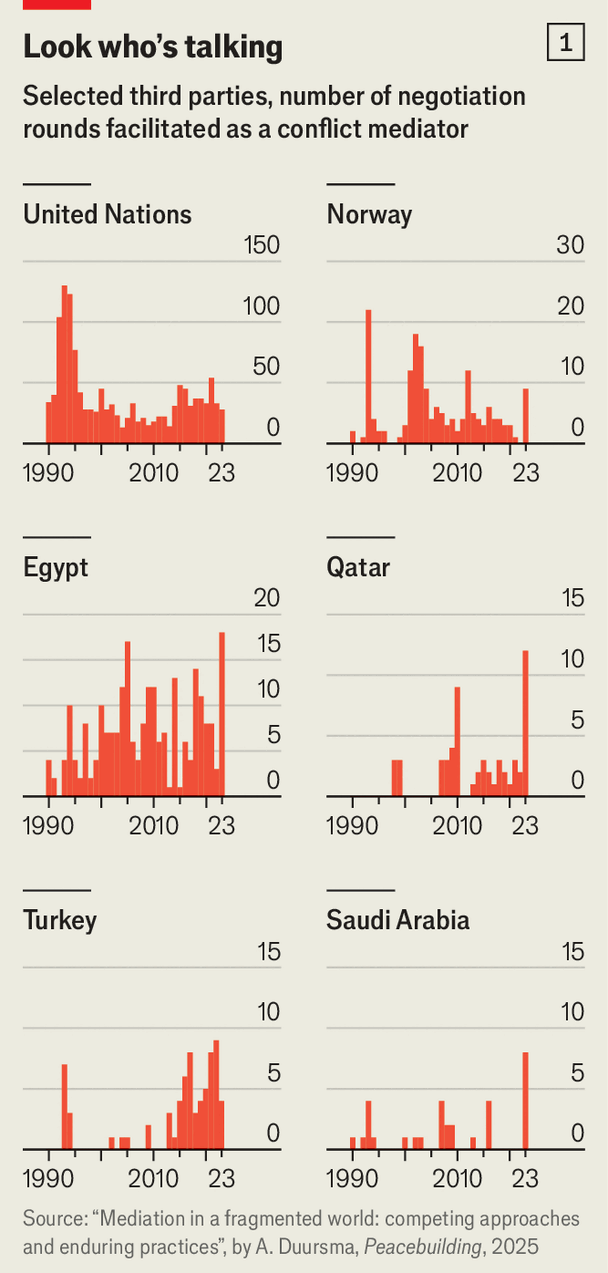
Across the world, peacemaking by autocratic regimes is becoming the norm(常态,标准). In 2025 one or more of China, Qatar, Saudi Arabia, Turkey and the United Arab Emirates were involved as mediators in at least 20 of 53 peace processes recorded worldwide, according to the School for a Culture of Peace (ECP) at the Autonomous University of Barcelona. At the same time, the established(已确立的,老牌的) peacemakers of the post-war era—the United Nations and democracies far removed from(远离,与…截然不同) the field of battle such as Norway, Sweden and Switzerland—are either involved less, or less prominently (see chart 1). This shift does not mean that more or fewer deals are being struck than before. Much like their democratic counterparts, autocrats come up empty-handed(空手而归,一无所获) more often than not(往往,通常). But the accords they do manage to(确实设法做到) bring about are different in both style and substance.
在全球范围内,威权政权进行和平调解正成为常态。据巴塞罗那自治大学和平文化学院的数据,2025年,中国、卡塔尔、沙特阿拉伯、土耳其和阿联酋中的一个或多个国家作为调解人参与了全球记录的53个和平进程中的至少20个。与此同时,战后时代既有的和平缔造者——联合国以及远离战场的民主国家如挪威、瑞典和瑞士——要么参与减少,要么不那么突出(见图表1)。这种转变并不意味着达成的协议比以前更多或更少。与它们的民主同行一样,威权国家通常也空手而归。但它们确实达成的协议在风格和实质上都不同。
First, consider the incentives(动机,诱因). The autocrats are drawn to(被吸引) mediation for at least three reasons. One is prestige(威望,声望) and domestic standing(地位,身份). Pakistan’s military leaders have parlayed(成功利用) their role in the talks between America and Iran to project(投射,展现) an image of Pakistan as an indispensable(不可或缺的) ally. Turkey’s president, Recep Tayyip Erdogan, has used successful mediation abroad to shore up(支撑,加强) support at home, and to pose as(装扮成,装作) a champion of the global south(全球南方(发展中国家)).
首先,考虑一下动机。威权统治者被调解吸引至少有三个原因。一个是威望和国内地位。巴基斯坦的军事领导人利用他们在美伊谈判中的角色,塑造巴基斯坦作为不可或缺的盟友的形象。土耳其总统雷杰普·塔伊普·埃尔多安利用在国外成功的调解来巩固国内支持,并把自己装扮成全球南方的捍卫者。
Your conflicts have my interests
你的冲突,我的利益
We have ways of making you talk
我们自有办法让你开口