FROM THE top of the slide, which curves(弯曲延伸) into a little backyard pool, the view as recently as April would have been of lush Ohio farmland, dense forest and pretty clapboard houses. Now it is of six giant weatherproof(防风雨的) tents of the type used by the armed forces to house fighter jets or by aid organisers in disaster zones. These will soon contain perhaps $30bn-worth of cutting-edge semiconductors. Along with a clutch of(一批;一组) gas turbines to provide power, they occupy a site the size of an airport terminal. If Meta, the site’s owner, stays on track to bring its “Prometheus” data centre online in 2026, it will dedicate an entire gigawatt (GW) of power—the amount needed to power as many as 1m homes, or roughly the output of a large nuclear reactor—to artificial intelligence.(如果场地所有者Meta公司按计划在2026年将其“普罗米修斯”数据中心上线,它将为人工智能投入整整一千兆瓦的电力——这个电量足以满足多达100万个家庭的用电,或大约相当于一座大型核反应堆的发电量。)
从蜿蜒伸入后院小泳池的滑梯顶端望去,就在四月份时,眼前还是俄亥俄州郁郁葱葱的农田、茂密的森林和漂亮的木板房。如今,那里矗立着六座巨大的防雨帐篷,这种帐篷原本用于军队停放战斗机,或由救援组织在灾区使用。这些帐篷很快将容纳价值约300亿美元的尖端半导体。连同提供电力的一批燃气轮机,它们占据了一个机场航站楼大小的场地。如果场地所有者Meta公司按计划在2026年将其“普罗米修斯”数据中心上线,它将为人工智能投入整整一千兆瓦(GW)的电力——这个电量足以满足多达100万个家庭的用电,或大约相当于一座大型核反应堆的发电量。
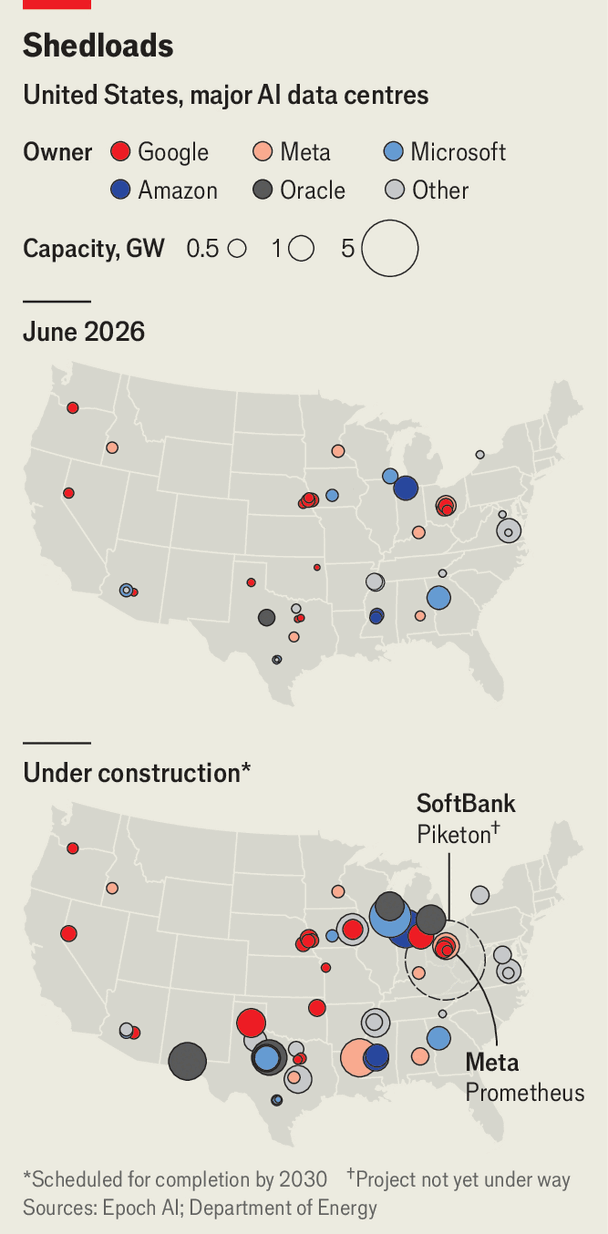
The mammoth(巨大的;庞大的) data centres of the future, capable of training frontier AI models(前沿AI模型) in 2030, will not be in the urban clusters in Virginia or California that house most of America’s server farms today, but in the emerging “Silicon Heartland” of Michigan, Wisconsin and Ohio, or in southern states like Louisiana, Mississippi and Texas. Vast sums—as much as $750bn by Amazon, Google, Meta, Microsoft and Oracle, plus billions more by various others—are being ploughed into(投入(资金)) investments in these places. An estimated $3trn will go into AI data centres globally between 2026 and 2030. Much of that is earmarked(指定用途的) for America. The money will expand total AI computing capacity, measured in the amount of power consumed by major data centres, from just under 12GW in America currently to as much as five times that amount by the end of the decade (see map). And across the country, people of all political stripes(各种政治派别) are furious(暴怒的;极其愤怒) about it.
未来能训练2030年前沿AI模型的巨型数据中心,将不再位于如今聚集了美国大多数服务器农场的弗吉尼亚或加州的城市集群,而是出现在新兴的“硅谷心脏地带”——密歇根、威斯康星和俄亥俄,或路易斯安那、密西西比和得克萨斯等南方州。巨额资金——亚马逊、谷歌、Meta、微软和甲骨文加起来高达7500亿美元,外加其他各方的数十亿美元——正被投入这些地方。据估计,2026年至2030年间,全球将有3万亿美元投入AI数据中心。其中大部分指定用于美国。这些资金将把美国的AI计算总容量——以主要数据中心消耗的电力衡量——从目前略低于12千兆瓦,扩张到本十年末的五倍之多(见地图)。而全美各地,无论何种政治派别的人,都对此怒不可遏。
There is plenty to dislike: the ugliness of the buildings; the roar of generators and cooling systems; the skeleton army(骨架军团(比喻)) of new transmission towers criss-crossing(纵横交错) the landscape; the fear of contaminated water. Surveys suggest that Americans would sooner live next to a nuclear plant than a data centre. The issue has surged in salience(显著性;突出性). Gubernatorial candidates facing voters in November are routinely quizzed on where they stand(被询问立场).
令人反感之处很多:建筑的丑陋;发电机和冷却系统的轰鸣;新输电铁塔的“骨架军团”纵横交错;对水源污染的担忧。调查显示,美国人宁愿住在核电站旁边,也不愿住在数据中心旁边。这个问题的重要性急剧上升。11月面临选民的州长候选人经常被问及他们的立场。
Permission denied
许可被拒
Hillbilly uprising
乡巴佬起义