IS THIS IT, finally? After four years of sanctions-busting(突破制裁的) growth, a chorus of think-tank economists is calling time on(宣告……的结束) Russia’s war economy. A new report from the Kiel Institute for the World Economy argues that Russia faces “structural exhaustion”.(基尔世界经济研究所的一份最新报告认为,俄罗斯面临“结构性衰竭”。) Charles Hecker of the Royal United Services Institute reckons(认为,估计) it “is probably already in recession”. Nigel Gould-Davies of the International Institute for Strategic Studies talks of “the coming crisis in Russia’s political economy”. Even Russian official figures point to GDP shrinking by 0.2% in the first quarter, year on year.(就连俄罗斯官方数据也显示,第一季度GDP同比萎缩0.2%。)
终于走到这一步了吗?经过四年的制裁突破式增长,一群智库经济学家纷纷宣告俄罗斯战时经济走到尽头。基尔世界经济研究所的最新报告认为,俄罗斯面临“结构性衰竭”。皇家联合军种研究所的查尔斯·赫克估计,“可能已经陷入衰退”。国际战略研究所的奈杰尔·古尔德-戴维斯谈到“俄罗斯政治经济即将到来的危机”。就连俄罗斯官方数据也显示,第一季度GDP同比萎缩0.2%。
Since invading Ukraine in 2022 Vladimir Putin’s Russia has thumbed its nose at(对……嗤之以鼻,蔑视) those who have predicted economic doom(厄运,毁灭). It has defied(违抗,蔑视) Western sanctions by trading more with places like China and India, and spent ample(充足的,大量的) fiscal reserves on the armed forces, infrastructure and social benefits. Between 2022 and 2025 GDP per person, adjusting for inflation, rose by 12%—weak by the standards of other emerging markets, and flattered by defence production that does not benefit households, but not bad when compared with the dire predictions.(2022年至2025年间,经通胀调整后的人均GDP增长了12%——按其他新兴市场的标准来看较弱,而且受到对家庭无益的军工生产的虚假美化,但相比那些可怕的预测并不算差。) Despite fresh strains(新的压力), the economy is not about to collapse.
自2022年入侵乌克兰以来,弗拉基米尔·普京的俄罗斯一直对预测经济末日的人嗤之以鼻。它通过与中国和印度等地增加贸易来对抗西方制裁,并将充足的财政储备用于军队、基础设施和社会福利。2022年至2025年间,经通胀调整后的人均GDP增长了12%——按其他新兴市场的标准来看较弱,而且受到对家庭无益的军工生产的虚假美化,但相比那些可怕的预测并不算差。尽管有新的压力,经济也不会崩溃。
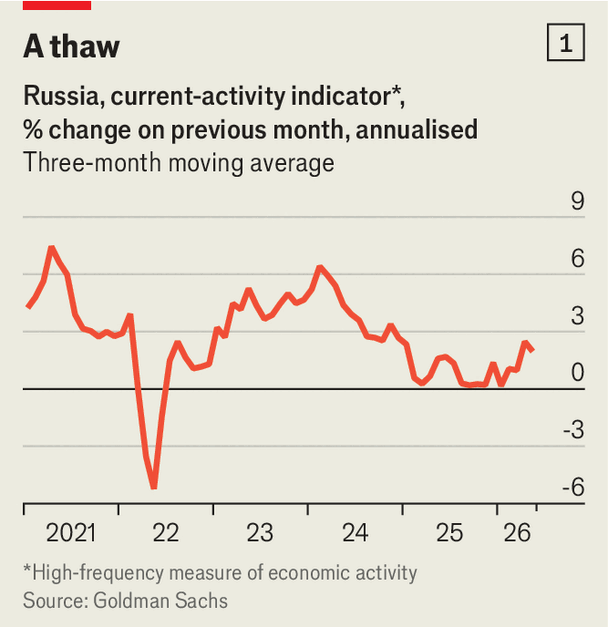
Start with the weak official statistics. These are, largely, a statistical mirage(统计幻象). A rise in value-added tax (VAT) in January, from 20% to 22%, encouraged Russians to make lots of purchases in late 2025, boosting(促进,使增长) that quarter’s growth at the expense of(以……为代价) the next. Early 2026 also had fewer working days than a year earlier, and—even by Russian standards—grim(严酷的,阴冷的) weather. A potentially cleaner gauge(衡量标准,指标) of economic activity, produced by Goldman Sachs, is consistent with sluggish(缓慢的,无活力的) growth but no slump(暴跌,衰退) (see chart 1). Data from VEB, another bank, points to a pick-up in GDP in March and April, thanks in part to a surge in oil prices.(来自另一家银行VEB的数据显示,3月和4月GDP出现回升,部分原因是油价飙升。) Russia is almost certainly not in recession.
首先看疲软的官方数据。这些在很大程度上是一种统计幻象。1月份增值税从20%提高到22%,鼓励俄罗斯人在2025年底大量采购,以牺牲下一个季度的增长为代价提振了当季增长。2026年初的工作日也比去年同期少,而且——即使按俄罗斯标准来看——天气恶劣。高盛编制的一个可能更干净的经济活动指标,与增长缓慢但不衰退的情况一致(见图表1)。另一家银行VEB的数据显示,3月和4月GDP有所回升,部分原因是油价飙升。俄罗斯几乎可以肯定没有陷入衰退。