Everywhere you turn, European leaders are blaming the imbalanced global economy for their woes(困境,苦难). Emmanuel Macron is trying to use France’s presidency of the G7 group of rich countries to raise the alarm(敲响警钟,发出警告). Friedrich Merz, Germany’s chancellor, complains about competing with those who invoice(开具发票,开发票) in undervalued currencies. “Some countries produce too much and do not consume enough, and vice versa(反之亦然),” moans(抱怨,哀叹) Ursula von der Leyen, president of the European Commission.
无论你走到哪里,欧洲领导人都在将他们的问题归咎于失衡的全球经济。埃马纽埃尔·马克龙正试图利用法国担任七国集团(G7)主席国的机会敲响警钟。德国总理弗里德里希·默茨抱怨与那些用低估货币开票的国家竞争。“一些国家生产太多而消费不足,反之亦然,”欧盟委员会主席乌尔苏拉·冯德莱恩抱怨道。
What the leaders really mean is that they have a beef with(与…有矛盾,有不满) China, whose formidable(强大的,令人畏惧的) manufacturers are outcompeting(胜过,超越(竞争)) European producers in many markets. Partly as a result of Chinese competition, Europe is gently deindustrialising: the share of value added(增加值,附加值) in manufacturing is one percentage point lower than it was in 2018. Because the resulting lost jobs are in industries, most notably carmaking, that draw special attention from politicians, fear of the “second China shock(第二次中国冲击)” has become politically explosive(爆炸性的,极具争议的). But in blaming China for their troubles, Europe’s leaders risk losing sight of(忽视,忽略) their home-grown(本土的,内在的) failings.
这些领导人真正的意思是他们与中国有矛盾,中国强大的制造商在许多市场上正超越欧洲生产商。部分由于中国的竞争,欧洲正在缓慢去工业化:制造业增加值占比比2018年低了一个百分点。因为由此导致的失业发生在汽车制造等尤其受政客关注的行业,对“第二次中国冲击”的担忧已成为政治炸药。但欧洲领导人将问题归咎于中国,可能忽视自身固有的缺陷。
The Europeans are right that the world economy is imbalanced and that China is partly to blame(应受责备,负有责任). It runs a large current-account surplus(经常账户盈余), of almost 4% of its vast GDP, although some analysts think it is even higher. Its economy has unusually low consumption, often blamed on the lack of a social safety-net(社会安全网(社会保障体系)) for households. Its exporters, though in brutal competition with each other(彼此残酷竞争), do indeed benefit from subsidies and a cheap currency. At a global level, America provides much of the corresponding deficit that soaks up(吸收,吸纳) China’s surplus, mostly as a result of its huge government borrowing.
欧洲人认为全球经济失衡,中国应负部分责任,这是对的。中国经常账户盈余巨大,约占其庞大GDP的近4%,尽管一些分析人士认为实际更高。中国经济消费异常低迷,常被归咎于缺乏面向家庭的社会安全网。其出口商虽然彼此残酷竞争,但确实受益于补贴和廉价货币。在全球层面,美国提供了吸收中国盈余的大部分相应赤字,主要是由于其庞大的政府借款。
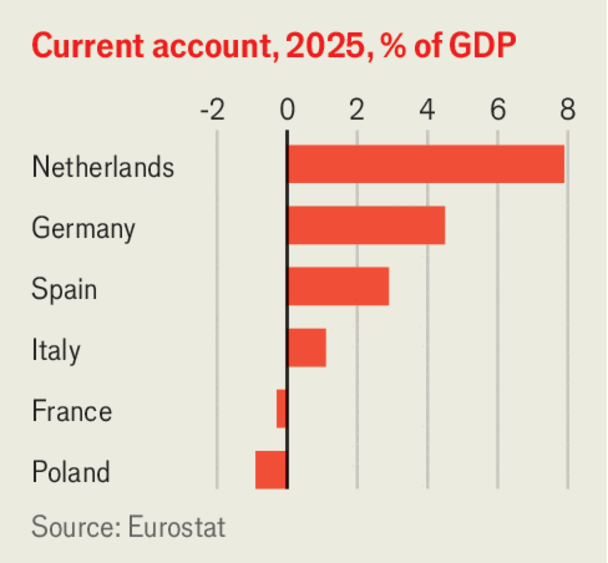
New balance
新平衡