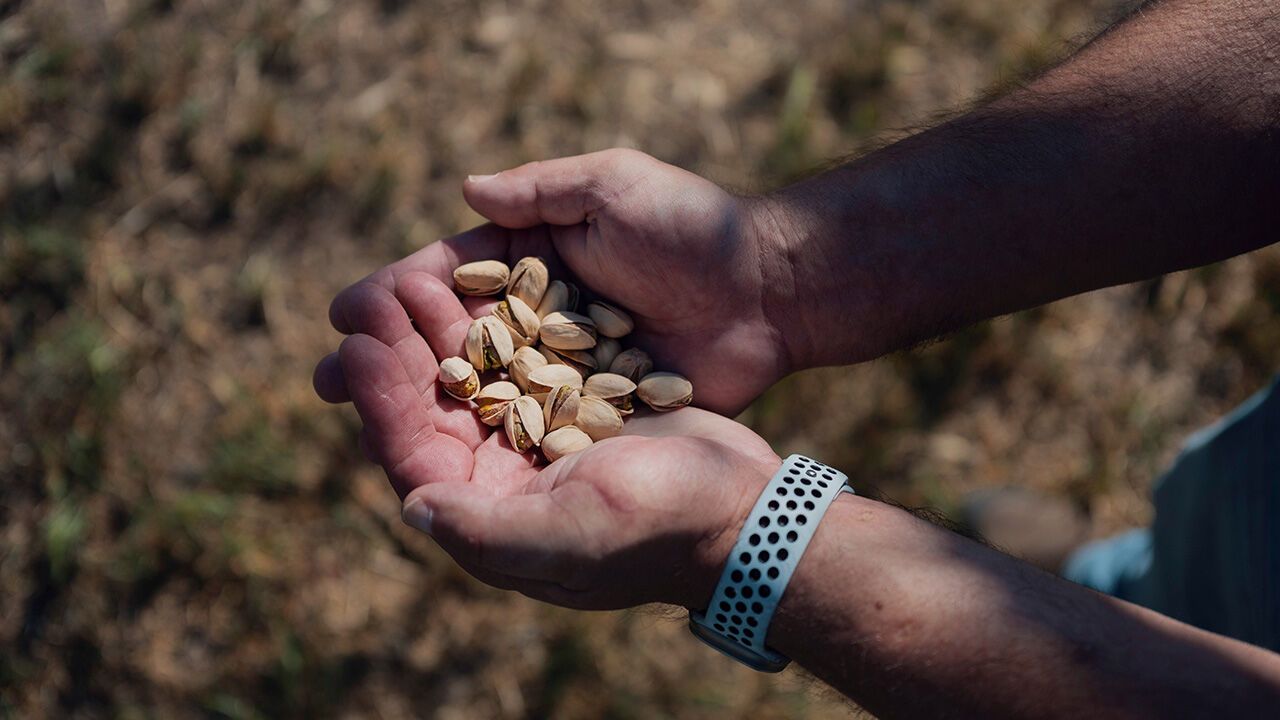
JOE COELHO’S(乔·科埃略(人名,全大写强调)) family has been farming near Riverdale, in California’s San Joaquin Valley(圣华金谷(加利福尼亚农业重镇)), for four generations. “I’m the fifth of my name, like Game of Thrones(《权力的游戏》(美国史诗奇幻剧)),” he says. His family ran a dairy(奶牛场;乳制品厂) for decades, but in 2021 they sold the cows and planted pistachio trees. The crops thrive in the valley’s dry heat, and the switch to pistachios has paid off(得到了回报;成功). In May the nuts fetched $5.30 a pound(售价每磅5.30美元) in America, according to Expana(Expana(市场数据供应商)), a market-data provider(市场数据供应商), the highest price in a decade, inflated by the war(因战争而推高(价格)) in Iran.
乔·科埃略(JOE COELHO’S)家族在加利福尼亚圣华金谷的里弗代尔附近耕种了四代。“我是第五代同名者,就像《权力的游戏》一样,”他说。他的家族经营奶牛场数十年,但2021年他们卖掉了奶牛,种下了开心果树。这种作物在山谷的干燥高温下茁壮成长,转向开心果种植获得了回报。据市场数据供应商Expana的数据,五月份美国开心果每磅售价5.30美元,为十年最高,因伊朗战争而推高。
As peace talks(和平谈判) between America and Iran continue, the White House is arguing that the war has advanced Americans’ interests. By conventional metrics(常规标准/指标)—dismantling(拆除;瓦解) Iran’s nuclear programme, for instance, or lowering prices for American consumers—that argument has flaws. But at least one set of Americans is profiting from the conflict(从冲突中获利): the 950 or so(大约;左右) pistachio farmers of California.
随着美伊和平谈判继续,白宫认为战争增进了美国人的利益。按照常规标准——例如拆除伊朗的核计划,或降低美国消费者的价格——这一论点存在缺陷。但至少有一群美国人正从冲突中获利:加州大约950名开心果农户。
Pistachio trees have grown in Iran for millennia(数千年(millennium的复数)), and the country long dominated the market. But during the Iranian hostage crisis(伊朗人质危机(1979-1981)) in 1979, President Jimmy Carter imposed a trade embargo(实施贸易禁运) that prevented the import of 25m pounds of pistachios, among other things. Later, in the 1980s, American farmers accused Iran of dumping(倾销(以低于成本价出口)) cheap nuts to undercut competition(削弱竞争;压价竞争). So America slapped the country with a whopping 241% tariff. California’s farmers filled the gap, and an industry blossomed(蓬勃发展;开花). The state’s orchards accounted for(占(比例)) 60% of global pistachio production in 2025.
开心果树在伊朗生长了数千年,该国长期主导市场。但在1979年伊朗人质危机期间,吉米·卡特总统实施了贸易禁运,阻止了2500万磅开心果等商品的进口。后来,在20世纪80年代,美国农场主指责伊朗倾销廉价坚果以削弱竞争。于是美国对该国征收了高达241%的关税。加州的农户填补了空白,一个产业蓬勃发展。2025年,该州的果园占全球开心果产量的60%。