Oil majors(大型石油公司) have two ways to make big money during an energy shock(能源冲击). One is to sell the hydrocarbons(碳氢化合物) they pump and refine themselves. The other is to buy barrels that rival companies produce and flog(出售,甩卖) them to whoever wants them the most. The third Gulf war has now demonstrated just how important the latter has become as a source of profit for the industry—particularly in Europe.(第三次海湾战争证明了后者作为行业利润来源的重要性,尤其是在欧洲。)
石油巨头在能源冲击期间有两种赚大钱的方式。一是出售自己开采和提炼的碳氢化合物。二是购买竞争对手生产的石油桶,然后转卖给最需要的人。第三次海湾战争已经证明,后者作为行业利润来源的重要性——尤其是在欧洲。
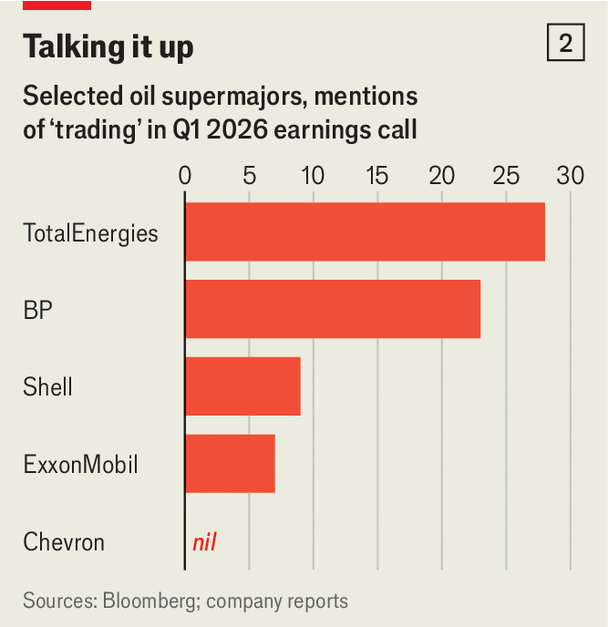
Trading used to be the majors’ dirty little secret(难以启齿的小秘密) for topping up their returns. It is not little anymore. The volume of hydrocarbons traded by BP, Shell and TotalEnergies—the equivalent(相等物,等量) to 40-50m barrels of oil per day—is five to ten times what they produce. Nor is the contribution to their profitability a mere rounding error(四舍五入误差). Our calculations suggest that the trading arms of these three companies could be on course to(有望,即将) increase their average return on capital(资本回报率) by roughly a third or more this year.
交易过去是巨头们用来补充收益的秘密小手段。但现在它不再是小打小闹了。BP、壳牌和道达尔交易碳氢化合物的量(相当于每天4000-5000万桶石油)是他们产量的五到十倍。其利润贡献也不再是四舍五入的误差。我们的计算显示,这三家公司的交易部门今年有望将平均资本回报率提高大约三分之一甚至更多。
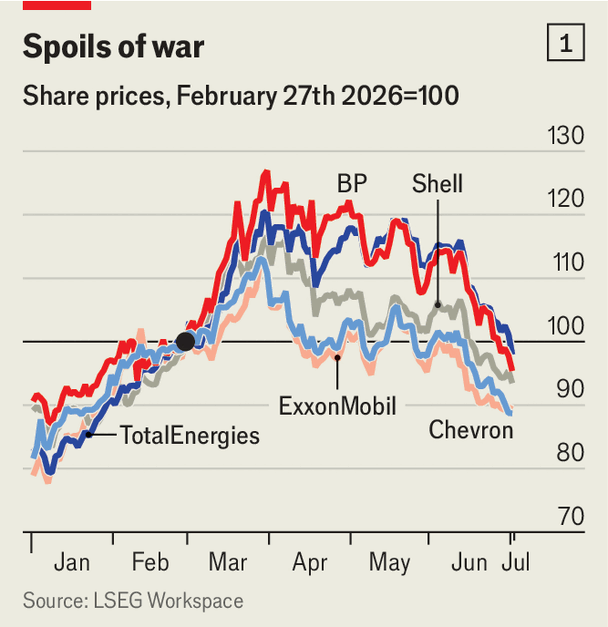
Yet secretive these activities remain. The majors disclose plenty about their production and distribution businesses. But information about their trading arms is, in effect, classified(机密的,保密的). Opacity helps protect their competitive edge(竞争优势). Trading profits alone explain why European majors, whose valuations have long trailed those of their American cousins, have outperform(表现胜过)ed Exxon and Chevron since the end of February (see chart 1). To understand how they mint so much money—and whether it can last—The Economist spoke to a range of insiders from across the industry. Our findings indicate that the golden geese(金鹅(源自伊索寓言)) still have eggs to lay. But foxy(狡猾的,像狐狸的) competitors are circling.
然而这些活动仍然保密。巨头们大量披露生产和分销业务的信息,但关于其交易部门的信息实际上属于机密。不透明有助于保护其竞争优势。单单是交易利润就解释了为何欧洲石油巨头(其估值长期落后于美国同行)自二月底以来表现优于埃克森和雪佛龙(见图表1)。为了理解它们如何赚取如此多的钱——以及这种局面能否持续——《经济学人》采访了一系列行业内部人士。我们的发现表明,金鹅仍有蛋可下,但狡猾的竞争者正在逼近。
Trading blows
交易之争