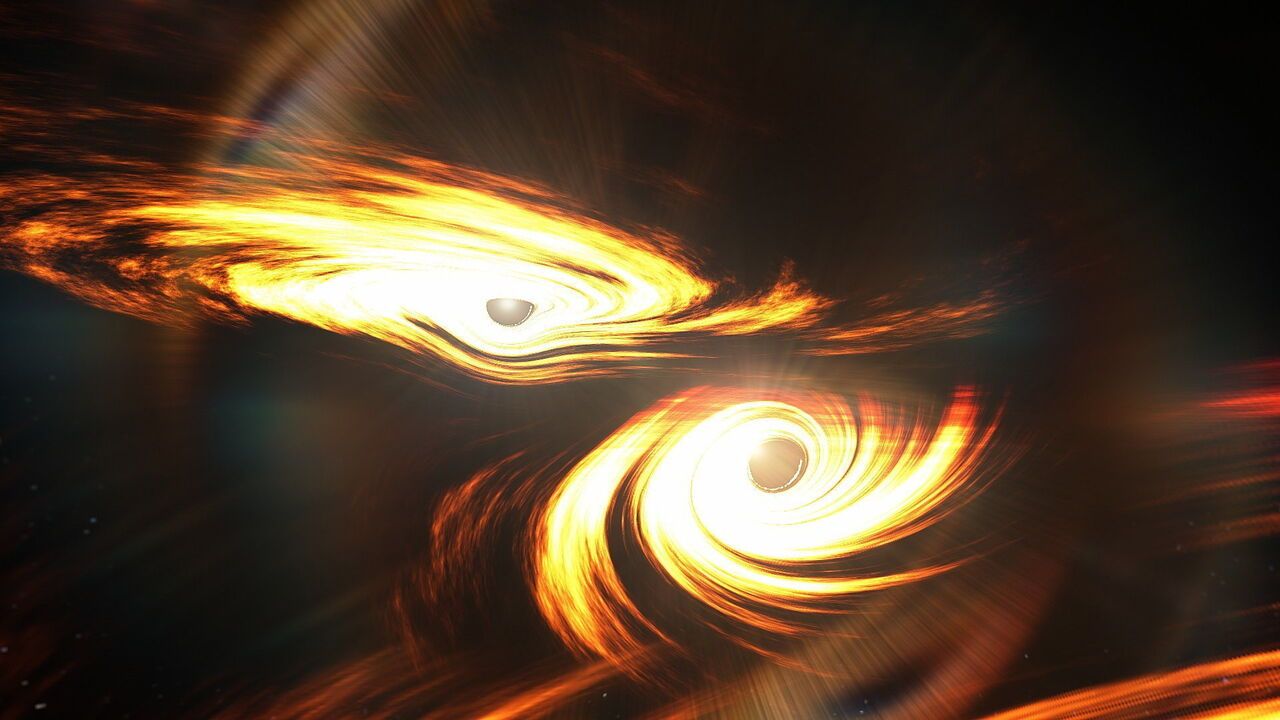
A LONG TIME ago(很久以前), in a galaxy far, far away—somewhere in the general direction of the constellation of Leo—two black holes crashed together and merged(相撞并合并). About 1.3bn(13亿) years later, on January 14th 2025, a blip(短暂信号) appeared in the detectors at the Laser Interferometer Gravitational-Wave Observatory (LIGO)(激光干涉引力波天文台), an instrument based in Louisiana and Washington state.
很久以前,在一个遥远的星系中——位于狮子座大致方向——两个黑洞相撞并合并。大约13亿年后,2025年1月14日,位于路易斯安那州和华盛顿州的激光干涉引力波天文台(LIGO)的探测器中出现了一个脉冲信号。
The blip marked the arrival of the pulse(脉冲) of gravitational waves—ripples in the fabric of the universe(宇宙结构中的涟漪)—emitted as the black holes collided. In a paper published in Nature on June 24th, a team led by Sizheng Ma of Perimeter Institute for Theoretical Physics, in Ontario, report that they have used those waves to glimpse one of nature’s strangest phenomena: the “event horizons” that surround black holes.(在《自然》杂志6月24日发表的论文中,马思正团队报告利用引力波窥见了事件视界。)
该脉冲信号标志着黑洞碰撞时发出的引力波——宇宙结构中的涟漪——的到来。在6月24日发表于《自然》杂志的一篇论文中,安大略省理论物理研究所的马思正领导的研究团队报告说,他们利用这些引力波窥见了自然界最奇特的现象之一:环绕黑洞的“事件视界”。
An event horizon marks the point beyond which gravity so warps spacetime that nothing, not even light, can escape.(事件视界标志着引力扭曲时空到连光都无法逃脱的临界点。) An object that crosses the horizon is cut off from(与……隔绝) the rest of the universe, with all possible roads leading to the black hole’s centre. Event horizons are invisible, although their effects can often be seen when a black hole is swallowing(吞噬) hot, glowing gas. Physicists nevertheless know a great deal about how they work, thanks to Albert Einstein(阿尔伯特·爱因斯坦)’s theory of general relativity. But physics is an empirical(经验主义的,基于实验的) science as well as a theoretical one. Dr Ma thought that gravitational waves might offer a way to check that Einstein’s theory does indeed match reality at the boundary of a black hole.
事件视界标志着引力扭曲时空到连光都无法逃脱的临界点。任何跨过这一边界的物体都将与宇宙其他部分隔绝,所有可能的路径都通向黑洞中心。事件视界本身不可见,尽管当黑洞吞噬炽热发光的气体时,其效应常常能被观测到。然而,得益于爱因斯坦的广义相对论,物理学家对它们的运作方式了解颇多。但物理学既是一门理论科学,也是一门实验科学。马博士认为,引力波或许提供了一种方法来检验爱因斯坦的理论是否确实与黑洞边界处的现实相符。