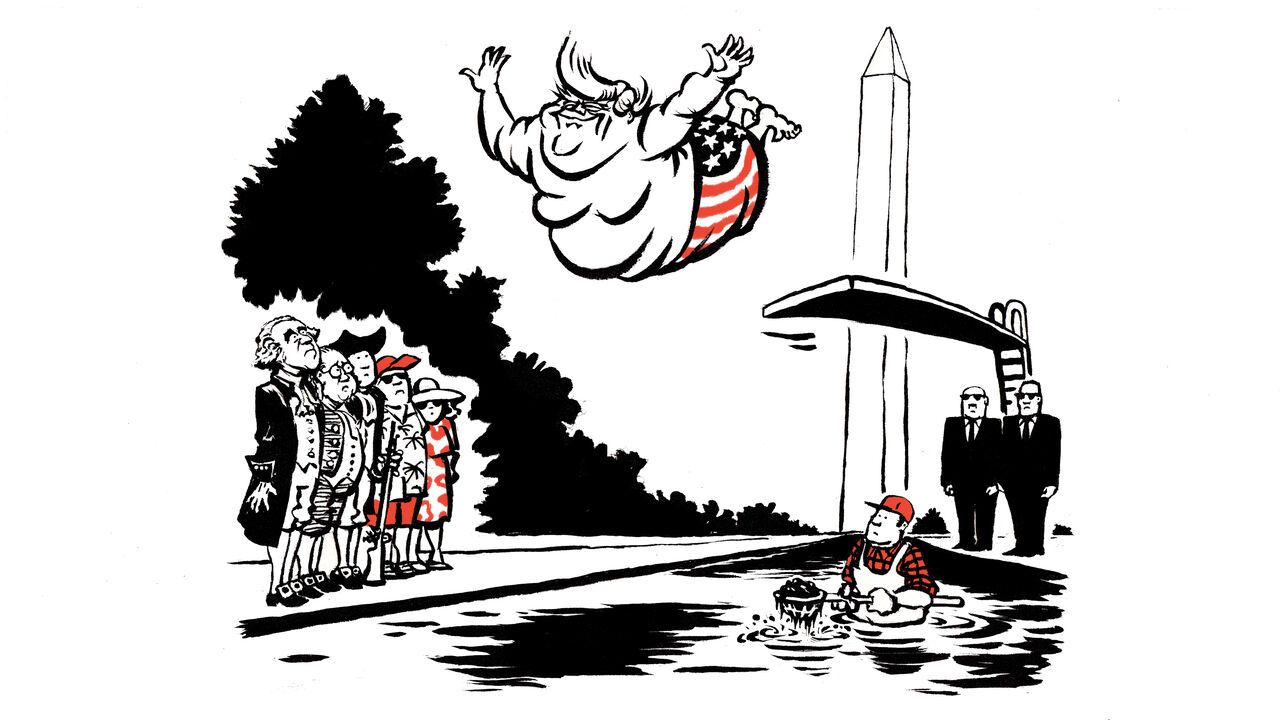
Just what message Washington, DC, means to send about itself, and about the country of which it is the capital, has always been uncertain. Is the city out to intimidate or inspire(意在恫吓还是鼓舞)? To overwhelm visitors with the potency(威力,效力) of centralised authority, or to summon the potential of every citizen? The mixed signals reflect varying ambitions at the foundation of the city and then muddled(混乱的,糊涂的) execution in developing it. Thomas Jefferson(托马斯·杰斐逊,美国第三任总统) envisioned(设想,展望) a compact(紧凑的,小巧的), modest capital, in line with(与…一致) his republican values. But the French engineer hired by George Washington to design the city, Pierre L’Enfant, was inspired partly by Versailles, where his father was a royal painter. He planned a governing seat(政府所在地) of grand proportions, suitable for what he believed would be a “vast empire”.
华盛顿特区究竟想传递什么信号,无论关于自身还是其所代表的国家,始终悬而未决。这座城市意在恫吓还是鼓舞?是要以中央集权的威力压倒游客,还是要唤起每位公民的潜能?这些混杂的信号反映了建城之初的雄心各异,以及后续开发的混乱执行。托马斯·杰斐逊设想了一个紧凑简朴的首都,符合他的共和价值观。但乔治·华盛顿雇用的法国工程师皮埃尔·朗方,部分灵感来自凡尔赛宫——他的父亲曾是那里的宫廷画师。他规划了一个规模宏大的政府所在地,配得上他心目中那个“庞大帝国”。
Washington forced the irascible(易怒的,暴躁的) L’Enfant out after a year, in early 1792. A decade later, when President Thomas Jefferson took solitary(独自的,孤独的) horseback rides through the soggy(湿透的,泥泞的) wilderness, along rutted(有车辙的) tracks L’Enfant had designed to be elegant boulevards(林荫大道), sceptics(怀疑者) doubted his vision would ever be realised.
华盛顿在一年后(1792年初)就迫使暴躁的朗方离职。十年后,当托马斯·杰斐逊总统独自骑马穿越泥泞的荒野,沿着朗方设计本应为优雅林荫大道的车辙痕迹行进时,怀疑论者质疑他的愿景能否实现。
When Mark Twain visited after the civil war, he found a jumble of(一堆杂乱) grandiosity(宏伟,浮夸) and squalor(肮脏,污秽), a suitable backdrop for the pomposity(自负,浮夸), incompetence and corruption of the elected denizens(居民,常客). Yes, the Capitol was noble, he wrote in 1873, in the novel that gave its name to the era, “The Gilded Age(镀金时代,指19世纪末美国)”. But the cost overruns(成本超支) in its construction were shocking and it lorded over(凌驾于…之上) “a sorrowful little desert of cheap boarding houses”. As for the Washington monument, “that memorial Chimney”, it was still unfinished, with cow sheds at its base and pigs dozing(打盹) in “its protecting shadow”. The executive mansion was an ugly “white barn”, and the streets so sodden Twain wondered why “they do not dilute the mud a little more and use them for canals”. In fact, L’Enfant had designed a stately(庄严的,雄伟的) canal, but it became a health hazard(健康危害)—Washingtonians used it as a sewer—and it was filled in.
马克·吐温在内战后造访时,发现这里各色宏大与肮脏混杂,恰如其分地衬托出当选居民的浮夸、无能与腐败。是的,国会大厦气派不凡,他1873年在命名了整个时代的《镀金时代》中写道,但其建设成本超支惊人,并且它俯瞰着“一片由廉价公寓组成的凄凉小沙漠”。至于华盛顿纪念碑,“那座纪念烟囱”,尚未完工,底部有牛棚,猪在其“庇护的阴影下”打盹。总统官邸是一座丑陋的“白色谷仓”,街道如此湿透,吐温纳闷“他们为何不把泥巴再稀释一点,用作运河”。事实上,朗方曾设计一条庄严的运河,但它成了健康隐患——华盛顿人将其用作下水道——最终被填平。
Spoiling L’Enfant’s view
破坏朗方的景观