WHEN ERIC STALLARD, an actuary(精算师) and academic, began looking into the incidence(发病率) of dementia among elderly Americans, he was so stunned(震惊的) by his findings that he held off(推迟,拖延) publishing his first paper on the subject for two and a half years while he double-checked his work. “I wanted to be absolutely certain,” he recalls, since the numbers defied all expectation(出乎所有预料). Instead of confirming the received wisdom(普遍看法,公认观点) that America faced an intensifying plague(瘟疫,灾害) of the condition, they showed that the proportion of old people succumbing to(死于(疾病)) it was in fact shrinking fast. “I was shocked by the declines,” he says.
当精算师兼学者埃里克·斯托拉德开始调查美国老年人痴呆症发病率时,他对自己的发现感到震惊,以至于推迟了两年半才发表第一篇相关论文,期间反复核对数据。“我想绝对确定,”他回忆道,因为这些数字完全出乎意料。数据并未证实美国正面临日益严重的痴呆症瘟疫这一普遍看法,反而显示老年人患此病的比例实际上正在快速下降。“这些下降让我震惊,”他说。
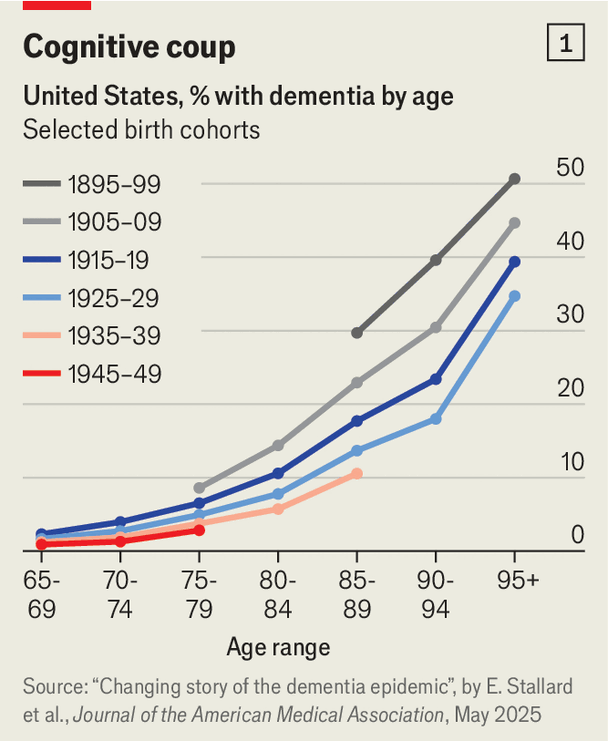
Mr Stallard has been working for a decade to corroborate(证实,确证) this revelation(揭示,惊人发现). His findings have, if anything(反而,甚至可以说), become even more striking(显著的,引人注目的). Last year he and some colleagues published research in the Journal of the American Medical Association showing that, whereas 40 years ago three in every ten Americans aged 85-89 had dementia, by 2024 just one in ten had it (see chart 1). What is more, America is not the only beneficiary(受益者) of this trend. Between 1988 and 2015 the share of older people being diagnosed with dementia fell by 13% a decade across six countries in North America and Europe, according to a study of almost 50,000 people by Frank Wolters of the Erasmus Medical Centre in Rotterdam, and colleagues.(1988年至2015年间,北美和欧洲六国老年人痴呆症诊断率每十年下降13%。)
斯托拉德先生花了十年时间来证实这一发现。他的研究结果反而变得更加引人注目。去年,他和一些同事在《美国医学会杂志》上发表研究称,40年前每10名85-89岁的美国人中有3人患有痴呆症,而到2024年,每10人中仅有1人患病(见图表1)。此外,美国并非这一趋势的唯一受益者。根据鹿特丹伊拉斯谟医学中心的弗兰克·沃尔特斯及其同事对近5万人进行的研究,1988年至2015年间,北美和欧洲六个国家的老年人痴呆症诊断率每十年下降13%。
Some smaller studies have also found big declines. Data from the Framingham Heart Study, which has tracked three generations in an American town, show an average drop in new dementia cases of 20% per decade over almost 40 years between the late 1970s and early 2010s. Those who were entering their dotage(老年期,衰老) when Daft Punk’s “Get Lucky” was topping the charts(登顶排行榜) (2013) were 44% less likely to have dementia than those who were doing so when Sting was urging Roxanne to switch off her red light(关掉红灯(隐喻)) (1978).
一些规模较小的研究也发现了大幅下降。来自弗雷明汉心脏研究的数据显示,在20世纪70年代末至21世纪初近40年间,新发痴呆症病例每十年平均下降20%。当Daft Punk的《Get Lucky》登顶排行榜时(2013年)进入老年期的人,比斯汀(Sting)催促罗克珊关掉红灯时(1978年)进入老年期的人,患痴呆症的可能性低44%。
Making memories
创造记忆
Mind-bending
令人费解
Memory laws
记忆法则
Mind control
思维控制