When last month the chip industry’s elite(精英) descended on(蜂拥而至) Taipei for Computex(台北电脑展), an annual trade show, two topics dominated(主导) discussions. The first was artificial intelligence, which has turned semiconductors into one of the world’s most profitable(盈利的) industries. The second was China. Its chipmakers were absent from the event, but their shadow was long(影响力巨大).
上个月,芯片行业的精英们齐聚台北参加年度贸易展Computex,两个话题主导了讨论。第一个是人工智能,它已使半导体成为全球最赚钱的行业之一。第二个是中国。该国的芯片制造商虽未出席活动,但他们的身影无处不在。
The fascination(着迷) with China is easy to explain. A week before Computex, Huawei, the country’s tech-hardware champion, unveiled(公布,揭幕) a technique that stacks(堆叠) layers of circuits onto a chip to get better performance without relying on the latest Western manufacturing tools. Investors are also signalling confidence(显示信心). The share prices of semiconductor firms on Hong Kong’s stock market has risen by 140% over the past year, beating a comparable American index. Alibaba and Baidu, two Chinese internet giants, intend to spin off(剥离(业务)) their chip-design businesses. CXMT(长鑫存储), a maker of memory chips, is preparing a public listing(上市).
对中国兴趣的原因不难解释。在Computex前一周,中国科技硬件领军企业华为公布了一项技术,该技术通过将多层电路堆叠到芯片上来获得更好的性能,而无需依赖西方最新的制造工具。投资者也显示出信心。过去一年,香港股市半导体公司股价上涨了140%,超过可比的美国指数。阿里巴巴和百度这两家中国互联网巨头打算剥离其芯片设计业务。内存芯片制造商CXMT正准备上市。
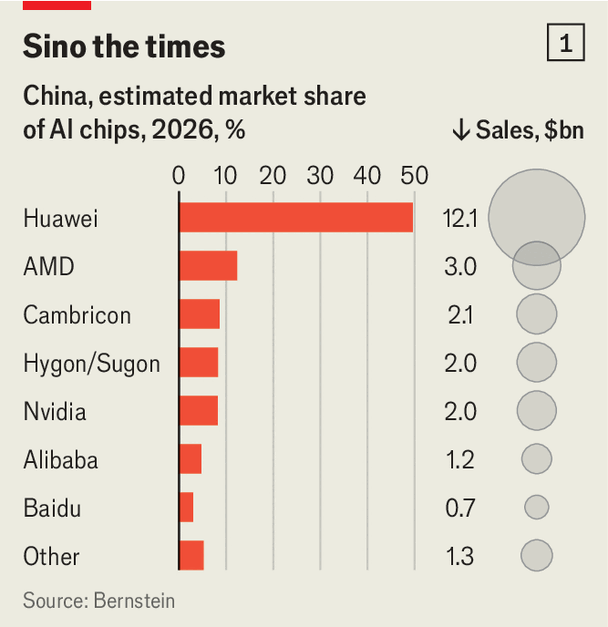
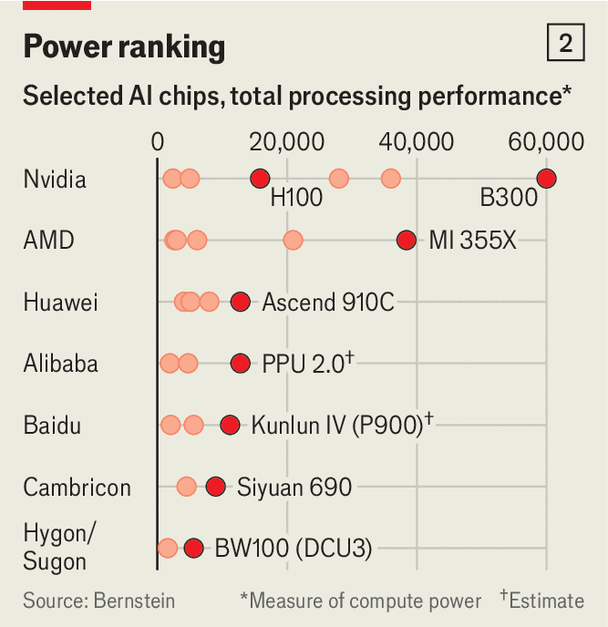
China’s potential for self-sufficiency(自给自足) in chipmaking is one of the industry’s biggest questions. The answer matters because “compute(算力)”—the processors and memory that train and run AI models—has become the currency of technological power(技术力量的通货). At the end of 2025 China had only around one-seventh of the compute capacity of America. Closing the gap requires mastering two very different activities: designing chips and manufacturing them. China has made remarkable(显著的) progress in the first. In the second, it has much further to go.
中国在芯片制造上实现自给自足的潜力是该行业最大的问题之一。答案至关重要,因为“算力”——训练和运行AI模型的处理器与内存——已成为技术力量的通货。2025年底,中国的算力仅为美国的七分之一左右。缩小差距需要掌握两项截然不同的活动:芯片设计与芯片制造。中国在第一项上取得了显著进展,而在第二项上,还有很长的路要走。