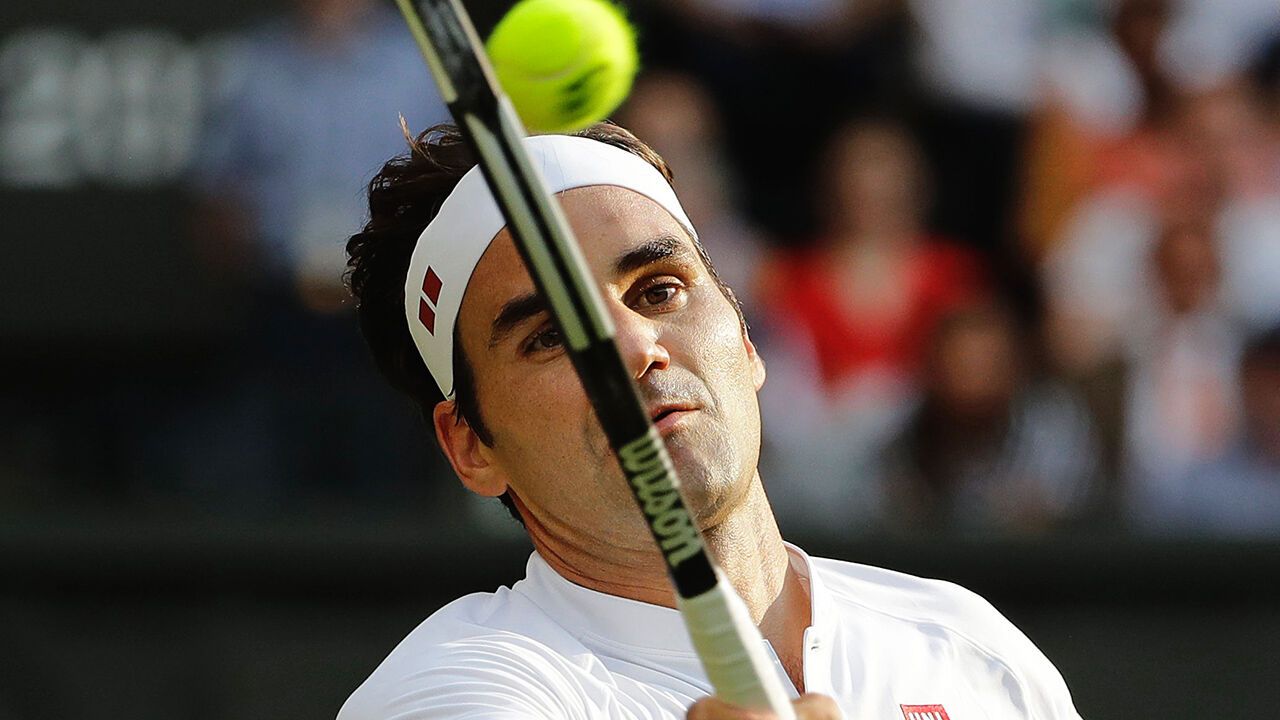
ROGER FEDERER won 20 major tournaments during his career. Wimbledon, which started this year on June 29th, was his happiest hunting ground(最得意的赛场): he won eight times, a men’s record. Yet as Mr Federer himself has noted, he won only slightly more than half(略多于一半) of the thousands of points(分数(网球计分单位)) he played during his career.
罗杰·费德勒在其职业生涯中共赢得20次大满贯赛事。今年6月29日开赛的温布尔登是他最得意的赛场:他八次夺冠,创造了男子纪录。然而正如费德勒本人所指出的,他在职业生涯中赢得的分数仅略高于总得分数的一半。
This year Mr Federer, who retired in 2022, has been watching Wimbledon from the crowd. But those less familiar with the game than he is may wonder how he—or the current crop(一批,一群(人)) of top players—manage to convert such a narrow advantage into a winning record(将微弱优势转化为胜利纪录).
今年,2022年退役的费德勒在观众席上观看温网。但那些不如他熟悉比赛的人可能会好奇:他——以及当今顶尖球员——是如何将如此微弱的优势转化为胜利纪录的。
Much of the answer lies in(在于) tennis’s scoring system. Stringing points into games, games into sets, and sets into a match gives plenty of time for a small advantage to compound(累积,使恶化) into a convincing win(令人信服的胜利). Analysis by The Economist of data from major tournaments between 2014 and 2025 shows that, in the men’s game, a player that is just 1% more likely to win the average point is 12.5% more likely to win the match.(《经济学人》分析显示,男子比赛中,球员赢得平均分的概率仅高1%,赢得比赛的概率就高12.5%。) For women, the figure(数字(此处指百分比)) is about 10.5%.
答案很大程度上在于网球的计分系统。将分数串成局,局串成盘,盘串成比赛,这就为微小优势累积成令人信服的胜利提供了充足时间。《经济学人》对2014年至2025年间主要赛事数据的分析表明,在男子比赛中,一个球员赢得平均每分的概率仅高出1%,他赢得整场比赛的概率就高出12.5%。女子比赛的这个数字约为10.5%。