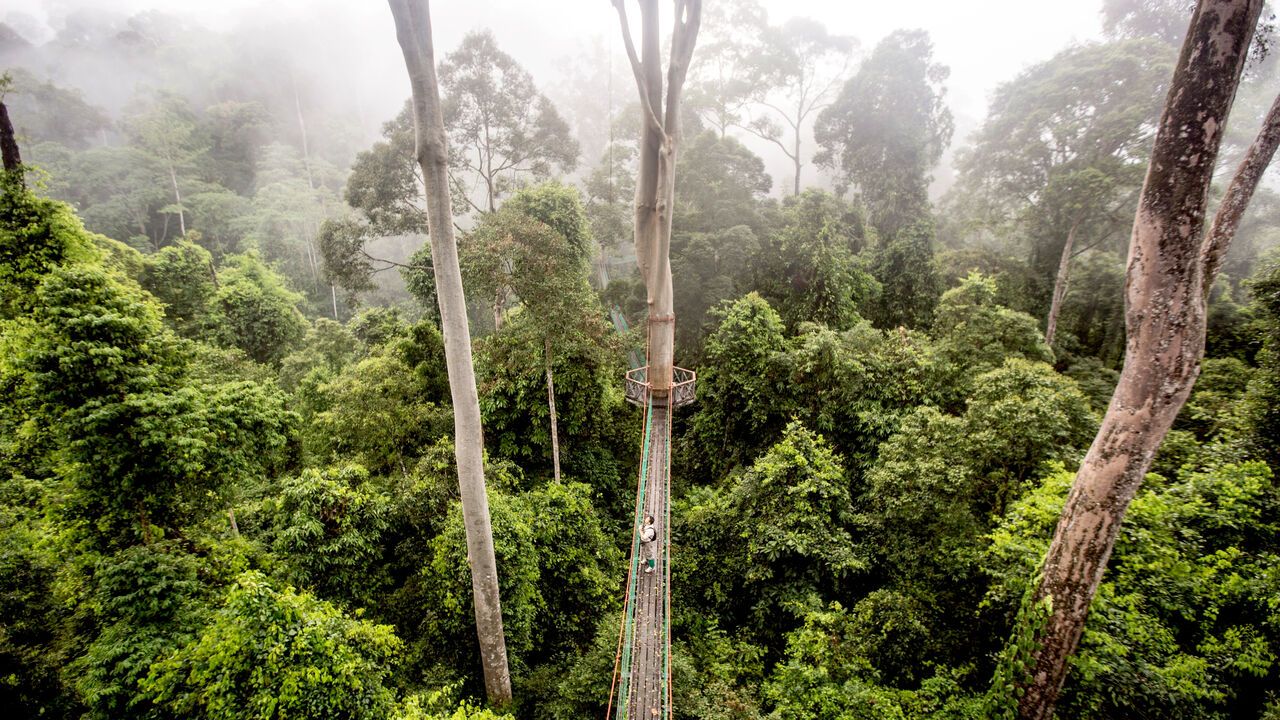
TOWERING OVER(高耸于...之上) 100 metres above the forest floor, the dipterocarp(龙脑香科树木)—named after its winged seeds, which spiral away in the wind—is the tallest tropical tree in the world. For a plant, being tall is an advantage: if your neighbours cannot overshadow you, that leaves you with the lion’s share(最大份额) of the sunlight.
龙脑香树——以其有翅种子命名,这些种子在风中螺旋飘散——高耸于森林地面之上100多米,是世界上最高的热带树木。对植物而言,长得高是一种优势:如果邻居无法遮蔽你,你就能获得阳光的最大份额。
But trees need water as well as light, and here being tall presents a problem. The physics of moving liquid through thin channels means that the taller a tree gets, the harder it is to pump water(泵送水分) from the soil to the leaves in the crown. Scientists had assumed(假设,假定) that would leave big trees, like dipterocarps, more vulnerable than their more diminutive(矮小的,微小的) competitors when water was scarce(稀缺的,不足的). But in a paper published on July 2nd in Science, a team led by Paulo Bittencourt of Cardiff University have shown that, thanks to some clever evolutionary engineering(巧妙的进化工程), that is not true.
但树木既需要光也需要水,而高大在这里带来了问题。液体在细管中流动的物理学原理意味着,树长得越高,将水从土壤泵送到树冠叶片就越困难。科学家曾假设,这会使大树(如龙脑香树)在水分稀缺时比其更矮小的竞争对手更脆弱。但在7月2日发表于《科学》杂志的一篇论文中,由卡迪夫大学的Paulo Bittencourt领导的团队表明,由于一些巧妙的进化工程,事实并非如此。
A tree’s trunk contains a network of tubes known as xylem(木质部) whose job is to ferry water(运水) from the roots to leaves. While many animals pump fluid around their bodies with a heart, trees rely on evaporation to keep the liquids flowing. As water in the leaves escapes into the air, it creates suction in the xylem. That draws more water up to fill the space. That process is aided by the properties of water itself. Water molecules tend to cling to(附着,紧贴) their neighbours, so that as one is drawn up, others follow. The molecules also adhere to(粘附,遵循) the walls of the xylem, helping to counteract(抵消,对抗) the downward pull of gravity.
树的树干包含一个称为木质部的管状网络,其任务是将水从根部运送到叶片。许多动物用心脏泵送体内液体,而树木则依靠蒸发来保持液体流动。当叶片中的水分蒸发到空气中时,就会在木质部中产生吸力。这种吸力将更多的水向上抽吸以填充空间。这一过程得益于水本身的特性。水分子倾向于相互附着,因此当一个分子被向上拉时,其他分子也随之跟上。分子还附着在木质部壁上,有助于抵消向下的重力拉力。