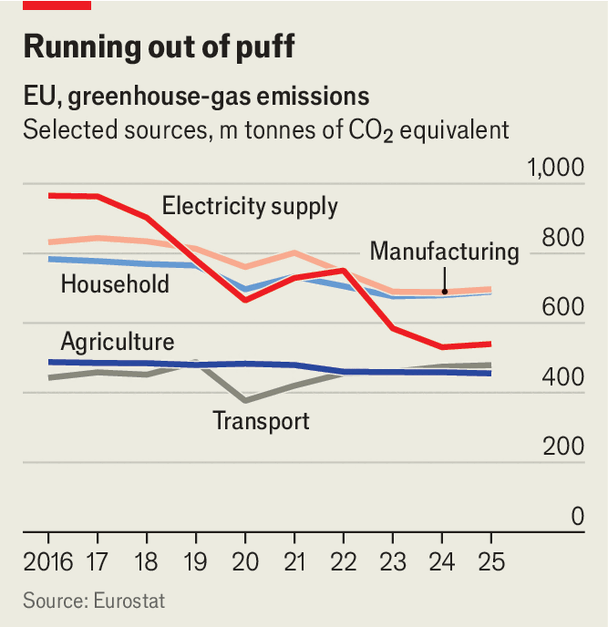
THE EUROPEAN UNION’s carbon price is an economist’s dream. The bloc’s emissions-trading scheme (ETS) distributes rights to emit greenhouse gases to firms in electricity generation, heavy industry and aviation. Then it lets the market do the rest. It was phased in(逐步实施) gradually, with all kinds of cushioning(缓冲措施) such as free allowances (not all of them justified) to give emitters plenty of time to adjust. Now, however, the system is starting to bite(开始产生实质性影响), which makes it a perfect scapegoat(替罪羊) for politicians struggling to contain soaring energy prices and to shield struggling industries from global competition.
欧盟的碳价格是经济学家梦寐以求的。欧盟的排放交易体系(ETS)将温室气体排放权分配给发电、重工业和航空领域的企业,然后让市场完成其余工作。该体系逐步实施,并伴以各种缓冲措施(如免费配额,其中并非所有都合理),以便排放者有充足时间调整。然而,现在该体系开始产生实质性影响,使其成为政客们应对能源价格飞涨和保护受困产业免受全球竞争影响的完美替罪羊。
On July 17th the European Commission is expected to reveal a watering down(削弱,淡化) of the ETS amid worries that, since it is essentially a tax, it is hampering(阻碍,妨碍) European competitiveness. Auctioning carbon allowances(配额,津贴) brought in(带来(收入)) around €40bn ($46bn) to the EU and its members in 2024.
7月17日,欧盟委员会预计将公布一项削弱ETS的方案,原因是担忧该体系本质上是一种税,正在损害欧洲的竞争力。2024年,碳配额拍卖为欧盟及其成员国带来了约400亿欧元(合460亿美元)的收入。
In March, ten EU member states, including Italy, Poland and Romania, urged the commission to conduct a thorough review of the scheme with an eye to(着眼于,目的是) helping electricity consumers and industry. Friedrich Merz, Germany’s chancellor, worried that his country’s manufacturing sector was wavering(摇摆不定,犹豫): “We should be very open to revise it, or at least to postpone it.” Since then, the commission has worked on a plan that tries to reconcile(调和,使一致) its contradictory goals of cutting greenhouse gas emissions while allowing the bloc’s industries to compete—all without breaching(违反,破坏) international trade rules.
今年3月,包括意大利、波兰和罗马尼亚在内的十个欧盟成员国敦促委员会对该计划进行彻底审查,以帮助电力消费者和工业界。德国总理弗里德里希·默茨担心本国制造业摇摆不定:“我们应该非常开放地修订它,或者至少推迟它。”此后,委员会制定了一项计划,试图调和其相互矛盾的目标——既削减温室气体排放,又允许欧盟产业参与竞争,且不违反国际贸易规则。