On July 13th President Donald Trump said America would reinstate its naval blockade(海军封锁) on Iran and charge a 20% fee on cargo passing through the Strait of Hormuz. Brent crude, the global oil-price benchmark(基准,参考标准), jumped(跃升,暴涨) by 10%, to $83 a barrel. That night America launched air strikes on Iran, which responded by hitting two Emirati tankers with missiles. Yet Brent is still a quarter below April’s peak, even though the truce signed in June looks dead and Hormuz traffic has nearly stopped.(然而,布伦特原油仍比4月份峰值低四分之一,尽管6月签订的停火协议形同虚设,且霍尔木兹海峡交通几乎中断。)
7月13日,唐纳德·特朗普总统表示,美国将恢复对伊朗的海上封锁,并对通过霍尔木兹海峡的货物征收20%的费用。全球油价基准布伦特原油跳涨10%,至每桶83美元。当晚,美国对伊朗发动空袭,伊朗则用导弹击中了两艘阿联酋油轮作为回应。然而,布伦特原油仍比4月份的峰值低四分之一,尽管6月份签署的停火协议似乎已经失效,霍尔木兹海峡的交通几乎停止。
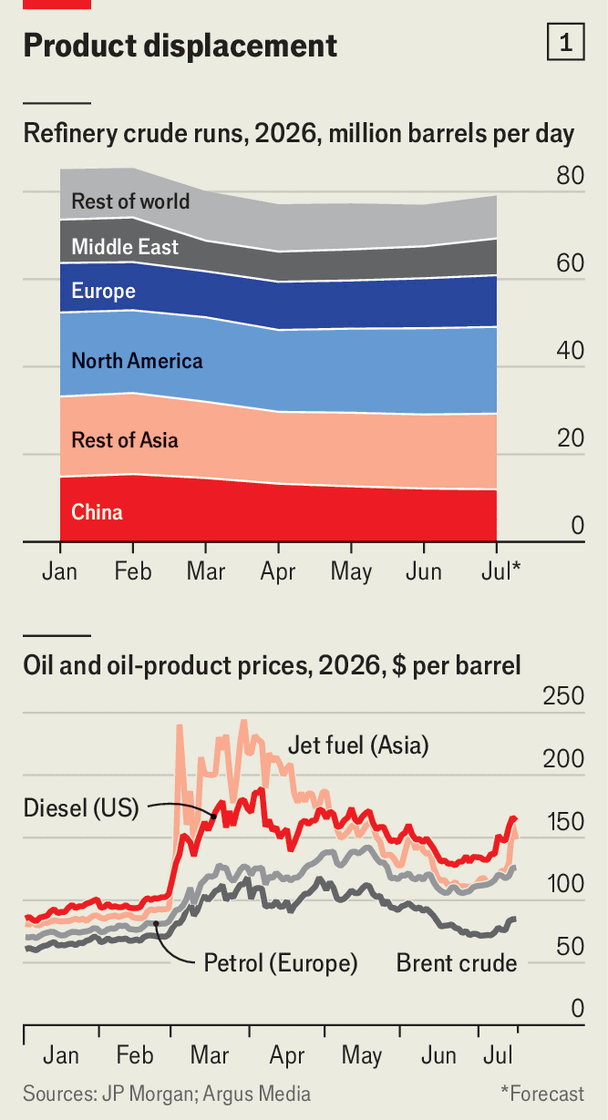
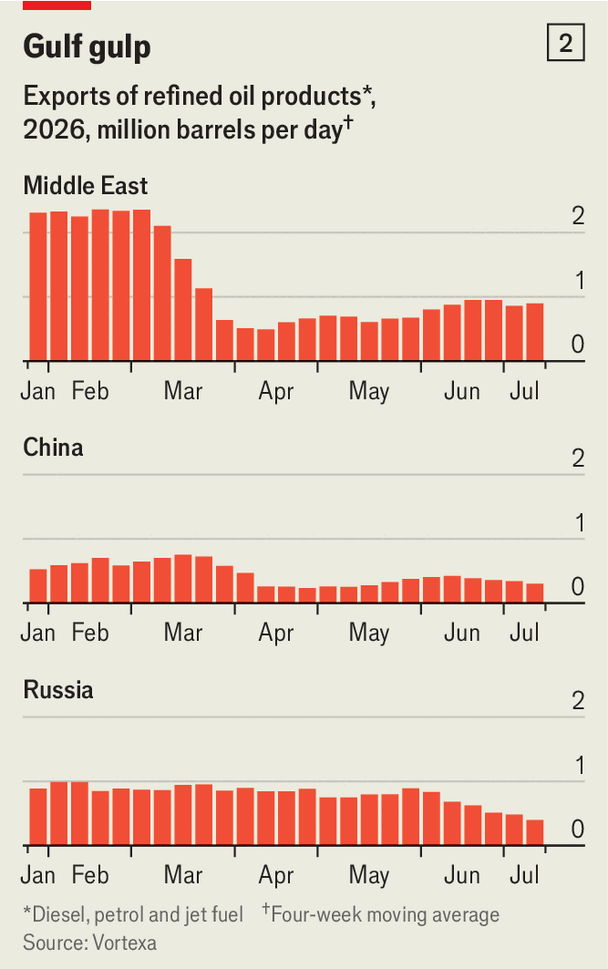
One reason prices have not risen further is that oil markets still deem(认为,视为) it likely that, with America’s midterm elections four months away, Mr Trump will cave(屈服,让步). On July 14th he dropped his plans for a transit fee(过境费), which is to be replaced by unspecified Gulf investments in America. A bigger factor is that the world’s supply of crude currently outpaces(超过,比…快) demand—not because production has surged, but because idled(闲置的,停产的) refineries are consuming less. At 79m barrels per day (b/d), the global output of refined products remains 7m b/d below pre-war levels (see chart 1, top panel).
油价没有进一步上涨的一个原因是,石油市场仍然认为,考虑到美国中期选举还有四个月,特朗普很可能会屈服。7月14日,他放弃了征收过境费的计划,取而代之的是海湾国家在美国进行未具体说明的投资。一个更大的因素是,目前全球原油供应超过需求——不是因为产量激增,而是因为闲置的炼油厂消耗减少。目前全球精炼产品产量为每天7900万桶,仍比战前水平低每天700万桶(见图表1,上方面板)。
As a result, even as crude abounds(大量存在,充裕), refined products remain scarce. Their prices are between 35% and 60% higher than before the war (see chart 1, bottom panel) and traders are wagering(押注,赌博) billions that they will rise further. The International Energy Agency, an official forecaster, warns that the crunch will get much worse unless flows through Hormuz resume.(国际能源署警告说,除非霍尔木兹海峡的流动恢复,否则危机将更加严重。) The margin(利润率) that refiners in Europe make on diesel is the highest since at least 2011; in America “3-2-1” crack spreads(裂解价差)—a measure of profitability for turning crude into petrol and diesel—are hitting a record. In Asia a barrel of jet fuel fetches(卖得,售价为) around $150, up from $100 or so before the war.
因此,尽管原油充裕,但精炼产品仍然稀缺。它们的价格比战前高35%到60%(见图表1,下方面板),交易员们正在押注数十亿美元,认为它们会进一步上涨。国际能源署(IEA)警告说,除非霍尔木兹海峡的运输恢复,否则危机将更加严重。欧洲炼油商从柴油中获得的利润率是至少自2011年以来的最高水平;在美国,“3-2-1裂解价差”——衡量将原油转化为汽油和柴油的盈利指标——正创下纪录。在亚洲,一桶航空燃油的价格约为150美元,高于战前的100美元左右。