WHEN THE leaders of the biggest Western economies gathered last month in the French Alps for the G7 summit(七国集团峰会), it was not just presidents and prime ministers in attendance. The bosses of America’s leading artificial-intelligence firms—Sam Altman of OpenAI, Sir Demis Hassabis of Google DeepMind and Dario Amodei of Anthropic—were seated alongside the political bigwigs(要人,大人物). Even the stewards of the mightiest economies, it turns out, are buttering up the potentates of AI.(即使是最强大经济体的管理者们,事实证明,也在讨好AI的掌权者。)
当西方最大经济体的领导人上个月在法国阿尔卑斯山参加七国集团峰会时,出席的不仅仅是总统和总理。美国领先人工智能公司的老板们——OpenAI的山姆·奥特曼、谷歌DeepMind的德米斯·哈萨比斯爵士和Anthropic的达里奥·阿莫代——与政界要人并排就座。事实证明,即使是最强大经济体的管理者们也在讨好人工智能的掌权者。
Days before the summit, America’s government had barred Anthropic from making its most advanced model available to foreigners. OpenAI soon imposed similar restrictions on some of its frontier(前沿的,领先的) systems. The move turned a simmering concern into a burning one: might countries without their own, home-grown AI firms end up excluded from the world-changing technology?(这一举措将酝酿中的担忧变成了迫在眉睫的担忧:没有自己本土AI公司的国家最终会被排除在这项改变世界的技术之外吗?) Emmanuel Macron, France’s president, warned that no one would buy American AI if it could “turn off the switch” at will. The American AI labs’ Chinese rivals offer only faint reassurance(微弱的安慰). On July 7th Reuters reported that Chinese officials, too, were considering restricting foreigners’ access to leading AI models.
峰会前几天,美国政府禁止Anthropic将其最先进的模型提供给外国人。OpenAI很快对其一些前沿系统实施了类似限制。这一举措将酝酿中的担忧变成了迫在眉睫的担忧:没有自己本土人工智能公司的国家最终会被排除在这项改变世界的技术之外吗?法国总统埃马纽埃尔·马克龙警告说,如果美国人工智能可以随意“关掉开关”,没人会购买。美国人工智能实验室的中国竞争对手只提供了微弱的安慰。7月7日,路透社报道称,中国官员也在考虑限制外国人访问领先的人工智能模型。
Sovereign chic
主权时尚
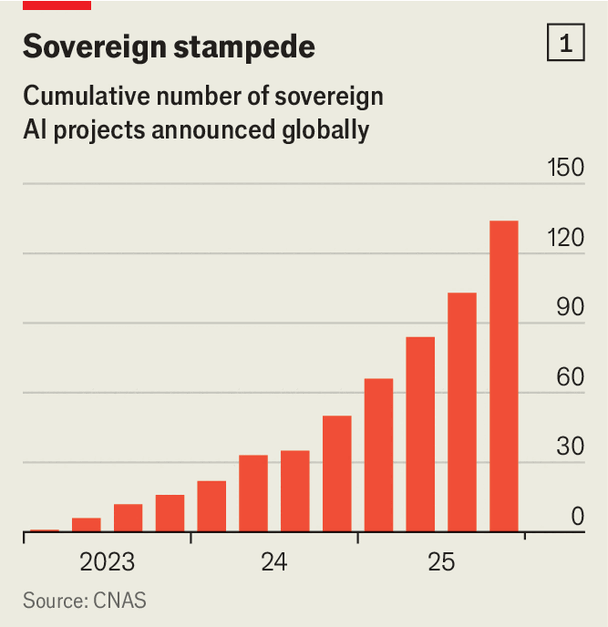
Caught between the world’s two AI superpowers, governments are increasingly pinning their hopes on(把希望寄托在) “sovereign AI”: the idea that countries should limit their dependence on foreign providers of AI by actively developing domestic AI firms and infrastructure. Announcements of such initiatives are proliferating(激增,扩散). The European Union has unveiled a technology-sovereignty package encompassing(包含,涵盖) semiconductors, AI and cloud computing. Canada has launched its own plan to reduce reliance on American technology providers. India, Japan and Singapore are backing(支持,资助) domestic AI infrastructure and models. The Centre for a New American Security (CNAS), a think-tank in Washington, estimates that the number of state-backed AI projects outside America and China grew fivefold over the course of 2024 and 2025 (see chart 1).(新美国安全中心(CNAS)估计,美国和中国以外的国家支持的AI项目在2024-2025年间增长了五倍。) Governments have announced investments of $70bn-plus in such initiatives, according to CNAS’s tally.
夹在世界上两个人工智能超级大国之间,各国政府越来越多地将希望寄托在“主权人工智能”上,即各国应通过积极发展国内人工智能企业和基础设施来限制对外国人工智能提供商的依赖。此类计划的公告层出不穷。欧盟推出了一项涵盖半导体、人工智能和云计算的技术主权计划。加拿大启动了自己的计划,以减少对美国技术提供商的依赖。印度、日本和新加坡正在支持国内人工智能基础设施和模型。华盛顿智库新美国安全中心估计,2024年和2025年期间,美国和中国以外的国家支持的人工智能项目数量增长了五倍。根据CNAS的统计,各国政府已宣布对这类计划投资超过700亿美元。
Sovereign gold
主权黄金
Sovereign detonator
主权雷管
Sovereign-as-a-service
主权即服务