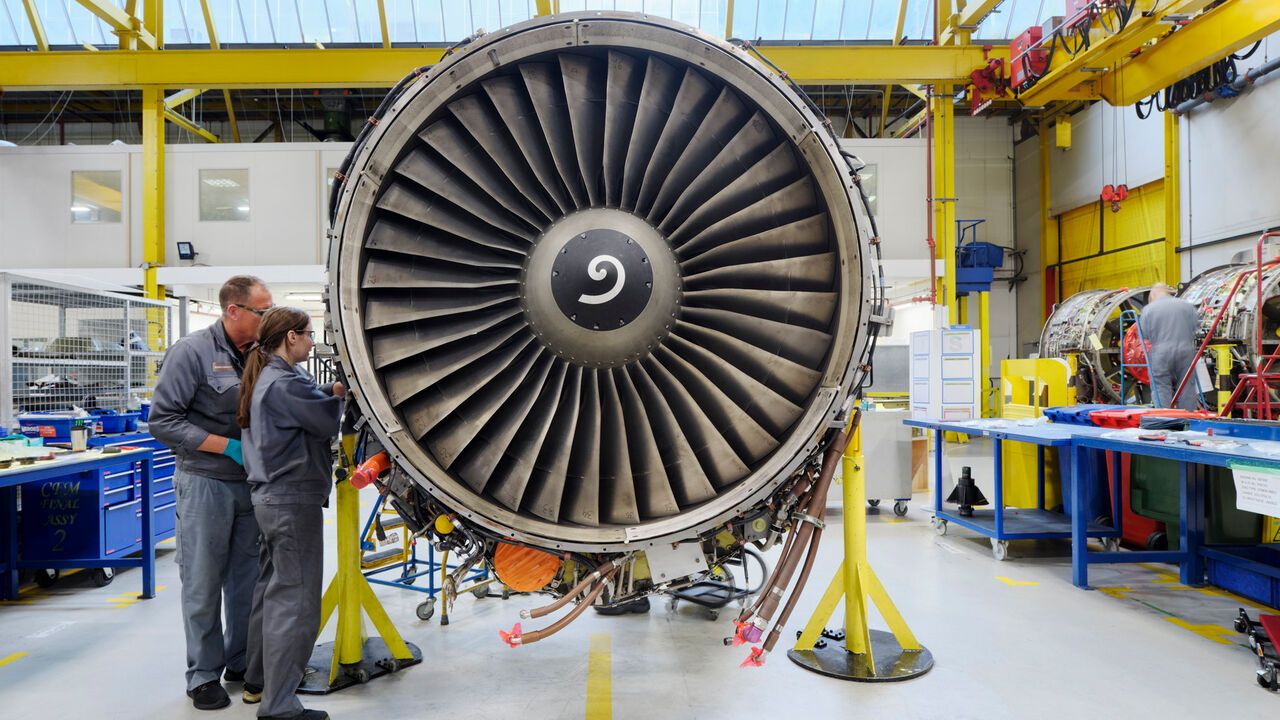
Among the eye-catching announcements at this week’s Farnborough International Airshow, a biennial aerospace get-together, was a deal signed by IndiGo, a fast-growing Indian carrier.(在本周范堡罗国际航展的众多引人注目的公告中,有一项是快速增长的印度航空公司IndiGo签署的协议。) It will procure(采购,获得) over 1,000 Leap jet engines from CFM, a joint venture(合资企业) between America’s GE Aerospace and Safran of France. The engines will power a fleet of planes on order from Airbus. For CFM, the deal brought another prize: the company will help IndiGo establish a maintenance, repair and overhaul(大修,彻底检修) (MRO) operation to keep those engines running. Often overlooked, such MRO contracts are perhaps the most profitable corner of the aviation industry.
在本周举行的范堡罗国际航展(两年一度的航空航天盛会)上,众多引人注目的公告中包括印度快速增长的航空公司IndiGo签署的一项协议。它将从CFM(美国GE航空航天与法国赛峰的合资企业)采购超过1000台Leap喷气发动机。这些发动机将为向空客订购的一批飞机提供动力。对CFM而言,这笔交易还带来了另一个收获:该公司将帮助IndiGo建立维护、修理和大修(MRO)业务,以保持这些发动机的正常运转。这类MRO合同常常被忽视,但或许是航空业最赚钱的角落。
According to Arthur D. Little, a consultancy, there is an MRO “supercycle(超级周期)” under way(正在进行中). The global fleet of passenger jets is set to grow by over 3% a year, to more than 50,000 in 2045, according to Boeing. Even more importantly, those planes will be run to a punishing(严苛的,繁重的) schedule and kept in operation for longer, owing to the 16,000-strong order backlog(订单积压) at Airbus and Boeing. As a result, the demand for maintenance and spare parts will soar(激增,飙升).
据咨询公司Arthur D. Little称,MRO正经历一个“超级周期”。根据波音公司的数据,全球客机机队预计将以每年超过3%的速度增长,到2045年超过5万架。更重要的是,由于空客和波音积压了超过1.6万架的订单,这些飞机将按照严苛的日程运行,并保持更长时间的运营。因此,对维护和备件的需求将激增。
Transporting over 5bn passengers will bring airlines revenues of $1.2trn in 2026, according to IATA, an industry body. MRO contracts will eat up(消耗,吞噬) around $140bn of that, reckon(估计,认为)s Oliver Wyman, another consultancy, with that figure rising to over $190bn by the end of the decade, nearly double the spend in 2019. Some of that will be for “shop” visits to dedicated(专用的,专门的) hangars to fix a landing gear, for example, or for a “D-check(D检,飞机最高级别检修)”, when a plane is all but(几乎,差不多) taken apart and reassembled, as happens every six to ten years. But the majority of MRO revenue comes from keeping engines, which can account for half the cost of a new plane, in prime(最佳的,首要的) condition.
据行业机构IATA称,2026年运送超过50亿乘客将为航空公司带来1.2万亿美元的收入。另一家咨询公司奥纬咨询估计,MRO合同将消耗其中约1400亿美元,到本十年末这一数字将超过1900亿美元,几乎是2019年支出的两倍。其中一部分将用于“进厂”维修,例如在专用机库修理起落架,或进行“D检”——每六到十年一次,飞机几乎被完全拆解再重新组装。但MRO收入的大部分来自保持发动机处于最佳状态,而发动机的成本可占一架新飞机的一半。