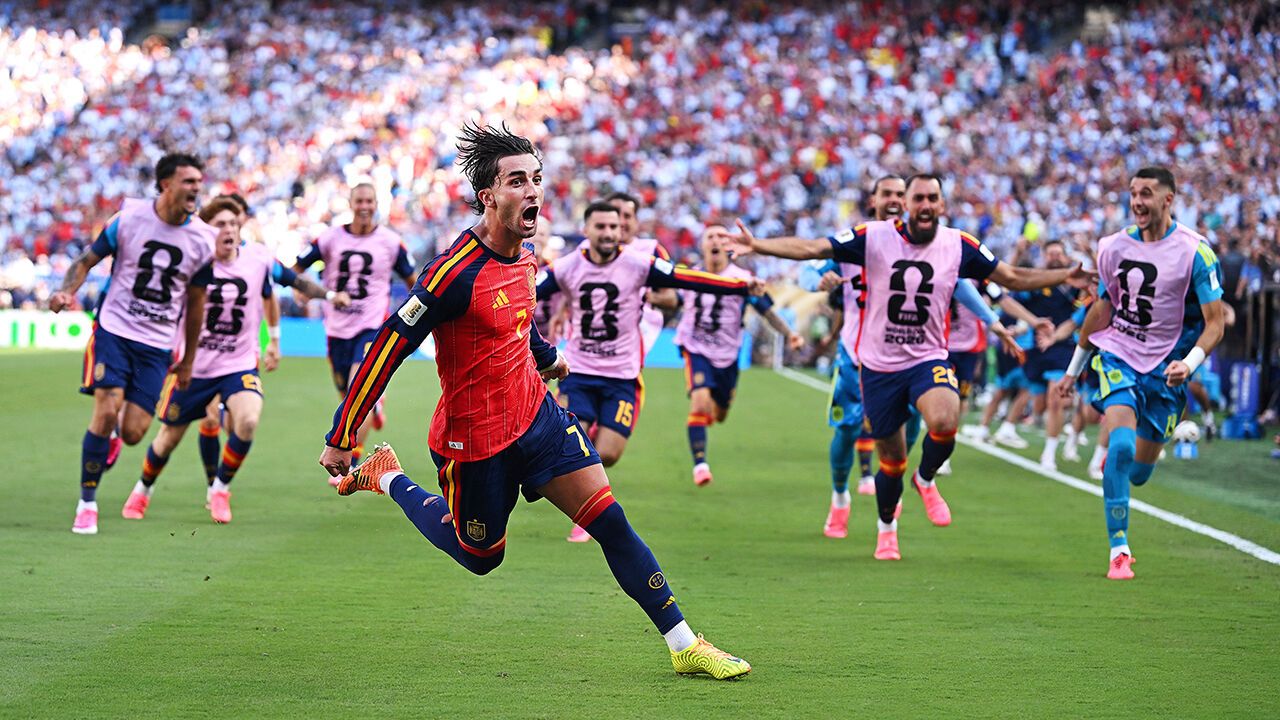
Less than 24 hours after Spain’s victory over Argentina in the World Cup final, Madrid turned out(出动,聚集) to congratulate the team as they paraded in an open-top bus. “Champions of the World”, sang the crowds. The government reckoned 1.8m people (in a city of 3.5m) attended the celebration, many waiting hours in suffocating(令人窒息的) heat.
西班牙在世界杯决赛中战胜阿根廷后不到24小时,马德里市民便涌上街头,祝贺球队乘坐敞篷巴士巡游。人群高唱“世界冠军”。政府估计有180万人(该市人口350万)参加了庆祝活动,许多人在令人窒息的高温中等候了数小时。
La Roja (The Reds) embody(体现,代表) Spanish virtues that casual visitors often overlook: modesty, hard work and above all(尤其是,最重要的是) teamwork and unity. Their success is based on denying the opposition possession of the ball, and close control and probing inter-passing when attacking. In an era of flamboyant(浮夸的,炫耀的) sporting superstars, Spain’s most influential figure was Rodrigo “Rodri” Hernández, an unobtrusive(不引人注目的,低调的) midfield general(中场指挥官) who was named the World Cup’s best player.
“La Roja”(红队)体现了普通游客常常忽视的西班牙美德:谦逊、勤奋,尤其是团队合作与团结。他们的成功建立在不让对手控球的基础上,进攻时则依靠紧密控球和试探性的相互传球。在一个浮夸的体育巨星时代,西班牙最具影响力的人物是罗德里戈·“罗德里”·埃尔南德斯,一位低调的中场指挥官,被评为世界杯最佳球员。
The team represents national cohesion(凝聚力,团结) in a country of fragmented(碎片化的,分裂的) political geography. The squad included nine Catalans and three Basques. Lamine Yamal and Nico Williams, two rising stars, are the children of African immigrants. Until recently, many Catalans and Basques were ambivalent(矛盾的,摇摆不定的) towards La Roja. Now many seem enthusiastic. The final’s audience share on TV in the Basque country was 84%, just below the national average of 87%. The only acts of intolerance(不容忍,偏狭) were by Bilbao’s mayor, a Basque nationalist, who refused to install an outdoor screen for the final, and extremists who tried to sabotage(蓄意破坏,捣乱) one set up by a conservative party.
这支球队代表了一个政治地理碎片化国家的民族团结。球队阵容包括九名加泰罗尼亚人和三名巴斯克人。拉明·亚马尔和尼科·威廉姆斯这两位新星是非洲移民的后代。直到最近,许多加泰罗尼亚人和巴斯克人对西班牙队的态度还很矛盾。现在许多人似乎充满热情。巴斯克地区决赛的电视收视率为84%,略低于全国平均的87%。唯一的不宽容行为来自毕尔巴鄂市长——一位巴斯克民族主义者——他拒绝为决赛安装户外屏幕,以及一些极端分子试图破坏保守党设置的一个屏幕。