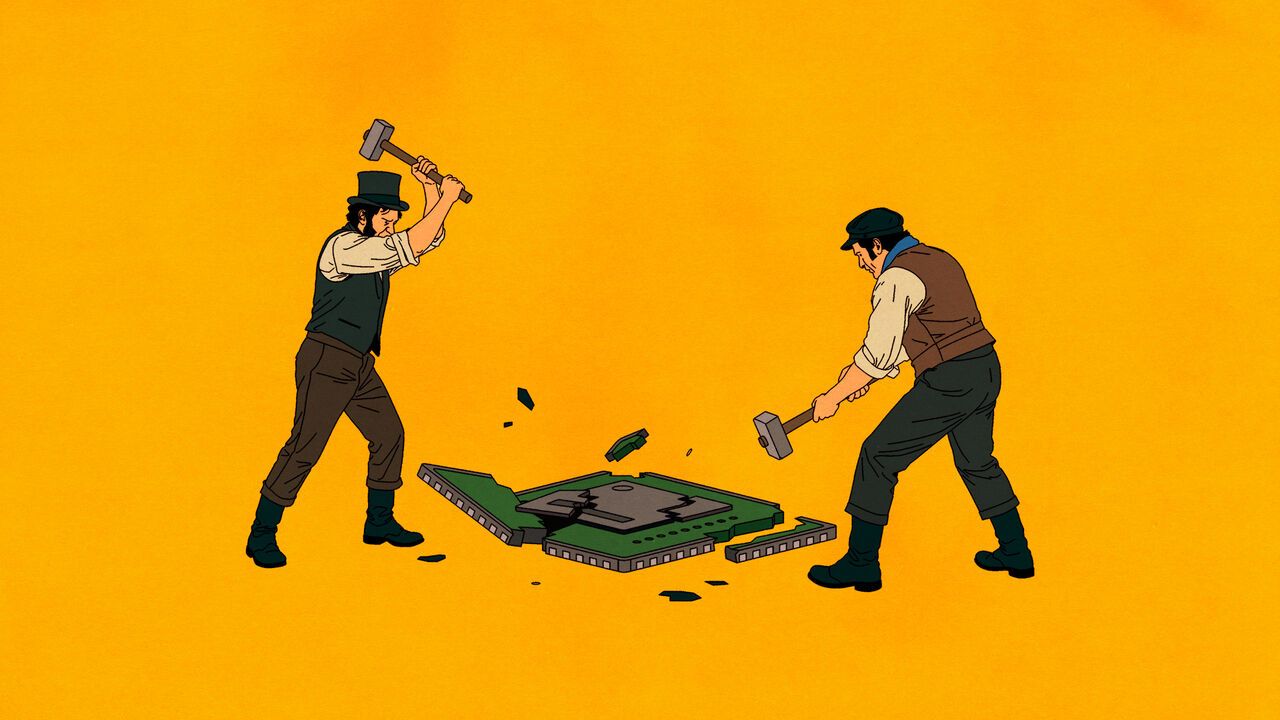
They were led by a man who did not exist. There was no king in England but King Ludd, they said, though sometimes he was a general or a captain. Supposedly he had been a humble apprentice driven to smashing looms by an overbearing(专横的,霸道的) master. Now he lived in Sherwood Forest, ancient home of Robin Hood, another legendary champion of the downtrodden. His followers, the Luddites(卢德派成员), were textile workers in the north of England. By night they would sneak into(潜入) mills and smash the stocking frames(袜架(织袜机)) and mechanical looms(机械织布机) which, they said, stole jobs from humans.
他们由一个并不存在的人领导。他们说,英格兰没有国王,只有卢德国王,尽管有时他被称为将军或上尉。据说他曾是一个卑微的学徒,因被专横的师傅逼迫而开始砸毁织布机。如今他住在舍伍德森林——罗宾汉的古老家园,另一位传奇的受压迫者捍卫者。他的追随者——卢德派——是英格兰北部的纺织工人。夜晚,他们会潜入工厂,砸毁那些据他们说抢走人类工作的袜架和机械织布机。
“Luddite” has become a slur(贬损语,侮辱) for technophobic stick-in-the-muds(顽固保守的人), the whingers(抱怨者,牢骚满腹的人) who stand in the way of progress and want the clock to be turned back to a better time. The newest descendants of those looms are the artificial-intelligence models that can easily and cheaply perform much white-collar work. Some coders and software engineers worry, like the artisan weavers of northern England, that AI will destroy jobs that once meant creativity and prestige. Even normally sanguine(乐观的,充满信心的) economists have signed a letter saying that governments must “act now” to prevent the widespread loss of work. Ludd Clubs have sprung up(涌现,突然出现) on America’s campuses, though most members are more worried about technology’s effect on their social life and attention span(注意力持续时间) than on jobs.
“卢德派”已成为一个贬义词,用来指代那些恐惧技术、固步自封的人,那些阻碍进步、希望时光倒流到更美好时代的抱怨者。那些织布机的最新后代是人工智能模型,它们可以轻松廉价地完成大量白领工作。一些程序员和软件工程师担心,就像英格兰北部的工匠织工一样,人工智能将摧毁那些曾经意味着创造力和声望的工作。甚至通常乐观的经济学家也签署了一封信,表示政府必须“立即行动”以防止广泛的工作流失。卢德俱乐部在美国校园中如雨后春笋般涌现,尽管大多数成员更担心技术对社交生活和注意力的影响,而非工作。
Economists and historians are kinder to the Luddites. The weavers were selective(有选择性的) in their smashing, breaking only those machines that made what they perceived to be lower-quality goods. They were not ignorant about the potential benefits of automation. Nor were they the broad-based movement of the destitute that later lefty historians claimed; they were a small bunch of relatively well-off workers, often keen to preserve the demand for skills gained through a long apprenticeship.(他们也不是后来左翼历史学家所声称的广泛的赤贫运动;他们是一小群相对富裕的工人。) And it is not clear whether they were right or wrong about the immediate effects of automation. Bob Allen, an economic historian, has suggested that for the early part of the Industrial Revolution most ordinary Britons did not share much in the gains from mechanisation; others, including the late Nick Crafts, have suggested they did. Data from the period are patchy(零散的,不完整的).
经济学家和历史学家对卢德派更为友善。织工们在砸毁机器时是有选择性的,只破坏那些他们认为生产低质量产品的机器。他们并非对自动化的潜在好处一无所知。他们也不是后来左翼历史学家所声称的那种广泛的赤贫运动;他们是一小群相对富裕的工人,常常热衷于保护通过长期学徒期获得的技能需求。而且,关于自动化即时影响的对错并不清楚。经济历史学家鲍勃·艾伦认为,在工业革命早期,大多数普通英国人并未从机械化中获得多少收益;其他人,包括已故的尼克·克拉夫茨,则认为他们确实受益了。该时期的数据零散不全。
With hatchet, pike and gun
手持斧头、长矛和枪支